
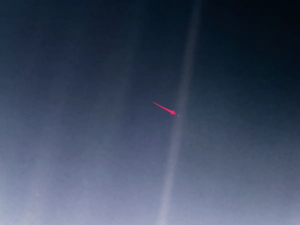
To listen to today’s reflection as a podcast, click here
It’s one of the most remarkable pictures ever taken.
That’s largely due to the fact that it was snapped almost four billion miles away from Earth.
The Voyager 1 probe had been launched in 1977, tasked with the mission of careening through our solar system at 40,000 miles per hour, taking pictures of planets and other interesting objects and sending them back to Earth.
Since there was never any expectation that Voyager would return to Cape Canaveral, and since it was now on the verge of slipping away into the trackless expanse of interstellar space, mission managers decided they would send a command to shut down its camera.
That move would conserve power. Voyager’s primary objects of study, after all, were now millions of miles in the rear-view mirror.
Before that happened, however, two imaging scientists – Carl Sagan and Carolyn Porco – requested one final series of pictures.
Why not have the camera pivot backwards so it could take a “family portrait” of the solar system that it was leaving behind?
On February 14, 1990, Voyager took 60 pictures – a kind of Valentine’s Day expression of love for the only corner of the cosmos we know by heart. The photos took in the sun, Venus, Earth, Jupiter, Saturn, Uranus, and Neptune. Mercury and Mars were excluded from the family album because their orbits didn’t happen to be in the right places at the right time.
It took a while for the pictures to arrive.
Each image was comprised of 640,000 pixels – tiny areas of illumination which, taken together, form a complete photo. Astonishingly, it took five and a half hours for each pixel to traverse the distance from Voyager (with its 1977 technology) to flat screens back on Earth. As author and pastor Louie Giglio points out, “Not five and a half hours for each photo, but for each pixel.”
That approximates how long it used to take, back in the day, for Kodak to develop your vacation pictures after you dropped your roll of film into the mailbox.
When the pixels were finally reassembled, they revealed a portrait of our planet that no one had ever seen before. There, seemingly afloat on a beam of sunlight, was a tiny, pale blue dot. You can just make it out in the original Voyager image posted above. Just follow the red arrow.
What you cannot see are continents, oceans, mountains, or cities – all the features we normally associate with life on Earth. What stands out is our sheer insignificance. Our world seems incredibly small and fragile in the context of the solar system.
But that’s only the beginning. Our solar system itself is nothing to write home about. Giglio notes that if our sun and its planets were represented by a quarter, the Milky Way galaxy to which we belong would be the size of North America. And the Milky Way is just one of hundreds of billions of other galaxies – and those are just the ones we know about.
Sagan pondered the ramifications of such insignificance in his 1994 book, Pale Blue Dot: A Vision of the Human Future in Space. He wrote:
“Look again at that dot. That’s here. That’s home. That’s us. On it, everyone you love, everyone you know, everyone you’ve ever heard of, every human being who ever was lived out their lives.” He notes that “every saint and sinner” has been confined to this “mote of dust suspended in a sunbeam.”
He concludes, “The earth is a very small stage in a vast cosmic arena. Our posturings, our imagined self-importance, the delusion that we have some privileged position in the universe, all are challenged by this point of pale light.”
Up to this point, Sagan is wholly aligned with the Hebrew prophets and psalmists.
“When I consider your heavens, the work of your fingers, the moon and the stars, which you have set in place, what is mankind that you are mindful of them, human beings that you care for them?” (Psalm 8:3-4).
But the famous cosmologist had more to say: “Our planet is a lonely speck in the great enveloping cosmic dark. In our obscurity, in all this vastness, there is no hint that help will come from elsewhere to save us from ourselves.”
That is the point where followers of Jesus must part ways with Carl Sagan.
Lifelong learners of Jesus believe there are more than a few hints that the universe did not arise from nothing. It is the work of a superbly creative Artist. This Creator has furthermore declared that the third planet in our solar system should be the home of creatures who are made in his image – self-aware beings who think, feel, choose, and love because he is a God who thinks, feels, chooses, and loves.
Is it possible to imagine that help might come to these creatures from elsewhere to save them from themselves?
Jesus dared to say that such a thing has already happened.
“For God so loved the world – that obscure, pale blue dot that looks like nothing at all but is in fact the vibrant center of his plans for the universe – that he sent his only Son – that is, that he himself became one of the residents of the world he had made – that whoever believes in him shall not perish but have eternal life” (John 3:16).
There’s no denying that on a cosmic scale, we are insignificant.
But in the mind and heart of God, our significance is off the charts.
You might say we’re endowed with a significant insignificance.
Which is another way of saying that on this cosmic speck, we are loved and cherished beyond anything we can possibly imagine.