
To listen to today’s reflection as a podcast, click here
I’ve only heard a few people who spoke with genuine authority.
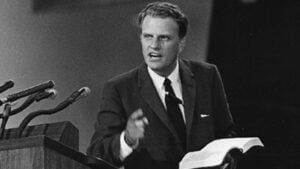
The late evangelist Billy Graham was one of them.
I heard Graham for the first time almost 50 years ago, when he was preparing for one of his Indianapolis Crusades. At that point I had been out of seminary for about two years. I attended the pastors’ luncheon that was part of the lead-up to the big event.
Just about every pastor I knew attended the midday gathering. Pulling together local clergy was always part of the Graham Association’s strategy to build local grass roots support. I looked around the noisy room and suspected that a great many of these church leaders were theologically and culturally at odds with Graham’s message. But everyone wanted to be part of the spectacle, if only to get a free lunch.
After the preliminaries, Billy rose to speak. His task was to ask for our support – to inquire if we would commit ourselves and our congregations to whatever the Holy Spirit was going to do that week.
As soon as he began to speak, the room became absolutely silent. I was completely caught off guard. Afterwards I replayed in my mind the words that he had spoken. They weren’t really that special. He had shared nothing groundbreaking or esoteric. “I could have said that,” I thought.
But there was one huge difference: Billy Graham spoke as if he really believed what he was saying, and that what he was saying mattered more than anything.
In other words, he spoke authoritatively.
As I walked away from the luncheon, it occurred to me that I rarely spoke that way. Why not? Why had I come to the conclusion that I wasn’t empowered to speak with the same boldness and grace as Billy Graham?
That was a turning point in my ministry. I never shared the Good News the same way again.
There was something about Jesus’ teaching that impressed people from the earliest days of his ministry. “The people were all so amazed that they asked each other, ‘What is this? A new teaching – and with authority!'” (Mark 1:27).
The phenomenon of Jesus’ authority was still making waves during the final hours of his life. The chief priests, teachers of the Law, and elders pounced on him in the temple courts: “By what authority are you doing these things, and who gave you the authority to do this?” In other words: Who do you think you are, talking to us like this?
There is a significant difference between power and authority.
A police officer standing in the middle of the road has little power. Frankly, he’s no match for my Mazda. But if he holds up his hand and instructs me to stop, I had better choose to stop. That’s because he has the authority to halt my progress, change my direction, and even make a dent in my checking account.
General Jonathan Wainwright was the highest-ranking American officer taken prisoner during World War II. He was in command of the troops that reluctantly surrendered to the Japanese in the Philippines in 1942. Wainwright suffered horrifically, along with his men, for more than three years in a Japanese concentration camp.
When word reached the prisoners in August 1945 that Japan had surrendered, Wainwright walked to the camp commandant’s office. Frail and emaciated, he had little physical power. But now he had authority. “Get out of my office. This is my camp now.”
If he had done such a thing 24 hours earlier, it might have cost him his life. But the world had changed in that short period of time. General Wainwright now acted with the authority that was delegated to him by the victors in the great conflict.
Jesus acted and spoke with authority for the simple reason that he was continually acting in concert with the Author.
On a far humbler scale, we can do the same.
We may be people of little physical power. But God grants us the authority to speak his Good News.
We can assure the brokenhearted that they have not been abandoned. And remind those racked by guilt that they can receive forgiveness. And speak a word of hope to those who have no hope.
With calmness and grace, we can deliver the authoritative message that because of what Jesus accomplished on the cross, God is healing this broken world.
We can even speak with the confidence that we really believe what we are saying.
And that it matters more than anything.