
To listen to today’s reflection as a podcast, click here
Throughout the month of November we’re looking at civility – how trusting God can help us cultivate a disposition of the mind and heart that has the potential to revolutionize our culture and ourselves.
During baseball’s earliest days in the middle of the 19th century, a number of the rules were different.
So different, in fact, that modern fans might struggle to recognize the game.
It was “four strikes and you’re out.” A walk required nine balls. Because fouls didn’t count as strikes, pitches could be fouled-off ad infinitum. Batters themselves actually ruled whether pitches were balls or strikes and even instructed pitchers where to throw – either above or below the waist in the batter’s box. Pitchers were required to comply.
Oh, and the ball was thrown underhanded.
The balls themselves were expensive, which is why only one was allotted for an entire game. By the last few innings, it was essentially “dead,” having been whacked beyond recognition. An average Major League Baseball game these days will use over 100 balls.
Fielders wore no gloves. If a ball was caught after one bounce, the batter was out. Catchers had little protective equipment, which is one reason why they stood 15 feet behind home plate.
But as Jim Stovall documents in his book First Inning Rules: How Baseball Became Baseball, the most extraordinary contrast between today’s game and that of the 1850s was the role of the umpire.
Umpires were selected from the crowd before the game. The players went in search of a gentleman – a prominent businessman, perhaps, or a lawyer, or even a pastor (who occasionally qualify as gentlemen).
They were given the best seat in the house: a padded rocking chair not far from home plate. The umpire (who was then called the arbitrator or judge) was given a hand fan on sweltering summer days, treated to a selection of the best local food, and given the tallest mug of beer. The players treated him as an honored guest, someone worthy of the utmost courtesy and respect. He was always addressed as “Sir.”
Umps rarely intervened in the flow of the game. The players, after all (who represented local social clubs and neighborhoods) were assumed to be gentlemen – and gentlemen could figure out the way things ought to be.
Stovall writes, “The umpire was there to settle the occasional disagreement among friends.” He was not “a gavel-pounding judge ruling in favor of one combatant or another.”
If, for instance, there was a close play at one of the bases, and if the umpire’s view was blocked, he would summon players from both teams and invite them to share their version of what happened. It was assumed that the truth would prevail. After all, if you respect good people, they will make good decisions.
No wonder baseball became America’s pastime.
Then things changed.
The Cincinnati Red Stockings became the first professional franchise in 1869. With money at stake, emotions got hotter. Gentlemen didn’t always act like gentlemen.
By the 1880s, umpires were no longer plucked from the crowd. Professional umps began to call balls and strikes and increasingly made unpopular decisions. Folks in the crowd brought loose change and ripe fruit to hurl at the man who dared to call their hero out at home. “Yes, sir” and “No, sir” were replaced by “Kill the umpire!”
Today, umpires endure constant criticism, are routinely overruled by the automated ball-strike challenge system, and are generally disrespected by fans and players alike.
Baseball is now a different world – one in which what used to be civility was progressively squeezed out by public rancor.
That’s what makes the events of June 2, 2010, at Detroit’s Comerica Park significant.
Detroit Tigers pitcher Armando Galarraga was on the verge of a landmark achievement. In the history of baseball, only 20 pitchers had ever thrown a perfect game: 27 batters up, 27 batters out – no runs, no hits, no walks, no errors. With two outs in the top of the ninth inning, all he had to do was retire Cleveland Indians batter Jason Donald and a lifetime honor would be his.
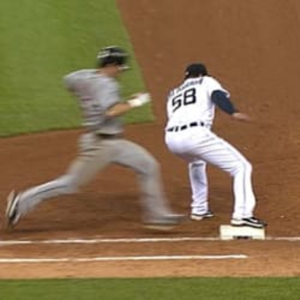
Donald hit an easy grounder toward Detroit’s first baseman. He flipped the ball to Galarraga (#58), who had run over to cover the bag. Armando’s foot clearly beat Donald’s foot by half a step, something clearly evident in the picture above. A perfect game!
But wait. First base umpire Jim Joyce called the runner safe. The crowd and TV commentators gasped. Galarraga looked stunned, then broke into a wry smile.
These days, TV replays are routinely used to provide official reviews of close plays. That wasn’t the case in 2010. The whole world, however, could watch endless replays on ESPN and see that Jim Joyce had blown the call. Armando Galarraga was deprived of his one and only shot at a perfect game.
Jim Joyce was no ordinary umpire. In an anonymous poll of 100 MLB players that same summer he was voted the best ump in all of baseball.
When he saw the replay for the first time, his heart sank. “I did not get the call correct,” he admitted. He knew that he had taken “a perfect game away from that kid over there that worked his a—off all night.” MLB refused to overturn the official results of the game, a position they have maintained for the last 16 years.
Predictably, Joyce received death threats from a few Tigers fans.
What he received from Galarraga was grace.
The pitcher said to reporters after the game, concerning Joyce, “Nobody’s perfect” – a statement brimming with unintended irony.
The next day, it was Joyce’s turn to be the home plate umpire. Traditionally, a player from each team walks out to the ump with that day’s lineup card. And who should come out from the Detroit Tigers dugout but Galarraga himself.
Standing together before the watching world, the two shook hands. Joyce put his hand on the pitcher’s shoulder and wept. In the days that followed, the mingling of accountability, regret, sportsmanship, and forgiveness was praised from coast to coast.
What stood out most dramatically was humility. Jim Joyce said, “I was wrong.” Armando Galarraga said, “This isn’t the end of my life.”
The apostle Paul writes in Philippians 2:3, “Do nothing from selfish ambition or conceit, but in humility count others more significant than yourselves.”
In other words, don’t thump your chest and declare, “I was wronged!” Don’t paper over the fact that you made a serious mistake.
The call of civility is to find ways to humbly walk into the future with mutual gratitude and respect, even in the midst of hurts and failures.
You don’t have to be sitting in a padded rocking chair sipping the tallest beer to recognize that that is a winning play.