
To listen to today’s reflection as a podcast, click here
Throughout the month of November we’re looking at civility – how trusting God can help us cultivate a disposition of the mind and heart that has the potential to revolutionize our culture and ourselves.
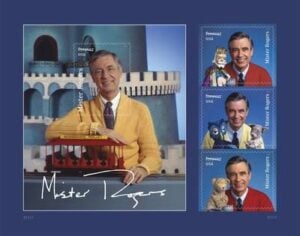
You really know you’ve made it when your face appears on a series of stamps.
Fred Rogers, of course, never cared about “making it” in that sense.
But he was honored nonetheless a decade ago by the U.S. Postal Service when he appeared on some 50th anniversary commemorative stamps with various puppet members of his Neighborhood of Make-Believe.
It’s noteworthy that Rogers’ first name is nowhere to be seen. That’s because millions of kids will forever know him simply as “Mister” Rogers, the soft-spoken man who launched all 856 episodes of his show by coming through the front door, hanging up his jacket, and pausing to tie his shoes.
Over the years, Rogers became the focal point of numerous urban legends.
Was he a ruthless Navy SEAL sniper who wore cardigan sweaters to cover up his arm-length service tattoos? Nope. Did he routinely make obscene gestures at the cameras between takes? No one ever saw him do such a thing. Was he a Presbyterian minister who couldn’t stand television?
Actually, that last one happens to be true.
“I went into television because I hated it so,” he once said in an interview. He grieved the kids’ shows that featured cartoonish violence, clever put-downs, or gallons of slime descending from the ceiling.
“I thought there was some way of using this fabulous instrument to nurture those who would watch and listen.” Fred Rogers’ congregation became the children of America. His call was to introduce them, gently, to why life is worth living – and how to embody what people have come to call civility.
Just two months after the debut of Mister Rogers’ Neighborhood, Martin Luther King, Jr., was murdered. Even as American cities roiled with violence and confusion, Mr. Rogers chose to unwrap the issues of the civil rights movement in a way that kids could understand.
Columnist Robert Galvin recalls that Rogers immediately added the character of an African American policemen to his show. “The iconic image from that relationship was the two men sharing a quiet moment while soaking their bare feet together in a wading pool.”
This is how we are called to live together, he was saying.
NY Times columnist David Brooks remembers going to a theater in 2018 to see Won’t You Be My Neighbor, a one-of-a-kind look at Rogers that quickly became the highest-grossing biographical documentary of all time. Brooks wrote:
“There’s nothing obviously moving here, and yet the audience is moved: sniffling, wiping the moisture from their cheeks. The power is Rogers’ radical kindness at a time when public kindness is scarce. It’s as if the pressure of living in a time such as ours gets released in that theater as we’re reminded that, oh yes, that’s how people can be.”
He then observed, “Moral elevation gains strength when it is scarce.”
The very next year, another Mister Rogers movie, You Are My Friend, arrived in theaters. Tom Hanks (who else?) portrayed Rogers in a biopic that explored his lengthy friendship with Tom Junod, a staff writer for Esquire.
Junod recalls when Fred met a 14-year-old boy with cerebral palsy. The affliction severely limited his ability to speak and walk. Rogers asked the boy to pray for him. The teenager, who had often been the object of others’ prayers, was floored. Did someone important like Mister Rogers actually see him as a spiritual resource?
Junod later complimented Rogers on his tactic to boost the boy’s self-esteem.
But for Fred Rogers, it wasn’t a tactic. His request was real. “I didn’t ask him for his prayers for him; I asked for me,” he later said. “I asked him because I think that anyone who has gone through challenges like that must be very close to God. I asked him because I wanted his intercession.”
We live in a world in which winners are valued above losers, and “successful” people believe they deserve center stage.
But Fred Rogers’ life and work were built on an entirely different conviction. Brooks writes that Rogers believed “the child is closer to God than the adult; the sick are closer than the healthy; the poor are closer than the rich; and the marginalized closer than the celebrated.”
Civility is not a matter of superficial politeness. Rather, it’s about embracing such beliefs at the very core of our being – and then living as if they are actually true.
When Rogers received a Lifetime Achievement Emmy in 1997 – six years before his untimely death from cancer at age 74 – he was given the opportunity to say a few words.
As the world had come to expect, his comments were brief, humble, and poignant.
“All of us have special ones who have loved us into being. Would you just take, along with me, ten seconds to think of the people who have helped you become who you are … those who have cared about you and wanted what is best for your life. Ten seconds of silence …”
Then he said, “Don’t worry, I’ll watch the time.”
Who knows how many people, watching that broadcast, were reminded of a parent, a mentor, a teacher, a grandparent, or a friend?
Take ten seconds at the end of this reflection. Think of someone who, by God’s grace, has somehow made a difference in your life.
Then ask God to help you live in such a way that you can be a neighbor who will help transform this broken world.