
To listen to today’s reflection as a podcast, click here
What kind of legacy will shine through your obituary?
Craig McKee, an attorney who practices in Vigo County, Indiana, has delivered dozens of eulogies over the years. He appreciates out-of-the-ordinary obits.
Here are several eye-catching newspaper testimonials that have come to his attention.
Concerning George Bruhl Jr of Newark NJ, who died in 2014: “There will be no viewing since his wife refuses to honor his request to have him standing in the corner of the room with a glass of Jack Daniels in his hand so he would appear natural to visitors.” The obituary also noted that Mr. Bruhl was preceded in death by his tonsils and adenoids, prostate, a spinal disc, and a large part of his thyroid gland.
“Faced with the prospect of voting for either Donald Trump or Hillary Clinton, Mary Anne Noland of Richmond chose, instead, to pass into the eternal love of God on Sunday, May 15, 2016” (The Richmond Times-Dispatch).
“Mary Early Johnson, 88, a lifelong resident of Crawfordsville IN, joined the heavenly beer-drinking Presbyterian chorus on January 24, 2018. She was no spring chicken. Her official cause of death was listed as ‘angelic consensus’ who notified her that her presence was requested, and it was time for her to move on.”
I must admit that until encountering Ms. Johnson’s obit, I was unaware of the reality of a heavenly beer-drinking Presbyterian chorus.
Then there’s Leslie Ray Charping, whose life was described as serving “no obvious purpose; he did not contribute to society or serve his community and he possessed no redeeming qualities besides quick-witted sarcasm which was amusing during his sober days.”
As McKee observes, “Ouch. Like it or not, your children will get the last word (in addition to selecting your nursing home).”
How will those who look back on your life describe your legacy?
As we noted last spring, only two historical figures besides Jesus are mentioned by name in the Apostles’ Creed, the most ancient statement of Christian faith.
One is Mary, Jesus’ mother. The other is Pontius Pilate, the Roman governor of Judea from AD 26 to AD 36. While Mary is revered, Pilate is reviled. According to the Creed, Jesus “suffered under Pontius Pilate, was crucified, dead, and buried.”
What we know from reliable historical sources is that Pilate caused many other people to suffer, too.
Imagine living in Rome, the greatest city in the ancient world, then being assigned to go keep order in Palestine. The Jews hated the Romans. The Romans barely tolerated the Jews. The fact that Pilate ended up babysitting in Israel meant that somebody in Rome genuinely disrespected him.
Pilate was petty and cruel. From the get-go he displayed an instinctive loathing for all things Jewish, and publicly violated their religious sensitivities. One of his first impulses was to abolish Jewish laws within the city of Jerusalem, and to impose Roman-style worship in the Temple.
He next attempted to confiscate the Temple treasury in order to pay for a local construction project. That was awkward, to say the least.
On two occasions he baited Jewish crowds into rioting, then released his soldiers into the mob with swords and clubs. Displaying a vindictive temper, he brutally put down anything that reeked of an uprising.
None of this played well in Rome. The emperor wanted order in his empire, not chaos. Pilate lived in terror that a delegation of Jews might one day set sail for Italy and squeal on him to Caesar Tiberius.
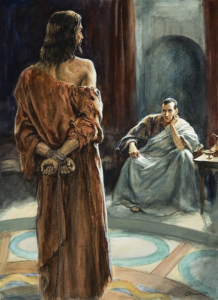
That left him politically vulnerable on the day that local Jewish leaders brought before him a rabbi from Galilee whom some people were calling king.
“Are you the king of the Jews?” he asked Jesus.
The last thing that Pilate wanted was someone running around who posed a threat to Rome. Or someone who posed a threat to him, for that matter. After sentencing Jesus to death, he publicly washed his hands.
It’s amazing. Pontius Pilate stood face to face with the man who would, more than anyone else, shape Western civilization. Over the next 2,000 years, more people would debate this man’s identity, worship him fervently, write songs in his honor, serve the poor because of his example, and even use his name as a swear word than anyone else who has ever lived.
Yet what chiefly occupied Pilate’s mind was how he could survive this whole mess and keep his job. That’s how he will be remembered.
So, what kind of legacy are you leaving behind? Will those closest to you shed tears of relief or tears of sorrow when they find out that you’ve stepped from this world into the next?
Here are two things worth remembering:
If you’re reading or listening to this reflection, the final word about your life hasn’t yet been set in stone.
Which means there’s still time, by God’s grace and power, to leave behind a legacy of love.