
To listen to today’s reflection as a podcast, click here
Throughout the month of November we’re looking at civility – how trusting God can help us cultivate a disposition of the mind and heart that has the potential to revolutionize our culture and ourselves.
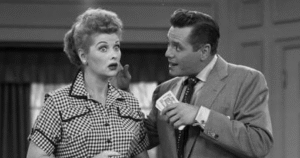
I Love Lucy is regarded by many critics as the finest TV show of all time.
The sitcom, which ran for six seasons on CBS beginning in 1951, has achieved an almost iconic loyalty among generations of viewers.
At the time of its 180th and final episode in May 1957, the show was #1 on the Nielsen charts. Only The Andy Griffith Show and Seinfled have been able to go out the same way – on their own terms while sitting at the top.
While the show was still in the planning phase, Lucille Ball and Desi Araz were repeatedly pressured to compromise their commitment to excellence. Their answer was always the same: Thanks for your counsel, but we’re going to stick with our own vision.
As TV critic Chris Morgan has observed, their resolve to politely decline “the way it has to be” changed how television shows were created. TV sitcoms were typically filmed on a stage with one camera, with a laugh-track added after the fact. At Ball and Arnaz’s insistence, episodes were filmed with three cameras before live studio audiences.
That changed TV forever.
Likewise, CBS didn’t want the Cuban-born Arnaz to play Ricky Ricardo. Why not cast someone who was, well, a bit more “mainstream”? But Ball wouldn’t budge. She insisted that her real-life husband would play her TV husband – a significant breakthrough for inclusion in Hollywood.
The casting of Arnaz added a surprising comedic element to the dialogue – his heavily accented Spanish renderings of various English words and phrases.
Ask a fan of the show for their favorite line and they’re likely to quote Ricky sternly confronting his wife after another of her failed schemes: “Lucy, you have some ‘splainin’ to do!” The irony is that Arnaz never actually spoke those words in that order during any of the six seasons, just as Captain Kirk never actually said, “Beam me up, Scotty,” on any episode of Star Trek.
But memes are powerful things, and Lucy will always be remembered as someone whose behind-the-scenes machinations required a great deal of ‘splainin.’
So, too, do we remember John Adams and Thomas Jefferson – America’s second and third presidents, respectively – whose exceedingly public falling out left the country wondering if they would ever speak to each other again.
But as Adams famously wrote to his old friend more than a decade after their separation, “You and I ought not to die before we have explained ourselves to each other.”
Adams had won the presidential election of 1796, narrowly defeating Jefferson. Jefferson returned the favor in 1800, beating Adams in a contest that had to be decided by the U.S. Senate. Over time they came to believe the worst about each other. Adams was so bitter about the vote that he didn’t even stick around to see Jefferson’s inauguration. He and his wife Abigail packed up their things and left town.
That appeared to be the sad end to one of America’s most fruitful political collaborations.
But Jefferson and Adams were blessed to have a common friend. He was Dr. Benjamin Rush, a fellow signer of the Declaration of Independence. In 1811, the doctor approached Jefferson. Rush suggested that Adams might be open to re-establishing a relationship.
The reconciliation of two of America’s Founding Fathers would be wonderful for the country and a blessing for the whole world, he argued. Adams seemed to have softened. And time was growing short. Would Jefferson be willing to give it a shot?
The Virginian pondered things a while, then put pen to paper.
When Adams received the first letter from his old friend he sighed, “I always loved Jefferson, and still love him.” According to historian Jon Meacham, “These eight words were all it took for Jefferson.”
Thus began the most remarkable correspondence in American history. Over the next 15 years they exchanged 158 letters. These days, a motivated teenager might send that many texts in one day. But the distance between Adams’ home in Quincy, Massachusetts, and Jefferson’s home at Monticello, Virginia, was more than 600 miles – a span that had to be traversed by horseback or on foot, sometimes on dirt trails. It took considerable effort to sustain their newfound connection.
What the two men endeavored to do was “explain themselves to each other.”
That they did.
For a decade and a half they worked through some of their most difficult personal obstacles. They listened to each other. They addressed old wounds with gentler spirits. Along the way they also ruminated on the greatest political, foreign policy, and judicial issues of the day. Meacham writes, “Thus an ancient friendship, shattered by politics, was restored.”
Such work lies close to the heart of civility. What does it take for former friends to find their way back to each other?
Step by step, they have to give up thinking the worst about each other’s motives. In providing explanations for their own thoughts and actions, they also have to place themselves in the other’s shoes, stretching as far as they can to understand why someone else would think and act in such different ways.
In that sense, we all have some ‘splainin’ to do. And we all need to listen, as empathetically as we can, to the ‘splainin’ of others.
One of the oft-told stories during America’s 250th birthday celebration this year was the strange truth that Adams and Jefferson died on the very same day: Tuesday, July 4, 1826, the 50th anniversary of the nation’s beginning. To the watching world, it seemed to be the perfect ending to a fabled friendship.
You may think you’ve had every good reason to give up on a relationship. You may be able to quote chapter and verse about how someone in your life messed things up and let you down. Perhaps today’s political polarization, which can sometimes feel as tumultuous as that of 1800, has led you to vow that you will never again waste time talking to someone so deluded by the Other Side.
But friendships are too rare and beautiful to let slip away just because you think you’re right.
“Two are better than one, because they have a good reward for their toil. For if they fall, one will lift up his fellow. But woe to him who is alone when he falls and has not another to lift him up!” (Ecclesiastes 4:9-10).
So, write the letter. Go knock on that door. Send the text. Reach out. Make the first move.
Or play the role of Benjamin Rush and gently help two people who are estranged from each other imagine the possibility that maybe, just maybe, they might still relate to each other in this world.
We’ll all have some ‘splainin’ to do before God if we walk away too soon from his gift of a great friendship.