
To listen to today’s reflection as a podcast, click here
The first ever Academy Award for Best Actor was presented in 1929 to Emil Jannings, not exactly a household name even for serious film buffs.
Interestingly, he didn’t receive the most votes.
The highest tally went to a German shepherd named Rin Tin Tin, who had been overwhelmingly regarded as the best “actor” in Hollywood during the previous year. The Academy wisely decided that its first Oscar should probably go to a human being.
That being said, Rin Tin Tin’s story was like a real-life fairy tale.
He was rescued in 1918 from a World War I battlefield. Lee Duncan, a California farm boy in the U.S. Army, came across a litter of puppies left behind by German soldiers who were retreating from France. He called one of the male puppies Rin Tin Tin, which was the name of a popular French rag doll at the time.
The dog barely made it to the United States. As G.I.s crowded onto the boats that would take them back across the Atlantic, animals were typically left behind. But a sympathetic officer allowed Duncan to keep his puppy.
The rest is Hollywood history.
The film industry came into its own in the 1920s. Talented dogs (mostly German shepherds) became staples in silent pictures. They included Strongheart, Braveheart, Wolfheart, Fang, Flash, Flame, Thunder, Lightning, Ace, Rex, Pearl, Thorn, Silverwolf, Silverstreak, King, Tarzan, Napoleon, Klondike, Zorro, Smoke, Cyclone, and Peter the Great. More than 50 canines appeared in early Hollywood films.
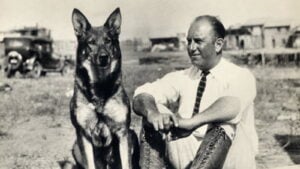
Lee Duncan (shown above with his best friend) humbly believed that Rin Tin Tin was more gifted than any of them. He was right.
Six of “Rinty’s” original 18 silent films are still in existence. His physical feats, performed without special effects, seem mind-boggling.
At various times, in order to save the day, he gnaws through wooden doors, unties knots, saves someone from drowning by dropping a lifeline, feeds a lamb with a baby bottle, treads water for at least 10 minutes, runs up a tree (and then back down again), and clears a 12-foot barrier in a single leap.
He fights the bad guys (including bad people, bad dogs, and bad wolves) and jumps through countless pane glass windows. The windows were made of sugar, and Rinty was allowed to eat the shards afterwards.
As his national reputation grew, the film plots got increasingly silly. We may presume that even Rin Tin Tin did not actually know how to light a wick and rekindle a lighthouse, operate a crane to rescue a female lead, or prevent a watery disaster by pressing the right levers to control the floodgates in a dam.
It didn’t matter. Rinty was a hero. He was always the smartest, bravest, and most loyal character in his films.
And his “acting” was remarkable. His expressive face could seemingly portray pain, resolve, hope, and joy. No wonder he earned more votes than any of the human actors.
Rinty died in 1932. But as Susan Orlean points out in her book Rin Tin Tin: The Life and the Legend, he was actually just getting started.
A number of other German shepherds (some who were his descendants, others not) carried on his name. Rin Tin Tin, the TV series, ran on ABC from 1954 to 1959, and then for years in reruns.
Orlean notes that TV’s two most famous “dog shows” in the 1950’s (Rin Tin Tin and Lassie) had a common theme: the heartfelt connection between a fatherless boy and his dog. Lee Duncan had grown up as an orphan. He knew what it was like to feel desperate for love. So did myriad young boys across the country who had seen their fathers go off to World War II, many of whom never returned.
In real life, Rin Tin Tin had been orphaned, too. His story resonated with America.
More than anything else, he was the dog who could do it all. At least, that’s what his fans were told. Did he singlehandedly do everything in all of his films? Decades later, Jack Warner of Warner Brothers admitted that as many as 18 different dogs might masquerade as Rin Tin Tin in a single picture.
One of the German shepherds specialized in jumping. Another really knew how to limp. Yet another was an expert growler. While the original Rinty provided most of the magic, he and his backups together created Rin Tin Tin the Wonder Dog.
Wouldn’t it be great to have 17 stunt doubles?
If you need to reconcile with someone, maybe you can call in an expert apologizer. If you’re struggling with talking to God, just summon the stand-in prayer warrior. If you’ve found it hard to sustain your commitment to Bible reading, dial up a study geek to do that hard work for you. Put enough specialists together and you can present yourself to the world as the Wonder You.
Maybe that can happen in Hollywood. But it doesn’t happen in real life.
That’s because there’s no such thing as a Wonder You. And that’s OK. There doesn’t have to be.
All God asks for is the Real You – not a stitched-together quilt of spiritual performance experts, but just you, with your quirks, frailties, imperfect family background, and sketchy faith history.
As Brennan Manning was fond of saying, we can’t wait until we become “what we should be” before we come to God, because we will never be what we should be.
But God welcomes, with joy, every yielded heart.