
To listen to today’s reflection as a podcast, click here
On May 20, 2018, the power went out in the middle of the night in Lake Worth, Florida.
Social media accounts immediately began to light up with an auto-generated emergency message.
The citizens of Lake Worth (a city of 37,000 about an hour north of Miami) were warned of “a power outrage and zombie alert.”
Say what?
The message ended with these somewhat less-than-reassuring words: “Due to extreme zombie activity, restoration time [is] uncertain.”
Lake Worth city officials later acknowledged that the alert was indeed official communication, but didn’t know how to account for the mention of the shambling undead. Public Information Officer Ben Kerr said, “I want to reiterate that Lake Worth does not have any zombie activity currently, and apologize for the system message.”
Wait…did he really say currently?
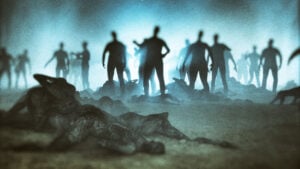
Let’s face it: We’re living in the Golden Age of Zombies – widespread fascination with human corpses that supposedly emerge from the grave or become afflicted by mind-altering viral infections, prompting them to begin feasting on living humans.
In classic Hollywood films, zombies are slow and lumbering. Their progress can be seriously impeded by a solid whack from a garden shovel.
During America’s zombie craze of the past 20 years, however, the undead have definitely picked up some speed.
In movies like 28 Days Later, I Am Legend, and World War Z, you’d better have a fast car and a full tank of gas to outrun the zombie hordes.
Even the U.S. government has gotten into zombie-mania. A few years ago, the Centers for Disease Control and Prevention (CDC) posted a blog called Preparedness 101: Zombie Apocalypse. It’s author, Rear Admiral Ali S. Khan, was clearly having some fun and hoped to pass along actual emergency preparedness principles to those drawn in by the title.
Some of our fellow citizens, of course, now wonder if the government (and the town council of Lake Worth, Florida) know something that we don’t.
No matter what their speed or their relationship to elected officials, zombies are intended to be scary.
Which raises an interesting question this Halloween weekend: Is there anything dark, ghoulish, or undead that we should actually fear?
Most scholars believe Halloween (All Hallows Eve, the night before All Saints Day / November 1) was originally a Christian celebration – a time for feasting and pranking that was appropriated from the old Gaelic day of Samhain (October 31).
Many pagans had believed that Samhain (pronounced “SAW-when”) – being the bridge between the end of summer and the onset of winter – might be exploited by evil spirits who would try to enter the realm of the living.
So what did Christians do? They carved Jack-O-Lanterns and wore frightening masks in order to scare the ghouls away – basically to laugh at the devil and treat him as irrelevant.
Halloween, in other words, was always imagined as a time for the saints to scare the spooks, not the other way around.
The grounds for this happy confidence is James 4:7: “Submit yourselves, then, to God. Resist the devil and he will flee from you.” It’s a testimony to the power of cinema (and generations of misguided church teaching) that people of faith have begun to wonder if they should stock up on garlic, gold crosses, and silver bullets.
But there is no need.
Yes, we’d have to say that America has become obsessed with Halloween. Candy manufacturers and costumed kids have no problem with that. But over-the-top decorations (Halloween now ranks second only to Christmas when it comes to annual holiday spending) and scores of Hollywood horror flicks seem to imply that evil can be family entertainment.
For followers of Jesus, it’s enough to say that evil was soundly defeated on the cross. Nothing, therefore, should ever make us afraid.
It should be noted that film director George A. Romero, who almost singlehandedly invented the modern zombie template, was concerned with much more than merely subjecting audiences to jump-scares. Yes, his horror movies feature scary monsters. But they also suggest that ordinary people can be the scariest monsters of all.
Romero, who was born in the Bronx in 1940, lived through the turbulence of the 1960s and society’s growing distrust of institutions.
Night of the Living Dead, his original zombie creation, included elements of serious social critique. The undead surround a farmhouse in rural Pennsylvania. No explanation is given for their condition. They simply show up one night and relentlessly close in on a small group of terrified people.
The leader who emerges to save the day is the Black actor Dwayne Jones, who is tragically killed in the final scene when local militia mistake him for a zombie. When the film debuted in 1968, that was an unusually bold statement for “just a scary movie.”
Romero’s next zombie films explored themes of militarism, media manipulation, income inequality, and the role of science in society.
He intentionally staged his biggest zombie attack (in Dawn of the Dead) in a shopping mall, as if to suggest that even what appear to be the safest and happiest places in our culture may turn out to be very threatening, indeed.
Members of the Hollywood establishment typically dismissed Romero as an outsider trying to make a few bucks through cheap thrills.
But most cultural critics have gradually come to a more nuanced appreciation of his work. Zombie movies aren’t there just to make us spill our popcorn. They can help us understand what should scare us about ourselves.
And that brings us to the one thing that the Bible says should make us tremble: “The fear of the Lord is the beginning of wisdom” (Proverbs 9:10).
Profound respect for God’s presence and power, which nothing in heaven or earth can match, is the foundation for true wisdom and understanding.
If we fear God – if we treat him in every circumstance as the most important aspect of Reality – we don’t need to cower before anything else.
And the wonderful news which follows?
He will faithfully begin to transform the darkest and scariest corners of our hearts.