
To listen to today’s reflection as a podcast, click here
It’s safe to say there’s never been a musician quite like John Cage.
This radically innovative American composer, who died in 1992 at the age of 79, created works that left audiences simultaneously amused and confused.
Cage was committed to “the principle of indeterminacy” – another way of saying that since the universe came about by chance, authentic art and music could also arise from sheer unpredictability. Even the artist doesn’t know what’s going to happen next.
Consider Cage’s most famous work, which he called 4’33”. It is written for any instrument or combination of instruments – any number will do. The musicians are instructed not to play for four minutes and 33 seconds.
The “music” that results is the sum total of the ambient sounds of the concert hall – the sneezes, rattles of paper, sniffles, scuffling of shoes, and muffled conversations that one is likely to hear during approximately four and a half minutes. It goes without saying that what results is never the same twice.
Cage extended the principle of indeterminacy to one of his press conferences. He answered reporters’ questions with one of six pre-prepared answers, which he rotated by chance.
His longtime partner, the choreographer Merce Cunningham, experimented with chance dancing – dancing that has no identified rhythm or predetermined outcome. I can confidently say that I have long excelled at chance dancing.
One of Cage’s more intriguing works is ASLSP (As Slow as Possible), a piano number which he published in 1985. The score is eight pages long and is subject to one astonishing requirement: The performer must take as long as possible to play it. A piano performance usually lasts about an hour.
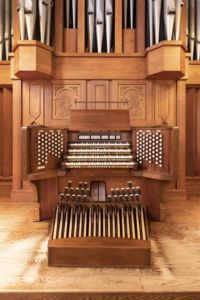
Two years later, Cage created a revised version of ASLSP for the organ. Since organ notes can be sustained as long as a finger is depressing a key and air is rushing through the pipes, the “race” (so to speak) was now on: Who could drag out a performance of this piece to the most ludicrous extremes?
The current record holder is Francesco Pio Gennarelli, who in March 2025 somehow stayed awake and stretched out Cage’s piece to 25 hours. You can watch his entire performance on YouTube in case you’re having a particularly uneventful day.
In January this year, four organists at Arizona State University decided they could top that. By taking turns at the keyboard, the quartet performed ASLSP at the record-setting slow pace of 192 hours, or exactly eight days.
That may represent the limits of human endurance. But that’s nothing when computers are invited to the party.
In 2001, an organ in St. Burchardi Church in Halberstadt, Germany – now appropriately known as the John Cage organ – began to play As Slow as Possible. A software program keeps the organ going 24/7, so a tone is always sounding. The final note of Cage’s piece will be sounded at the end of 639 years. That will happen in 2640, almost 400 years after the starship Enterprise is supposed to embark on its historic five-year mission, according to the official Star Trek canon timeline.
To get a sense of how slowly things are going, the most recent note to be sounded (an A4 pipe) was added just a month ago, on August 5. The next note will be played on October 5, 2027.
Enthusiastic crowds gather to hear each change. Thus, it might be wise to book your flight to Halberstadt as soon as possible.
To win John Cage’s crazy challenge, you’re going to have go slower than you have ever gone before.
But that’s the last thing you’ll want to do when it comes to the challenge of following Jesus.
From a certain perspective, Christianity is allergic to speed. Skeptics are urged to “taste and see that the Lord is good” (Psalm 34:8). At the end of the Sermon on the Mount, Jesus urges his listeners to “ask and it will be given to you; seek and you will find; knock and the door will be opened to you” (Matthew 7:7). Honest questions deserve honest answers. Seeking, knocking, and asking take time.
Then again, they don’t take forever.
And the simple fact is that none of us has forever to make up our minds as to whether Jesus’ truth claims hold water.
There’s an urgency associated with God’s work in the world. Jesus says in Matthew 9:37-38, “The harvest is plentiful but the workers are few. Ask the Lord of the harvest, therefore, to send out workers into his harvest field.”
There’s also an urgency associated with our response to the Spirit’s promptings. The apostle Paul quotes the Lord in 2 Corinthians 6:2: “‘In the time of my favor, I heard you, and in the day of salvation, I helped you.’ I tell you, now is the time of God’s favor, now is the day of salvation.”
Life is short. There is no guarantee of tomorrow.
At some point, when it comes to opening ourselves to God, every person has to decide whether or not to take Now for an answer.
That’s not to say we should stuff our questions and misgivings or do an end run around our doubts. That’s not healthy.
But spiritual procrastination isn’t healthy, either.
Now is the time to “taste and see” that the Lord is good – and to trust that in due time he will open our eyes and ears to the answers we’re seeking.
When the music stops playing, there’s no better place to be sitting than in the chair that God alone provides.