
To listen to today’s reflection as a podcast, click here
A few years ago, my wife opened the door to our garage to throw something into the recycle bin.
She stood there for a moment and then said, “I think you’d better come and see this.”
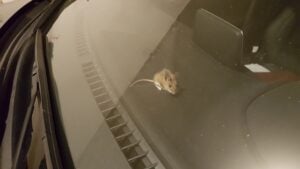
There, sitting atop the dashboard of my car, was a mouse.
The garage door was closed, as were the doors and windows to my car. Yet the mouse was inside.
People generally fall into one of two categories when it comes to encountering mice.
There are those who feel an instantaneous wave of primal horror. These are the people who have just resolved, upon reading the opening lines of this reflection, “I would rather walk 20 miles in the rain before taking a ride in Glenn’s car.”
Then there are those who think mice are rather cute. Mary Sue and I happen to fall into this category. As you can see in the picture above, “my” mouse appears to be doing nothing more than checking on the calibration of my GPS.
More realistically, the primary reason there was a mouse in my car is that there must have been something worth eating – perhaps a bit of icing from that Jack’s doughnut that I had smuggled into the front seat a few days earlier.
The common house mouse – technically Mus musculus, which has the ring of a pro wrestler’s name – will go virtually anywhere to eat virtually anything.
Rodents and humans have lived symbiotically for thousands of years. They are delighted to clean up behind us.
Mice can squeeze into impossibly small openings. An average-sized adult can slip through a crack just three-eighths of an inch wide. How did a mouse get into my car? My air vent probably seemed as wide as the Holland Tunnel.
Mice are champion reproducers. A female mouse is ready for motherhood at the age of six weeks, and about every three weeks after that. Each of her litters will yield 6-8 babies, or pups, also known affectionately as pinkies. You don’t have to be a math whiz to see that the numbers can accelerate pretty quickly. Theoretically, two mice could produce a multi-generation family of about a million descendants in one year.
Of course, the conditions in your house would have to be perfect for that to happen.
Unfortunately, the conditions in most of our houses right now are pretty close to perfect.
It helps that mice don’t live very long (most will never see a birthday cake with a single candle on it), and that many organisms are committed to keeping their numbers down. That includes humans, who for several centuries have been trying to come up with the proverbial better mousetrap.
The stakes are high. Mice consume at least 10% of America’s grain crop every year, an astonishingly large dent in our food supply.
But small creatures are capable of making a big impact.
That’s part of the story behind one of the more interesting verses in the Song of Songs, the Old Testament’s erotic love poem. A young man and young woman pour out their feelings for each other as their wedding day approaches.
The bride-to-be says to her lover, “Catch for us the foxes, the little foxes that ruin the vineyards, our vineyards that are in bloom” (Song of Songs 2:15). In the vivid imagery of this poem, the blooming of the local vineyards represents the unfolding joy of their shared romance.
But the Palestinian fox is a humble creature whose ramblings can spoil the harvest.
The relational wisdom of this verse seems to be that little things (little hurts, little resentments, and little habits) have the potential of becoming big problems if they aren’t addressed. “Catching the foxes” is a colorful way of counseling lovers to do a regular audit of their shared life – to set enough mousetraps to make sure little irritations don’t escalate to a critical mass.
It makes total sense to apply the same counsel to the workplace, to community relationships, to politics, and to the never-ending adventure of raising kids.
And the mouse in my Mazda?
I haven’t seen it since that first night. It darted out of sight as soon as I opened the door.
Just the same, I won’t be eating a cheese sandwich in the front seat any time soon.