
To listen to today’s reflection as a podcast, click here
Eight hundred years ago, the construction of European cathedrals experienced a kind of quantum leap.
Architects began to leave behind the monumentally thick walls of the Romanesque style.
For centuries, builders knew that the only way to go up – creating a majestically high vault above the sanctuary – was to increase the bulk of the load-bearing walls. That left little room for windows and exterior light.
Gothic innovations changed all that.
Soaring rib vaults and flying buttresses, which braced the exterior walls of the cathedrals, allowed for the construction of taller, thinner walls. And those permitted the inclusion of expansive clerestory windows – especially stained-glass windows that transformed what used to be somber interiors into explosions of color and light.
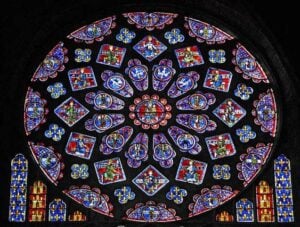
The Cathedral at Chartres, France, is an extraordinary example of the Gothic revolution.
Its 167 stained-glass windows, including the magnificent rose window shown above, were created principally between 1205 and 1240. They provided a way to teach biblical truths to medieval worshippers, a majority of whom were illiterate. Cathedral windows would also include scenes from the lives of saints as a means to inspire onlookers to deeper personal devotion.
The Chartres windows are renowned for their vivid colors, especially cobalt blue.
In the thirteenth century, however, applying color to glass was an inexact science. Raw pigments were sandwiched between sheets of crude, unevenly blown, bubbly glass. There were no guarantees regarding how much color might shine through.
Likewise, the technology to cut glass at this historical juncture left many pieces distorted. Thus the windows at Chartres were, from the beginning, unusually streaked, stained, curled, and scarred.
As it turned out, that’s what makes them fabulous.
The sunlight that streams through the imperfect windows is bent at odd angles. You never know exactly what you might see.
Within a century, European craftsmen figured out how to correct the production flaws. They learned how to make perfectly colored, perfectly trimmed pieces of glass. But Gothic windows made with all those perfect pieces have turned out to be, at least when set alongside Chartres, comparatively dull.
Remarkably, it is the Cathedral at Chartres that is thought to have the most beautiful windows in the world.
Its imperfections scatter the light in every imaginable direction as the sun slowly moves overhead every day.
God doesn’t need perfect people to filter the light of his presence and power.
Our hearts may be sadly bent for one reason or another. But He can do extraordinary things with the beauty of bent light.
“But we have this treasure in jars of clay, to show that the surpassing power belongs to God and not to us” (2 Corinthians 4:7).
We don’t have to be perfect.
For the world to experience something beautiful, all we have to do is turn ourselves in the direction of the One who is.