
To listen to today’s reflection as a podcast, click here
How do we know what America’s Civil War (1861-1865) was really like?
Most people would cast a vote for Matthew Brady’s photography. For the first time in history, someone was on site to snap pictures of battlefields, military camps, and even the bodies of fallen soldiers. Americans had never seen such things before.
But there were other realities that Brady’s cameras could never reveal: galloping horses, charging soldiers, and the dreadful chaos of hand-to-hand combat – in other words, what war was really like. The photographic technology of the time simply wasn’t up to the task. Brady’s lenses weren’t fast enough to capture motion.
But Alfred Waud’s pencil could.
Waud (whose name rhymes with “road”) was, in the words of historian Jim Stovall, “the Englishman who drew America’s war.”
At the beginning of the conflict, the 31-year-old agreed to provide illustrations to Harper’s Weekly – the country’s most popular magazine – by accompanying the Union’s Army of the Potomac “through the campaign.”
Observers from both North and South expected that campaign to last no more than a few months. Instead, Waud ended up journeying from Bull Run to Antietam to Gettysburg to the Wilderness over four grim years. As someone committed to sketching the way things really were, he frequently found himself in the middle of some of the most desperate action.
Waud’s drawings were spectacular. With just a few lines he was able to capture motion – the very thing that eluded the best photographers of the era.
After crafting rapid-fire renderings of battlefield drama, the young Brit typically added historical notes and observations along the margins. Then he sent his sketches by means of couriers to New York City, where Harpers Weekly staff members prepared them for publication.
That’s where the problems began.
Long before the advent of photocopiers, Waud’s drawings could not be directly reproduced. A team of 35 engravers had to translate them into a form that could receive printer’s ink. That would be a meticulously hand-carved “block” of boxwood, the best natural material available.
Each of the battlefield drawings was divided into two-inch blocks. An engraver would then imitate, as best he could, Waud’s lines, carving them into the boxwood with great care. The engravers, who were usually hundreds of miles away from each battle site, were also charged with adding small details to trees, horses, soldiers, and everything else in Waud’s landscapes.
The two-inch blocks were then joined together to form a complete picture, ready for the printing press.
Each engraving was meant to capture the motion and emotion of an original Alfred Waud drawing.
But they never quite succeeded. Something was always lost in translation. Waud’s sketches almost seem alive. The engravers’ copies, by comparison, seem to be, well, rather wooden.
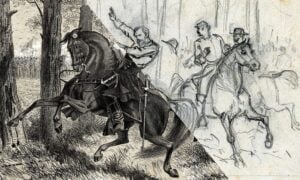
Note the image that accompanies this post. Waud was nearby when Union General John Reynolds was killed on the first day of the Battle of Gettysburg, July 1, 1863. The right side of the picture represents Waud’s original sketch. It swirls with activity. The left side is the Harpers Weekly engraving of the same scene. While there are many more details, the scene seems stilted by comparison.
The sad thing is that most of Waud’s drawings were thrown away after they were engraved. Historians therefore have plenty of engravings but few of his sketchpad masterpieces.
It’s so very hard to translate the beauty of something original into a new form.
That turns out to be true when it comes to Scripture.
The Old Testament was written in Hebrew (along with 269 verses in Daniel and Ezra that were composed in Aramaic, a similar ancient language). The New Testament was written in Greek – and that would be koine or “common” Greek, the language of everyday conversation, not the classic Greek of Plato nor the modern Greek spoken these days by citizens of Athens.
How can we ever capture the “motion and emotion” of the original texts when we live centuries after they were written?
Translators acknowledge that it’s not always easy.
Consider, for instance, the scene towards the end of the Gospel of John where Jesus tells Peter that he must wash his feet (an act of extreme humility). Peter is having none of it. Most translations of John 13:8 say something like, “You shall never wash my feet!”
The original Greek is far more dramatic. According to Bible scholar Dale Bruner, here’s the literal word order and emphasis: “Not NOT will you EVER wash MY feet – forever!” The word “forever” is actually “into eternity.” Peter is making it clear that under no circumstances will he ever let Jesus stoop (in any sense of the word) to such humiliation.
If John’s original text crackles like an original Alfred Waud battlefield sketch, most English translations feel more like a Harpers Weekly engraving.
Since most of us have no working acquaintance with ancient Hebrew and Greek, what in the world can we do?
We can commit ourselves to reading a number of different translations, as well as commentaries written by gifted scholars like Bruner. This is where the internet has become a priceless gift (and one has to admit those are words you don’t hear every day). Sites like BibleGateway.com provide, free of charge, the complete texts of numerous Scripture versions.
We can’t always “get at” every nuance of the original texts. But over the past century, global scholarship has helped millions of people draw far closer to the heart of God.
At last count, there are some 3,023 complete Bible versions on the market in 2,005 different languages. According to Wycliffe Bible Translators – the global ministry named for John Wycliffe, the medieval scholar who dared to keep translating Latin into English in the face of lifelong opposition – at least one book of the Bible is available in something like 3,600 languages. It’s the dream of WBT to render the Word in every global tongue and dialect. For at least 985 languages, that work has yet to begin.
How many English translations are out there?
If you count revisions and updates of existing versions, there are more than 450.
Which of those Bibles is the best one? Which one should I be reading?
It all depends on what you’re seeking. There’s an acknowledged tension between two very good things – accuracy and understandability. Some translations (the New American Standard Bible comes to mind) are wonderfully accurate. But they are notoriously wooden. Certain Bible paraphrases (like Kenneth Taylor’s Living Bible and the American Bible Society’s Good News Bible) are delightfully readable. But they lack theological precision.
Two popular English translations currently claim to combine readability with accuracy: the New International Version or NIV (which, when it comes to theological nuances, tends to favor evangelical perspectives) and the New Revised Standard Version or NRSV (which comes closer to the spirit of mainline Protestant churches). I appreciate both and use them interchangeably when writing reflections.
Then there’s The Message, the extraordinary paraphrase written over a ten-year-period by a single pastor-scholar, the late Eugene Peterson.
Peterson’s chief aim was to help 21st century Americans understand what ancient Hebrew prophets and the first apostles were actually thinking – in language that everyone can understand. When it comes to readability, Peterson hit it out of the park. He comes close to capturing something like the freshness of Waud’s quick sketches.
But the next time you find yourself on the verge of making a life-changing decision based on a verse or two, or writing a thesis on Paul’s theology of the cross, The Message is not going to be your go-to scriptural source. That was never Peterson’s intention. Check out some of the more standard translations instead.
In the end, there’s a simple way to identity which Bible translation is the best.
The Bible that’s best for you is not the one that’s gathering dust on your shelf, that all your friends rave about, or that consistently gets a five-star rating on Amazon.
The Bible that’s best for you is the one you actually read – whatever version that happens to be.
With God’s help, do whatever it takes to “see the picture” that the Bible’s original authors drew – then let the Holy Spirit draw those words close to your heart.