
To listen to today’s reflection as a podcast, click here
Throughout the month of November we’re looking at civility – how trusting God can help us cultivate a disposition of the mind and heart that has the potential to revolutionize our culture and ourselves.
It’s tempting to assume that America’s most recent election cycle set new lows for rudeness, incivility, and slander.
But that may simply reveal how easy it is to become prisoners of the moment.
As Alexandra Hudson points out in her book The Soul of Civility, incivility is nothing new. It “has been and always will be with us, because human selfishness will always be part of us.”
Consider some previous elections.
Andrew Jackson never got over his bitterness concerning the “corrupt bargain” of the election of 1824. Even though he won the most electoral college votes, Congress delivered the presidency to John Quincy Adams. In 1860, the election of Abraham Lincoln – who was publicly denounced as “the original gorilla” – split the nation and led to the Civil War.
A majority of historians, however, would suggest that our country’s darkest political hour came in the year 1800.
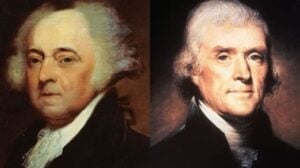
That’s when two of the original “founding brothers” – titans of the American Revolution who had once enjoyed a robust friendship – ran against each other for president.
John Adams already held the highest office in the land. Thomas Jefferson aimed to make it his own. Their supporters were absolutely convinced that America’s fate hung in the balance. Everything good, true, and beautiful would be lost if the other guy won the election.
Timothy Dwight, the president of Yale and a stanch supporter of Adams, declared that if Jefferson won, “America could well see the end of both religion and family. We may see the Bible cast into the bonfire, and our children…chanting mockeries against God. Our wives and daughters [will be] the victims of legal prostitution.“
Alexander Hamilton countered that Adams “was not presidential material, because of great and intrinsic defects in his character, including disgusting egotism, distempered jealousy, and an ungovernable indiscretion of temper.”
Adams responded angrily that Hamilton was “a bastard brat of a Scotch peddler, and a man devoid of every moral principle.”
This is probably not the best thing to say if you’re trying to disprove someone’s assertion that you have a temper problem.
Two months before voters went to the polls, the Gazette of the United States editorialized: “The only question to be asked by every American laying his hand on his heart is, ‘Shall I continue in allegiance to God and a religious president, or impiously declare for Jefferson and no god?’”
The Virginian’s supporters shot back, arguing that Adams was a dictator who would destroy religious liberty and the rights of conscience.
Jefferson was smeared as a man with the relational integrity of an alley cat and “an open enemy of Jesus.” His administration would welcome infidels and atheists. Adams’ supporters told their followers to hide their Bibles if Jefferson won, because he would be sending troops to seize them.
Jefferson’s allies countered that he was a far better man than the stocky John Adams, whom they mocked as His Rotundity. He was a more faithful Christian, too. The Virginia planter’s good works clearly exceeded those of the current president.
Most of America’s clergy castigated Jefferson, whom they described as “unmanly, a coward…a saboteur of everything sacred, the arch-priest of infidelity, a confirmed infidel, preaching insurrection against God.”
One of Adams’ opponents countered that the sitting president was “a hideous hermaphroditic character which has neither the force nor firmness of a man, nor the gentleness and sensibility of a woman.”
You have to admit: Even today’s politicians haven’t yet succumbed to labeling their opponents hermaphroditic.
After months of such ugly rhetoric, open hostility, and apocalyptic predictions, the election ended in a stalemate. Neither candidate had enough votes to declare victory according to the rules then in play. The outcome was left up to Congress. Deals were made. Jefferson ultimately became America’s third president. Drowning in unforgiveness, Adams retreated from public life.
Many people in 1800 thought America could not possibly survive such a crisis. But it did.
Stephen Prothero, professor of religion at Boston University, points out that in our culture, “there will always be deep-seated differences about moral, religious, and ethical questions. Our arguments will continue. They should continue.”
Civility, in fact, absolutely depends on principled discussions and disagreements that sometimes drag on for years.
But when each side becomes intolerant of the other – when we demonize our opponents and insist on their total defeat and humiliation – it becomes hard to go forward.
There’s a Jewish tradition that contrasts two ways to argue: arguing for the sake of ego and arguing for the sake of heaven. According to the former, you must do everything possible to win. You have to prove yourself superior to your opponent.
But as Prothero points out, arguing for the sake of heaven means both sides are actually trying to get closer to the truth. This approach begins with “the awareness that neither side possesses the whole truth. Only God has that.” Therefore each side stands to learn something by listening to the other.
And that means that along the way, even in the midst of our strongest disagreements, we must remember that civility is not a sign of weakness.
We cannot, in the name of Jesus, wish disaster upon those with whom we disagree. As Paul insists in Romans 12:14-18, “Bless those who persecute you; bless and do not curse… Live in harmony with one another… Do not be conceited. Do not repay anyone evil for evil…. If it is possible, as far as it depends on you, live at peace with everyone.”
Here is our word of hope: No matter how discouraged we might feel about the current state of our society, this isn’t the first time civility seems hard to find. And it most certainly won’t be the last. But the God of all hope is always at work in those who turn their hearts to him, and who choose to offer grace and peace to everyone they meet.
So what happened to Adams and Jefferson? We’ll pick up the “rest of their story” tomorrow.
Meanwhile, what’s the worst way to die? That’s a no-brainer.
The worst way to die is with some kind of unresolved bitterness in our heart.
Even if your soul has been bruised by hurts and disagreements that seem impossible to overcome, start building a bridge from your edge of the chasm.
Heaven and history will be on your side.