
To listen to today’s reflection as a podcast, click here
Each day this month of August we’ll be looking at one of the extraordinary metaphors that the Bible uses to illustrate the nature of our relationship with God.
On a wintry morning in February 1956, a riding instructor named Harry de Leyer drove four hours from his Long Island farm to New Holland, Pennsylvania.
Every Monday, as many as 300 horses were auctioned at this Amish community. Harry, a Dutch immigrant, knew horses. He had $80 in his pocket and hoped to purchase a gentle animal that could become a lesson horse for his students.
The auction attracted a plethora of buyers. Some of the horses were purebreds. They fetched the big bucks. Some animals needed to be trained. Others simply needed to be loved. There were worn-out plough horses, tired ponies, and creatures who had been ill-treated for years by callous owners.
By midday the auction would be over and every horse would be purchased.
The last bidder was always the Kill buyer. He would pay bottom dollar for the animals no one wanted. They would be crowded into a truck and driven to the slaughterhouse, where their carcasses would become pet food and their hooves boiled down into glue.
On his way to New Holland, Harry’s old car struggled through the snow. Then he blew a tire. By the time he arrived, the auction was over. Everyone was gone except the man who had just finished loading about 15 animals into the Kill truck for their final ride.
Harry still hoped his long drive wasn’t in vain. Maybe there was a decent horse on the Kill truck.
The slaughterhouse buyer was in a hurry. Harry stepped forward to take a look. He was drawn to an underfed, overworked plough horse, at least eight years old, covered with mud and manure. “I couldn’t see much through the slats in the truck, but I saw this gray horse that had very kind eyes who would be a quiet-type horse who would give back in loyalty and affection. He was missing a shoe, had cuts on his knees, and I could see where hair had been rubbed off by a harness.”
How much was he worth? “He’s yours for $80,” said the Kill buyer – exactly the amount of money in Harry’s wallet. He handed over the cash.
When the neglected horse arrived at the de Leyer farm, Harry’s daughter – captivated by his gray coat against the background of falling snow – thought he looked like a snowman. Now he had a name.
Snowman proved to be so gentle, especially around children and nervous riders, that a doctor who lived down the road from the de Leyers begged to buy him as a horse for his kids. Harry consented.
That’s when the fun began.
Three days later, Harry looked up and saw Snowman standing in his paddock. The horse had jumped numerous fences in order to rejoin the man he loved. Harry returned the horse, advising the doctor to build his fences higher and to tie a tire to Snowman so he couldn’t jump. Three days later, Snowman was back in Harry’s paddock – tire and all.
Gradually it dawned on the Dutch horse trainer that this might be an extraordinary animal.
The horse never again left Harry’s side. De Leyer began to enter Snowman in jumper events.
People laughed out loud when the old plough horse walked into arenas alongside the best of the best – animals specially bred and trained to clear high hurdles. But laughter turned to awe when Snowman won the National Horse Show Open Jumper Championship in 1958 – just two years after being rescued from the Kill truck. Then he was named the American Horse Shows Association Horse of the Year in both 1958 and 1959.
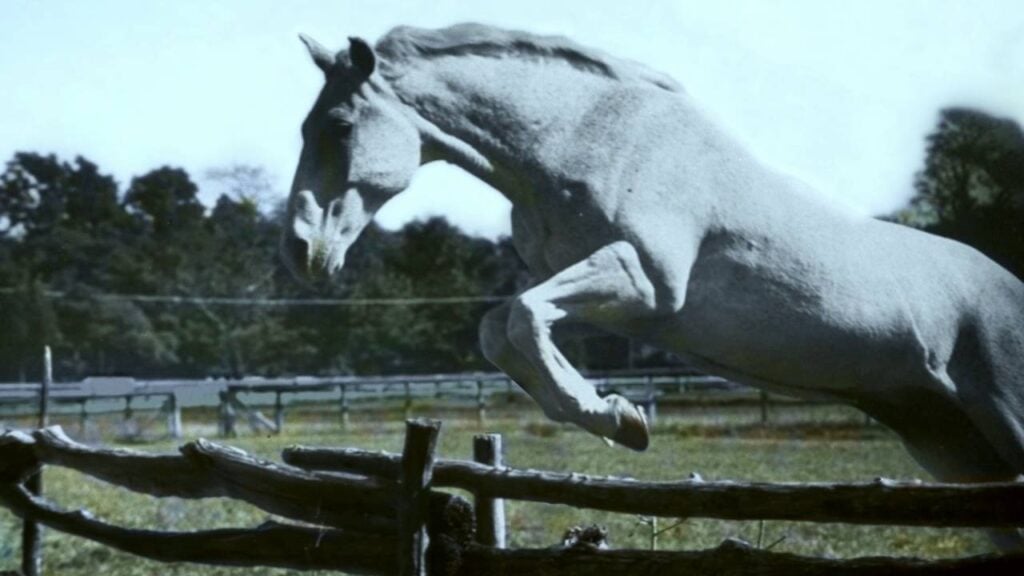
Snowman became a celebrity. He was featured in LIFE magazine, appeared on The Tonight Show with Johnny Carson, and for years was the star of his own fan club. He even inspired a Breyer Horse collectible. And yes, that’s actually Snowman in the picture above.
Along the way he never lost his love for children. When the school bus arrived in the afternoon to drop off the de Leyer kids, Snowman frequently jumped over his paddock fence to meet them.
Who knew that for a mere $80 Harry de Leyer had rescued one of the greatest jumpers in equestrian history – a horse that would become a member of his own family?
If it’s hard to imagine going from the slaughterhouse to the penthouse, just think what God has done for us.
The apostle Paul minces no words: “God rescued us from dead-end alleys and dark dungeons. He’s set us up in the kingdom of the Son he loves so much, the Son who got us out of the pit we were in, got rid of the sins we were doomed to keep repeating” (Colossians 1:13-14, The Message).
God, in other words, is our deliverer.
That stands out in one of the most metaphor-dense texts in all of Scripture, David’s celebration of how God rescued him from his own version of the Kill truck: “The Lord is my rock, my fortress and my deliverer; my God is my rock, in whom I take refuge, my shield and the horn of my salvation. He is my stronghold, my refuge and my savior—from violent people you save me” (2 Samuel 22:2-3).
Within the space of a few words, God is declared to be a rock, a fortress, a shield, a stronghold, a refuge, and a horn.
The word “horn” in this context suggests at least two things – the cranial protuberance of a strong animal intent on defending its young, and the horn-like corners of the altar in Israel’s tabernacle, which innocent people could cling to in search of justice.
It’s highly significant, and certainly no accident, that Jesus is described in Luke 1:68-69 as God’s horn of salvation. He is our true deliverer.
People in our day and age have a hard time picturing themselves on the Kill truck.
Many are put off by the very notion that we need to be rescued.
But once we’ve spent some time living under God’s leadership – experiencing hope instead of cynicism, grace instead of exasperation, purpose instead of meaninglessness – only then will we grasp what a miracle it was that when God looked at us, covered with spiritual mud and manure, he didn’t turn away.
Instead, he saw in us what he already knew us to be:
Champions.