
To listen to today’s reflection as a podcast, click here
Each day this month of August we’ll be looking at one of the extraordinary metaphors that the Bible uses to illustrate the nature of our relationship with God.
“Do you not know that in a race all the runners run, but only one gets the prize? Run in such a way as to get the prize” (I Corinthians 9:24).
It’s called the Goldman Dilemma.
During the 1970s and 80s, physician Robert M. Goldman and researcher Gabe Mirkin asked a number of elite athletes – U.S Olympians and Olympic hopefuls – to consider a provocative scenario:
“You are offered a banned performance-enhancing substance, with two guarantees: (1) You will not get caught, and (2) You will win. Would you take the substance?”
A majority of the athletes said Yes.
The same respondents were offered a second scenario: “You are offered a banned performance-enhancing substance, with two guarantees: (1) You will not get caught, and (2) You will win every competition you enter for the next five years, after which you will die from the side effects of the substance. Would you take it?”
According to Goldman, more than half the athletes said Yes to that proposition as well.
Recent research, fortunately, has demonstrated a shift in attitudes. Far fewer athletes these days appear willing to risk their integrity, their health, and their most important relationships for a few brief moments of glory. But no one doubts that there always have been, and always will be, athletes who consider winning a life-or-death proposition.
That tension is on display in an unusual British film that won the 1981 Academy Award for Best Picture. It’s a movie we’ve explored on several occasions in the past. It had no sex, no car chases, no spaceships, and no Kevin Bacon. It was called Chariots of Fire.
The movie portrays the events leading up to the 1924 Summer Olympics in Paris, in which the British track and field team unveiled two runners of exceptional talent but startlingly different motivations.
Harold Abrahams, a Jew of Lithuanian heritage, feels snubbed by the power structures of the day. At every turn he has to prove himself. The rage inside him compels him to train harder and run faster than any man he knows.
“Running is an addiction, a compulsion,” he says. “It is a weapon.” He admits that he needs to win the Olympics to justify his own existence. Even after winning the gold medal in the 100 meters, making him the so-called Fastest Man Alive, he feels strangely alone and unfulfilled. Contentment eludes him.
Eric Liddell, a Scottish sprinter, was expected to be Abrahams’ primary competition. But the qualifying trials for the 100 meters were scheduled for Sunday. Because of his spiritual convictions, Liddell refused to run on the Sabbath, thus surrendering his chance to compete.
To observers around the world, this seemed like madness. Why throw away your best chance for glory?
Liddell is unfazed by public opinion. He decides to run in the 400 meters, even though he has competed at that distance only four times in his life.
The experts give him no chance to win. He isn’t trained. He’s used to short bursts, not middle length grinds. His American competitors dismiss him out of hand. “After 300 meters, rigor mortis sets in.”
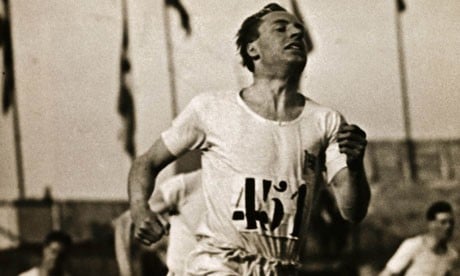
His running style, to put it gently, is absurd. He breaks every aerodynamic rule. His arms flail. He even sometimes throws back his head and looks upward while running (note the archival photo above). He just can’t help himself.
But for Eric Liddell, running is an act of joy.
It is an explosive release of gratitude that is deep inside him. Liddell doesn’t need a gold medal to justify his existence. He already knows who he is.
The son of Scottish missionary parents, he is on his way to China where he himself will be a mission worker, and where he will ultimately become a prisoner in a detention camp during Japan’s occupation of the country. There he will die while pouring out his life for others.
His sister Jenny doesn’t know why he bothers with athletic competition.
“Jenny,” he explains, in the film’s signature line, “I believe God made me for a purpose – for China. But he also made me fast. And when I run, I feel his pleasure.”
Competing against the best 400-meter runners in the world, Liddell throws back his head and wins the gold. Here’s how Chariots of Fire depicts the climactic race. Notice that he completes the event while holding in his hand a crumpled note of encouragement he’s given just before the starter’s gun.
Nineteen centuries earlier, the apostle Paul proposed athletic training as a metaphor for the Christ-pursuing life. He apparently was well acquainted with the Greek tradition of competitive games, since he observes in I Corinthians 9:24-27:
“Do you not know that in a race all the runners run, but only one gets the prize? Run in such a way as to get the prize. Everyone who competes in the games goes into strict training. They do it to get a crown that will not last; but we do it to get a crown that will last forever. Therefore I do not run like a man running aimlessly; I do not fight like a man beating the air. No, I beat my body and make it my slave so that after I have preached to others, I myself will not be disqualified for the prize.”
We may presume that Paul was as serious about keeping himself in “playing shape” spiritually as any rookie currently trying to win a place on an NFL roster.
But the rewards could not have been more different.
The winner of an ancient footrace received a crown of laurel leaves. They soon became brown and dry.
Paul, on the other hand, as he approaches the end of life, declares, “I have fought the fight, I have run the race, I have kept the faith. Now there is in store for me the crown of righteousness, which the Lord, the righteous Judge, will award to me on that day—and not only to me, but also to all who have longed for his appearing” (2 Timothy 4:7-8).
Suffice it say that the crown God provides lasts forever.
What practice or pastime or habit of the heart – whether singing or painting or organizing fundraisers or teaching or gardening or mentoring teenagers or restocking the food bank or comforting the sick or any number of other activities – so fills your soul with joy that you feel your Creator’s pleasure?
Keep at it. Practice diligently. Choose to excel.
As Paul puts it, “Run in such a way as to get the prize” – the prize of hearing God say, “Well done, good and faithful servant.”
That’s what it means to win the contest that really matters.