
To listen to today’s reflection as a podcast, click here
Each day this month of August we’ll be looking at one of the extraordinary metaphors that the Bible uses to illustrate the nature of our relationship with God.
In 1957, Theodore Suess Geisel (aka Dr. Seuss) hit a literary home run.
The Cat in the Hat put him squarely on the map in the ultra-competitive world of children’s books. Its simple vocabulary – just 236 distinct words – delighted readers both young and old.
Suitably impressed, Seuss’ editor, Bennett Cerf, made an unusual proposition. He bet Suess 50 bucks (a considerable amount of money at the time) that he couldn’t write a decent kids’ book with a vocabulary of just 50 words.
Seuss accepted the challenge and got to work.
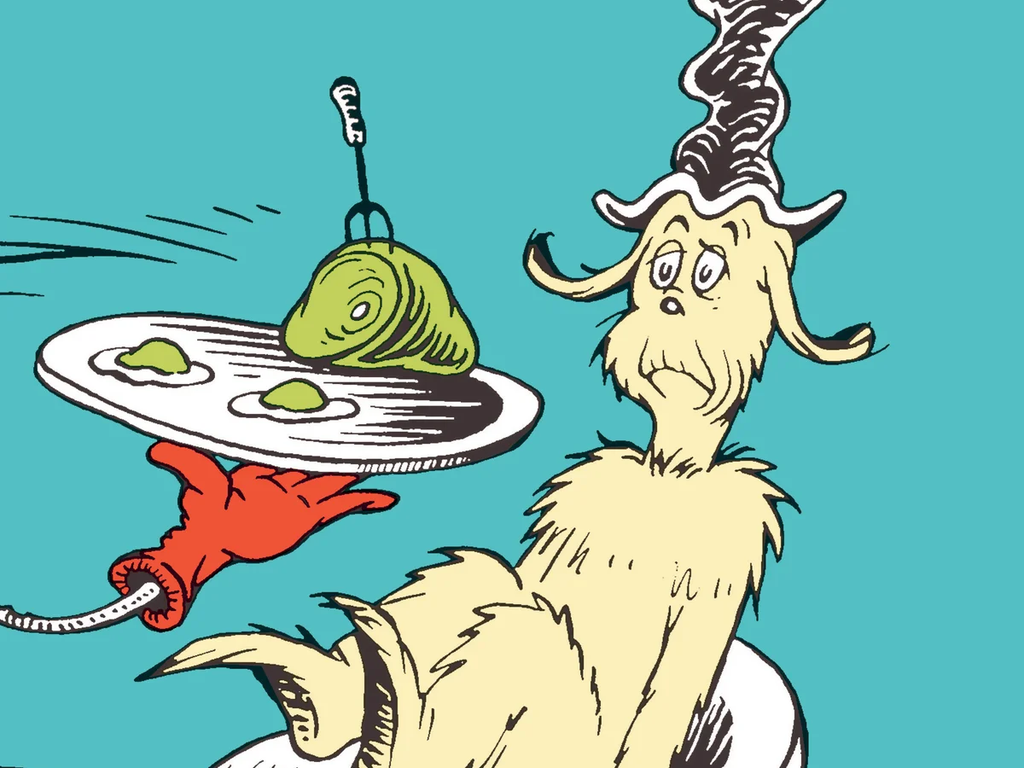
The result was Green Eggs and Ham, which arrived in the summer of 1960 and quickly soared to the top of the bestseller lists. If you’ve been around children recently, or were blessed to have access to books when you were growing up, you probably remember the plot.
A fellow named Sam-I-Am approaches an unnamed character with a plate of green eggs and ham, beckoning him to dig in. Absolutely not, comes the reply. Undaunted, Sam proposes numerous locations and a variety of dining partners. The answer remains the same. When Sam-I-am asks his new friend if he will at least try green eggs and ham, the unnamed character finally relents – and discovers he likes the bizarre dish after all.
The book uses exactly 50 different words. Each one is just one syllable, with the exception of “anywhere.”
To say that Green Eggs and Ham has been parodied throughout American culture would be an understatement.
It has become a stage production, a television series, and a rap song. In a memorable sketch on Saturday Night Live, the Reverend Jesse Jackson read the book during a sermon – with a pastor’s homiletical cadence, of course. Senator Ted Cruz recited the book on the floor of Congress during his filibuster over the funding of the Affordable Care Act. And musician will.I.am, frontman of the Black-Eyed Peas, has confirmed that he invented his name as a tribute to the book’s lead character.
Until his death in 1991, Seuss repeatedly received gifts of literal green eggs and ham. His verdict? “Deplorable stuff.”
It’s worth noting that he cherished an unshakeable conviction that kids’ books were not just kids’ stuff. He believed children’s literature played an essential role in the shaping of young minds and had a greater capacity to effect good and evil in society than anyone might dare to imagine.
If you put together enough words like “box,” “fox,” “boat,” and “goat,” you can come up with a children’s masterpiece.
Throughout the month of August, it’s been our hope to demonstrate that if you put together enough metaphors, it’s possible to catch a glimpse of God’s true nature and how we can know him better.
Interestingly, there are just about 50 such metaphors on the pages of Scripture.
Biblical metaphors are like a kaleidoscope. Turn the next page and a different kind of picture comes into view.
According to David, God is an immovable rock. We are those who huddle beside it for shelter and protection. Peter says that we ourselves are rocks, and God is a stonemason who is using us to construct a holy temple.
Jesus says that we are animals – either sheep who desperately need the leadership of a competent shepherd, or chicks who have enough sense to run under their mother’s outstretched wings in the midst of trouble. We are also plants – branches that have no hope of bearing clusters of grapes unless we’re locked into the life-giving central vine.
Some metaphors emphasize our helplessness. Isaiah declares that God is a potter, which makes us putty in his hands, shaping us according to his wishes.
But it’s not long before we encounter figures of speech that put the responsibility squarely on our shoulders. We are servants who either obey our Master or thumb our noses at him. We are children who either rejoice in our father’s grace or slam the door as we leave home.
Then there are the metaphors that take us to places – profoundly intimate places – where other religions dare not go. We are rescued by Jesus. That’s amazing enough. But we are also his friends, his brothers and sisters, and even his bride.
If you take one of these pictures and run with it – “this metaphor tells me all there is to know of God” – you will become a heretic.
We need to savor all the pictures that Scripture provides. That’s the only way to grasp all of God that Scripture reveals. Even then, after all our best efforts at Bible study, we know that we’re merely wading in the shallows of the oceanic depths of God’s true nature.
But God is faithful. Each metaphor is his gift to us. Each reveals something that is true.
There are days in which we need to hear, more than anything else, that our failures are not going to defeat us, since we’ve got the best defense attorney in the cosmos. There are other days when we need to be reminded that we are lifelong learners enrolled in the school of Jesus Christ, which means that yes, everything that happens today is going to be on the final.
We are just the kind of creatures who need every one of the pictures we find on the pages of the Bible.
Or, as Dr. Seuss might put it:
We will read them in a house.
We will read them with a mouse.
We like these pictures, Sam-I-am.
They grow our faith as nothing can.