
To listen to today’s reflection as a podcast, click here
Think of the extraordinary things you can experience that your great-grandparents could hardly have imagined.
You can hold in your hand a device that gives you access to all the knowledge humanity has ever obtained. You can travel from your home to almost any spot on earth within 24 hours. You can have joint replacement surgery and be back on your feet, without significant pain, in a matter of days. You can shop online and watch an autonomous drone drop off your purchases a few feet from your front door.
Your great-grandparents would have been astounded.
Then again, they did something many times that you may never get to do once.
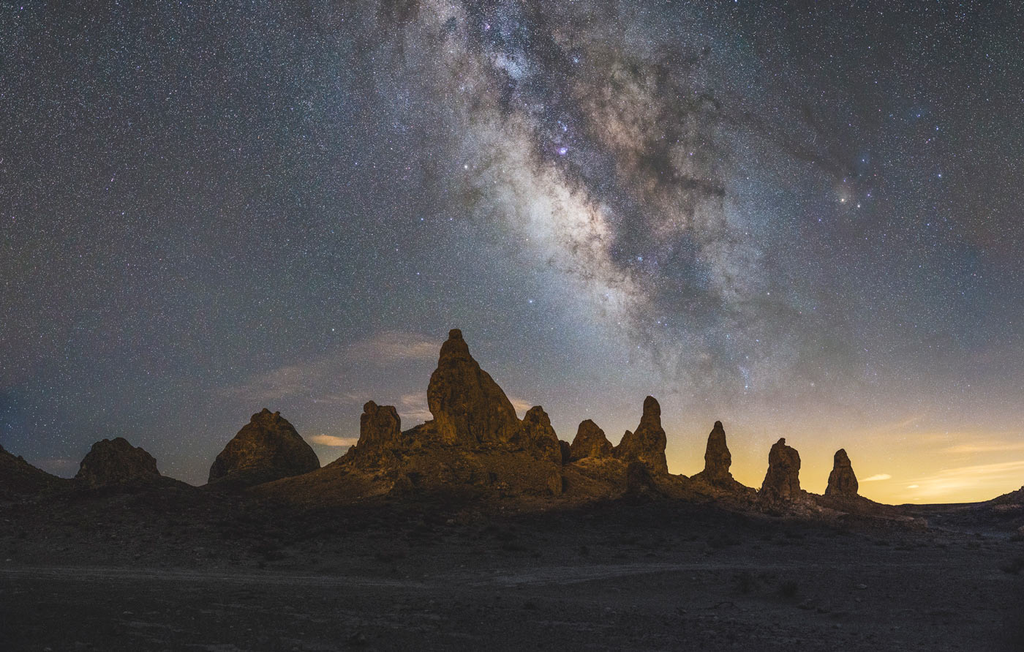
They could step outdoors at night and see the Milky Way.
The Milky Way, of course, is our galaxy – the vast swath of stars and dust to which our solar system belongs. Some 200 billion stars are currently pinwheeling around an enormous black hole. Since ancient times, the Milky Way has been plainly visible, especially in the northern latitudes of our planet during the summer months.
Plainly visible, that is, if the night sky is genuinely dark.
And that’s the problem. According to Fabio Falchi, a researcher at the Light Pollution Science and Technology Institute in Thiene, Italy, an astonishing 99% of the population of the United States and western Europe is unable to make out the Milky Way when they look up at night. That’s because the ambient glow from countless headlights, streetlamps, office windows, and Taco Bell signs has rendered all but the brightest nighttime objects invisible.
Vast areas of central Africa, the Amazon basin in South America, and Siberia provide sufficient darkness to see the stars. But Falchi estimates that less than 20% of the Earth’s land areas are truly free of light pollution.
Few of us would willingly surrender the miracle of illumination that arrived on the scene late in the 19th century. Electric lights have seemingly banished the boundary between night and day. The old 9-to-5 work schedule was on life support long before Dolly Parton turned it into a hit. Now we can work all night if we wish, the blue light of our laptops and smartphones mimicking broad daylight.
But there is a steep price to pay.
For one thing, most human beings function best according to a time-honored circadian rhythm: “Daytime is for activity, nighttime is for rest.” Numerous studies have demonstrated that this cannot simply be wished away, as if we could declare, “Since I need to work the late shift, my body will adjust.” For many people, such an adjustment is a monumental struggle. Our bodies appear to be engineered for work and play when it’s light outside and sleep and restoration when it’s dark.
Additional research demonstrates that cuddling up with a smartphone at bedtime is inviting trouble. Its artificial light tricks our bodies into wakefulness – a condition that compromises teenagers who check their Instagram accounts at all hours.
Living in a hyper-illuminated world is a downer when it comes to restful sleep.
But there’s a deeper, subtler concern when men, women, and children can no longer step outside at night and see the stars.
We lose the sense of wonder that was such a spiritual cornerstone of previous generations.
Last year I got to spend a week on a science cruise to the Galapagos Islands, hundreds of miles from the ambient light blanketing Ecuador’s coastline. One night the naturalists invited us to climb to the upper deck so we could experience the stars. The first order of business was to extinguish most of the lights on the boat and to dim our individual cell phones (an audacious request to make in the 21st century).
I’ve been a devoted amateur astronomer since I got my first telescope back in middle school. I memorized the constellations. Over the years, I’ve enjoyed starlight on numerous campouts, visits to national parks, and mission trips.
But this was different. Perhaps it had simply been a very long time since I had experienced profound darkness. The night sky was almost frightening – lit with what seemed to be a thousand campfires just above my head. I felt some of the awe that must have inspired Vincent Van Gogh’s “Starry Night” – an unsettling mixture of joy and fear.
It was both humbling and uplifting. The words of the psalmist came to mind: “When I consider your heavens, the work of your fingers, the moon and the stars, which you have set in place, what is mankind that you are mindful of them, human beings that you care for them?” (Psalm 8:3-4).
What, indeed, is our place in such a vast universe? What is our Creator asking us to do and to be?
Then there are the opening three verses of Psalm 19: “The heavens declare the glory of God; the skies proclaim the work of his hands. Day after day they pour forth speech; night after night they reveal knowledge. They have no speech, they use no words; no sound is heard from them.”
It’s true that no sound is heard from Orion or Sirius or Leo or Vega. Yet, as David the psalmist says, the nighttime sky nevertheless declares God’s glory.
The stars preach a sermon about the majesty of God – a message that may never reach us if at 10 pm we’re outside on a sidewalk staring at our smartphones instead of looking up.
It may not be a viable option for all of us, but it’s worth making a special effort to drive as far as you can into the countryside, away from city lights.
Step away from your car. Look up. Let your eyes become accustomed to the dark.
As you take in the stars, be still and know that God is God.
And he is an Artist like no other.