
To listen to today’s reflection as a podcast, click here
Historians don’t know all that much about the English mathematician Thomas Bayes.
Their best guess is that he was born around 1701. No one knows exactly where he spent his childhood.
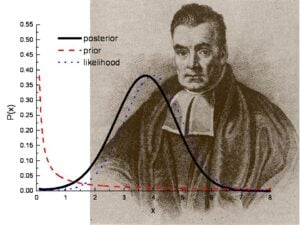
For that matter, no one really knows what Bayes looked like. The portrait above has long been thought to be his likeness, but uncertainties remain. The actor Charlie Sheen portrayed Bayes in an obscure biopic a few years ago, so you can always picture him as the “wild thing” relief pitcher in Major League.
What we do know is that Bayes created one of the landmark theorems in the history of mathematics. Amazingly, he never got around to publishing it.
When he died in 1761, his handwritten notes hadn’t even been edited.
Two years later, through the kindness of his friend Richard Price, his greatest accomplishment (which came to be known as An Essay Towards Solving a Problem in the Doctrine of Chances) finally saw the light of day.
Bayes was a Presbyterian minister. By all accounts, he was a mediocre preacher. Math was his hobby. He was intrigued by statistical probabilities.
For instance: Based on what we already know and what has already happened, what is most likely to happen in the future? And how would that probability change if and when we got new data?
In his spare time, the struggling clergyman wrote what has come to be known as Bayes’ Theorem. It looks like this: P(A|B) = P(B|A) × P(A) ÷ P(B). The four terms represent initial beliefs, probabilities of what is actually true, the arrival of new evidence, and updated probabilities.
The amazing thing is that that equation didn’t have a single practical application during his own lifetime. Nobody could come up with a problem that Bayes’ Theorem could solve.
What a difference 250 years can make.
Today Bayes’ Theorem is one of the central pillars of applied mathematics. With the help of supercomputers, his equation is being used to solve the toughest problems in astrophysics, stock market analysis, long-range weather forecasting, radiocarbon dating, medical diagnoses, machine learning, climate change projections, and a host of other thorny issues.
Eight years ago, when I first referenced Bayes’ Theorem in a reflection, I received a correspondence from two retired NASA engineers who affirmed its importance in assuring that the Apollo 11 astronauts were able to travel safely to the moon and back.
Are you hoping, planning, and praying that your life might somehow make a positive difference in the world?
It’s notoriously difficult to know if that is actually happening during your own lifetime.
We may presume that Bayes entrusted the outcome of his ministry to God. The Lord will one day reveal the full impact of his service. But it may never have occurred to him that his most celebrated contribution to humanity was sitting on his desk in a pile of neglected papers.
We rarely have the capacity to see how history is unfolding right before our eyes.
That’s why we always fall back on Paul’s words in 2 Corinthians 5:7: “For we live by faith, not by sight.”
So, work hard today. Smile at the stranger you pass in the cereal aisle of the grocery. Don’t give up on the problem you can’t seem to solve, even when you’re tempted to throw in the towel. Pray, even when you don’t feel like it. Do the one good thing that’s within your power to do. Keep going, even if it appears you’re giving your life to something that no one will ever fully understand or appreciate.
Be faithful. Then leave the results to God.
Who knows?
Our ultimate impact may turn out to be, as Bayes might have put it, beyond calculation.