
To listen to today’s reflection as a podcast, click here
Concrete is an almost miraculous building material.
It accounts for approximately half of the world’s structures, from humble homes to massive dams.
It is remarkably strong. A skyscraper with a concrete interior can soar hundreds of feet into the sky, supporting thousands of tons of office equipment and workers without keeling over.
Concrete is also cheap and easy to work with.
It can be poured and molded into interstate bridges, sports arenas, and the cores of nuclear power plants. One person with a concrete mixer can create the foundation of a house within a couple of weeks, and reasonably expect it to last a century.
But there’s always been a problem.
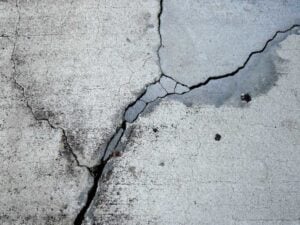
Concrete cracks.
Rising and falling temperatures put stress on concrete structures. Earthquakes and settling ground may introduce fissures. When water (especially seawater) finds its way into those cracks, it may begin to compromise the steel rebar skeleton embedded within. Or the water may freeze and make the cracks even bigger.
As Mark Miodownik, a professor at University College (London) points out in his book Stuff Matters, the slightest crack may lead to instability and eventually the collapse of an enormous structure.
Concrete is awesome, he acknowledges – but only if someone looks after it, with an eye to making necessary repairs. Since half the world’s structures are concrete, that represents an enormous challenge.
Wouldn’t it be great to have concrete that heals itself?
Now we do. It’s called “bio-concrete.”
Years ago scientists discovered that certain species of bacteria are able to thrive in extreme conditions. The bacterium B. pasteurii was found growing in alkaline lakes near volcanoes. The water of these lakes, which registers between pH 9 and 11, actually burns human skin. But the tiny microorganisms feel right at home.
Not only that, they display two remarkable behaviors.
The first is their ability to go dormant. B. pasteurii can sleep longer than a college student on Saturday morning. Even while encased in rock, they can stay inert but alive for up to 200 years. Second, they excrete the mineral calcite, which just happens to be one of concrete’s components.
These discoveries inspired scientists and engineers to dream up the recipe for bio-concrete.
They mix a generous portion of B. pasteurii and starch into a batch of concrete, then pour it into a structural shape. If a crack forms somewhere down the road, the arrival of water is like a microbiological alarm clock. The bacteria awaken from their slumber and begin to gobble up the starch.
As they continue growing, replicating, and feasting, the bacteria secrete a sufficient amount of calcite to fill the crack and bind together the fractured parts. Engineers estimate that cracked concrete can recover 90% of its original strength, all thanks to microorganisms that don’t mind bunking down for decades in an extreme environment.
Bio-concrete, from a certain perspective, is self-healing.
So are many living things. Human bodies are blessed with a remarkable immune system, along with the capacity to repair and restore many tissues.
But human hearts – our emotional and spiritual centers, that is – are a different matter.
Daily stress may render us unstable. Relational earthquakes may leave deep fissures across our souls. Certain self-help books imply that we can bravely pull ourselves together. But deep healing doesn’t come from within.
We need to be touched by a Healer beyond ourselves, one who intimately knows our frailties and weaknesses.
Fortunately, we have one.
“The Lord heals the brokenhearted and binds up their wounds” (Psalm 147:3).
In a world that is guaranteed to shake our foundations, that’s one of the Bible’s truly concrete promises.