
To listen to today’s reflection as a podcast, click here
In 1818, when Thomas Jefferson was 75 years old, he was still dreaming about what America might become.
He decided to establish a university.
Jefferson gathered friends and associates at Charlottesville, Virginia, and shared his vision for a new kind of school. It was a university “so thoroughly the work of his hands that it was to become known simply as Mr. Jefferson’s,” writes Jon Meacham in his biography of the third president.
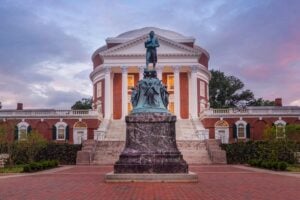
Two hundred years later, the University of Virginia remains one of America’s premiere schools. The founder’s statue stands prominently in front of the famous Rotunda.
What was so special about his vision?
Jefferson recognized that every human society has “elites.” A group of somebodies always ends up on top. But who should those somebodies be?
In Europe, the elites had to belong to the right families with the right titles. What mattered most were your hereditary bloodlines. Who’s your daddy? Jefferson dismissed that tradition out of hand. The elites should be the brightest and the best, no matter what your genealogy looked like.
In order to create a new kind of “natural aristocracy,” both rich and poor had to have equal access to the best possible education.
This was a revolutionary idea, one that’s become so much a part of the American dream that we almost take it for granted.
But as Fareed Zakaria points out in his book In Defense of a Liberal Education, it’s also an idea that’s suffered a beating in recent years.
A college education was affordable for most middle-class families in 1965. Today that’s far less true. Tuition costs have risen 1,200% since the late 1970’s, far beyond the reach of most individuals, unless they’re willing to take out crippling loans.
Jefferson would be dismayed that the children of financially blessed families now have an inside track to achieving elite status.
But there’s been an even more concerning trend in recent years.
Zakaria writes, “Admissions offices now prize nothing less than perfection.” He asked the leader of the admissions team at an Ivy League school, “Do you take in many kids who have failed in some significant way in high school?”
The director candidly admitted that they didn’t. His school only targeted students with the best transcripts and highest SAT scores.
“I pointed out.” Zakaria continues, “that how one responds to and recovers from failure is one of the most important characteristics of an individual, probably one that reveals more about his or her future success.”
The admissions director, a deeply educated scholar, acknowledged Zakaria’s point. But if they took in kids who had failed in some major way “the college would drop in its rankings and its ‘win-loss’ ratio against other key schools (that is, the percentage of students who, when admitted to two schools, accept one over the other).”
In other words, if you want to become an elite, you’d better not fail. Or even hint that your life might have been anything less than a beautiful and flawless journey.
And that is truly tragic.
Failure, perhaps more than anything else, is what makes us. And then remakes us.
We may be blessed with great DNA, great parents, and great opportunities, but our character really turns on how we respond to life’s inevitable moments of great pain and jarring disappointments.
Those who have faced up to such shortcomings, who have been forged by failure, become wiser and gentler – and thus the true elites.
“Forgetting what is behind and straining toward what is ahead,” writes the apostle Paul, who survived incredible mistakes early in his life, “I press on toward the goal to win the prize for which God has called me heavenward in Christ Jesus” (Philippians 3:13-14).
The occasional admissions officer and job recruiter may be shocked that we don’t have a perfect past.
But God has an amazing ability to turn “failures” into spiritual champions.