
To listen to today’s reflection as a podcast, click here
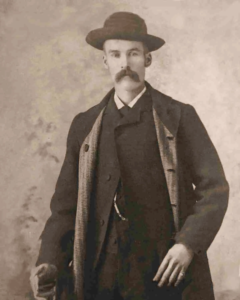
Of all the real-life gunslingers of the American West, Doc Holliday may have been the scariest.
Unlike most of the men who were foolish enough to point a loaded weapon in his direction, he wasn’t afraid of dying.
That’s because he had already received a death sentence. He knew he was dying of tuberculosis.
There’s not much scarier than squaring off with someone who, quite frankly, doesn’t care if he lives or dies, and who therefore isn’t likely to flinch in the midst of a gunfight.
John Henry Holliday was born in Georgia in 1851. He grew up with Southern manners and a Southern sense of honor during the years leading up to the Civil War. The Confederacy’s humiliation left him with an enduring chip on his shoulder.
After training to become a dental surgeon, he opened his own practice at age 21. Just a year later, however, he received the crushing news that he was afflicted with TB, the same disease (incurable at the time) that had previously stolen the lives of his mother and sister.
Visiting one’s dentist in the 1870s, well before the arrival of Novocain, was frightening enough. Having a dentist draw close, only to break into spasms of coughing, was hardly calculated to build a loyal client base.
The man who was now “Doc” Holliday realized he could never earn a living pulling teeth. Having heard that drier air might soothe his lungs, he headed west. Within a matter of months he had settled into a life of gambling and saloon-hopping – easily offended, quick on the trigger, and weighing barely more than 130 pounds.
Historians disagree on the number of men who ended up on the wrong end of Holliday’s guns. There were at least three and as many as a dozen.
What no one disputes is that Holliday made one lifelong friend – the sometime lawman Wyatt Earp, who credited Doc with saving his life in a Texas gunfight. The two later stood side by side during the infamous shootout at the OK Corral.
Nor is there any dispute that the most memorable cinematic portrayal of Doc Holliday is that of the late Val Kilmer in the movie Tombstone. “I’ll be your huckleberry” (that is, “I’m your man”) has since become an iconic Hollywood catchphrase.
Holliday never lost a gunfight. But he did lose his fight against tuberculosis, succumbing to the disease at the age of 36.
The meaning of his life was defined by the fact that his life would soon be coming to an end.
Something similar unfolds in Band of Brothers, the docuseries concerning the American soldiers who parachuted into Normandy in June 1945, then fought their way across Europe to defeat Hitler’s Germany.
One of the soldiers, Private Blithe, is overcome by fear of combat. He hides in a ditch instead of fighting alongside his comrades. Deeply ashamed, he admits his cowardice to Lieutenant Speirs.
Speirs asks, “You know why you hid in that ditch, Blithe?” The private answers, “I was scared.” Speirs replies, “We were all scared. You hid in that ditch because you think there’s still hope. But Blithe, the only hope you have is to accept the fact that you’re already dead.”
As author and pastor John Ortberg observes in his book Steps, as long as Blithe’s ultimate priority was self-preservation, he was doubly disabled – useless to his fellow soldiers and personally paralyzed by self-loathing. “But when he accepted the fact that he was already dead, he had something higher and nobler to live for than mere survival.”
Perhaps you’ve heard the old Sunday school story where the teacher asks the class, “What do you have to do to go to heaven? Do you have to go to church?”
“No!” everyone replies. “Do you have to give enough money?” Once again, “No!” “Do you have to be really, really nice?” “No!” says everyone. “Then what do you have to do to go to heaven?”
One of the kids finally says, “You gotta die first!”
You gotta die first. Ortberg notes, “The only way into spiritual life is to surrender – to die to our ego, our self-will, and our demand to have our own way and have the world revolve around ourselves. The only hope we have is to accept the fact that we’re already dead.”
Or as Jesus puts it, “For whoever wants to save their life will lose it, but whoever loses their life for me will find it” (Matthew 16:25).
The meaning of life is that it comes to an end. And it come to an end on God’s schedule, not ours.
But there is a hope that supersedes all our deepest fears. Even though none of us will get out of this world alive, life doesn’t end in a cemetery.
That’s because Jesus promises the miracle of life after life.
And those who make Him their ultimate security – whether frontier dentists, soldiers, cooks, accountants, plumbers, engineers, or preschool teachers – can live boldly every hour of every day.