
To listen to today’s reflection as a podcast, click here
The greatest health crisis in human history is shrouded in mystery.
Even after more than 100 years, scientists still struggle to answer important questions about the Flu Pandemic of 1918. It may seem frustrating to us that so many questions about the COVID-19 pandemic that swept the world just six years ago also remain unresolved. But final answers regarding both disasters have been tough to find.
What was the Flu Pandemic’s point of origin? No one knows for sure.
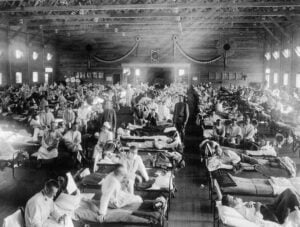
Although at the time the illness was given the exotic name Spanish Flu, historians note that the first outbreak seems to have happened on a military base in Kansas.
Influenza strikes most parts of the world every year. The majority of those afflicted suffer fever, body aches, and congestion. After feeling lousy for a few days, most of us recover.
The 1918 strain of flu was different. It killed huge numbers of people within a few days. Why was this strain so virulent? Nobody knows.
Flu typically cuts a swath through the very young and very old. The pandemic, however, cruelly targeted a third demographic: young adults in the prime of life. Why did that happen? That question also remains shrouded in mystery.
World War I was just coming to an end in the fall of 1918. Humanity was staggering under the unimaginable loss of something like 10 million combatants and another 7 million civilians.
But that was just the beginning of the suffering. Within six months, the Spanish Flu had taken the lives of at least 50 million people around the world, from the tropics to the Arctic. Some historians believe the total approached 100 million. The death toll in the U.S. exceeded 675,000, more than all the losses sustained during the four years of the Civil War.
Philadelphia was particularly hard-hit.
During the last weekend of September 1918, a military band marched down the streets of the City of Brotherly Love in an effort to raise money for war bonds. A number of the troops were unknowingly incubating the disease. In his book Influenza: The Hundred-Year Hunt to Cure the Deadliest Disease in History, Dr. Jeremy Brown describes it as “a marching band of influenza.”
Within 48 hours, Philadelphia had lost 100 residents. The next day 200 more were gone. The day after that there were 300 new corpses in the overflowing morgue. Panic spread. Local woodworkers spent most of the fall making coffins.
The 1918 strain, without warning, vanished almost as quickly as it appeared. That’s yet another of the mysteries.
After a century of research, is there a foolproof immunization? Not yet, although a flu shot may protect against 50% of this year’s strains. If you get the flu, is there a cure? So far all we can do is alleviate the symptoms. But the search continues for a Magic Bullet.
Dr. Brown pauses in his account of the 1918 Pandemic to tell the story of some true heroes.
One hundred years ago, the world’s top docs still didn’t know what caused the flu, or how they should treat it. At one point, 30 million people in Japan had been afflicted. A Japanese professor named T. Yamanouchi recruited 52 exceedingly brave doctors and nurses to become human guinea pigs.
Scientists wanted to know if the flu was caused by bacteria or by something else. Yamanouchi took infected goop from flu victims and placed it into the noses of the volunteers. About half of them got it “as is.” The goop given to the other volunteers was first run through a filter that would strain out any bacteria.
The results? All 52 of the Japanese volunteers got the Spanish Flu. The experiment confirmed that influenza is caused by a virus – a strange, primitive entity (little more than a microscopic box of chemicals) that is far smaller than any known bacteria.
That information immediately advanced the global medical community’s efforts to provide the best possible treatment for flu victims.
In the midst of all the mysteries surrounding the pandemic, this one stands out:
Why would 52 perfectly healthy people risk their own lives to be part of a medical experiment? Why would those nurses and doctors subject themselves to the worst plague in human history just to improve the odds for total strangers on the other side of the planet?
We may not be able to predict the behavior of viruses. But history has demonstrated that human beings are predictably hardwired to care.
If Darwinism is true, we would expect people to do everything they can to protect their own interests and those of their immediate family.
Why, then, would someone donate a kidney to a stranger? Why would a nurse in Japan choose to risk the ultimate sacrifice?
Followers of Jesus call it common grace.
There’s something about being created in the image of God that prompts us to live out one of Jesus’ most dramatic statements: “No one has greater love than this, that he lay down his life for his friends” (John 15:13).
Children’s TV producer Fred Rogers remembers what his mother always told him in the midst of a tragedy: “Look for those who are helping.”
By God’s grace, no matter what is happening in the world, our call is to join the helpers.
There’s never been a mystery about that.