
To listen to today’s reflection as a podcast, click here
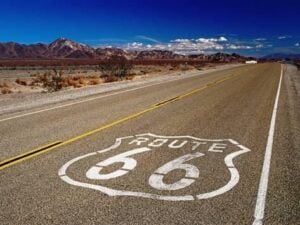
If there’s such a thing as the most famous highway in America, it would have to be the late great Route 66.
Paved roads were just beginning to show up 100 years ago. They accommodated the automobile explosion that happened just after World War I.
Seemingly out of the blue, Americans needed a national highway system. Newly created government agencies helped ensure consistent quality from coast to coast. They also made the tough calls on two key questions:
What cities would be connected by the new US highways? And what should they be called?
The first question became a matter of life and death for towns of every size. A paved road meant a steady stream of customers for stores, restaurants, and gas stations. If the highway bypassed your community, someone else would grow rich while you descended into poverty.
The second question turned out to be surprisingly emotional.
America’s first major roads had delightful, evocative names: the Lincoln Highway, the Midland Trail, and the Dixie Highway, among others. Officials decided that numbers would be more efficient and easier to remember.
They proposed a numerical “lattice” of east-west and north-south roads. The former would be even-numbered, and the most important would end in “0.” The latter would be odd-numbered, and the key roads would end in “5.” This system, which went into effect in the 1920s, was replicated by the interstates that were built in the 1950s and 60s. The difference between the US highways and their interstate successors is that the road numbers go from highest to lowest in different directions.
To paraphrase Forrest Gump, that’s probably all we need to say about that.
The interesting point is the competition that took place for the “best” US highway numbers.
Where, for example, would US 50 and US 60 go?
William J. Fields, governor of Kentucky, was absolutely sure his state would get one of them. Maybe both. He was apoplectic when he learned that he would get neither. US 50 missed Kentucky to the south. And US 60, according to Fields, was “stolen” by Chicago.
During the Roaring Twenties, the Windy City had a reputation for corruption (Al Capone comes to mind). Even though US 60 was supposed to go from the Atlantic to the Pacific, Chicago leaders talked the highway commission into charting it from their city to Los Angeles. It would meander on a southwesterly curve through St. Louis, Tulsa, Albuquerque, and then LA.
Governor Fields exploded. He demanded that Kentucky receive some love. Washington relented. The map was redrawn, and US 60 went across the Bluegrass State.
What would happen to “Chicago’s” highway? Would they like to call it US 62? No, they said. But they loved the sound of Route 66.
Thus was commissioned, in November 1926, the highway that became known as the Main Street of America. In chapter 12 of The Grapes of Wrath, John Steinbeck immortalized it as The Mother Road – the path taken by impoverished farm families fleeing the Dust Bowl of the 1930s as they headed for the Promised Land of California.
In this context, “mother road” did not connote something maternal, but the main road, the chief pathway among many.
Baby Boomers grew up watching a weekly half-hour drama called Route 66 in which two cool single guys in a Corvette convertible traveled its 2,448 miles seeking adventure and clues to the meaning of life. Despite the show’s title, most of the episodes were filmed far from the actual highway – including shrimp boats, an offshore oil rig, and visits to Canada and Mexico.
What mattered is that “Route 66” signified hope and freedom. It was the open road – the way of escape from a faltering and unsatisfying version of life to the possibility of something new.
The romance lasted 50 years. But Route 66’s two-lane blacktop was no match for the new and improved interstates.
It was officially decommissioned in 1985. The old highway markers came down.
Nostalgia, however, is a powerful thing. Driven by public interest, snippets of the original road – a few miles here, a few miles there – have gradually come back into service. What’s interesting is that many of these vintage stretches don’t appear on Google maps.
But they’re there if you know where to look. And if your heart is set on traveling the old path.
The Bible speaks of the Way of the Lord, the original “old path.” John the Baptist was convinced he was preparing the way for the Messiah. The book of Proverbs claims “there is a way that seems right,” but it ends in death (14:12). Parents are called to “train a child in the way he should go” (22:6).
The writers of the Psalms take it for granted that human beings must choose their way through life. Some paths are wise. Others are disastrous.
We must ask God to “make our way straight” (Psalm 5:8), make sure we have been taught “the way we should go” (Psalm 32:8), “commit our way to the Lord” (Psalm 37:5), and “keep our way pure” (Psalm 119:9).
Let’s be honest. Such phrases sound quaint and irrelevant to modern ears.
But are the “new and improved” paths of our culture taking us where we want to go?
The more we peruse the pages of Scripture, the more we hunger to walk in the way of the Lord. That path can seem hidden. Except for those who know where to look.
We’re just two weeks from the 100th anniversary of the opening of Route 66.
May that time remind us that the true Mother Road – the principal route, chief among all others – is the old path of trust and hope that unfailingly takes us to the heart of God.