
To listen to today’s reflection as a podcast, click here
Seattle is famous for its Space Needle, the Pike Place Fish Market, and the spectacular backdrop of Mt. Rainier.
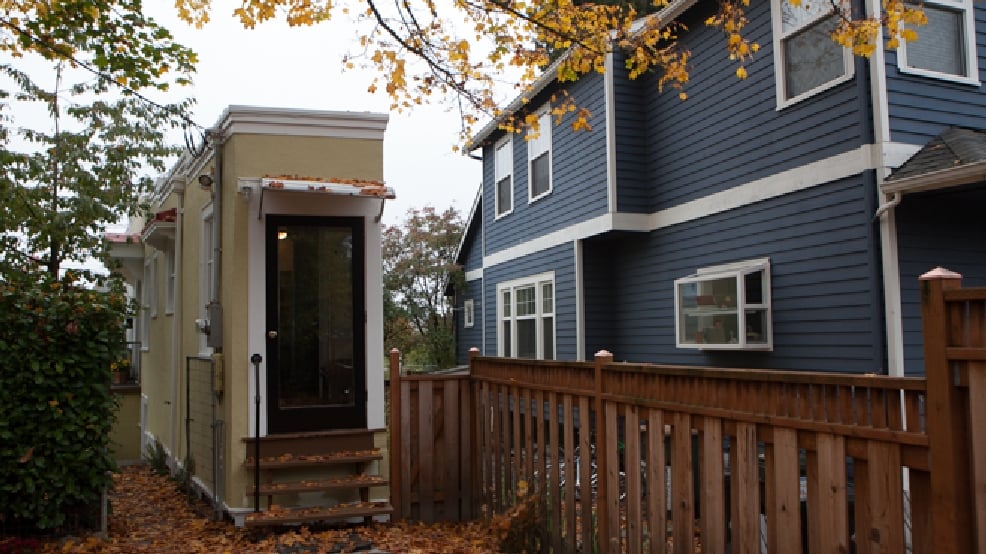
One of the city’s lesser-known attractions, which has long delighted residents, is the Montlake Spite House.
The story behind this sliver of a dwelling, not much wider than its own front door, has become clouded by legend.
But its history seems rooted in a real-life divorce battle between a local judge and his estranged wife. The judge prevailed in the settlement and received the lion’s share of their property. His ex had to be content with a tiny, pie-shaped strip of grass.
That’s when she exacted some architectural revenge.
She built a spite house.
As you can see above, it effectively blocks the view from an entire side of the judge’s house. But of course, that was the point. Why be mad unless you can display your fury to the whole world every time they drive by?
It’s estimated there are 20 spite houses in various corners of the United States. They have two things in common.
First, they are strange. They often have bizarre proportions in order to accommodate non-traditional pieces of real estate. One spite house is so narrow that its owner has to step aside just to open the oven door.
Second, they are intentionally provocative. Or even vindictive. Those who build spite houses want to make a point. Therefore they often ruin the view or block the sunlight coming into a neighbor’s house or go out of their way to create an annoying obstacle.
There are even more spite fences.
Two decades ago, a farmer in Hooper, Utah – enraged at his neighbor’s criticism of the condition of his property – stood up three old cars along their shared boundary. He calls it Redneck Stonehenge.
Then there’s that strange place in rural Saskatchewan where two ranchers, more than a quarter century ago, had a standoff concerning boundaries. Their cattle kept wandering onto each other’s property. It was clear they needed to build a new fence. It was also clear it wouldn’t be cheap.
The first rancher proposed they share the costs. The second rancher balked. The first rancher, angry at his neighbor’s obstinacy, went ahead and built the fence at his own expense.
“Well, I see we have our fence,” said the second rancher after it was completed. “What do you mean our?” said the first rancher. “I built the fence three feet into my property. If any of your animals ever cross into that three-foot zone, up alongside my fence, I will shoot them.” The second rancher was forced to build a miles-long second fence, parallel to the first.
Today, if you visit that part of Saskatchewan, you can still see a mind-boggling memorial to the fact that two neighbors couldn’t find a way to work out their disagreements.
Spite houses and spite fences are all about getting even. Returning pain for pain.
But the problem with building a spite house or putting up a spite fence is that you end up having to live inside it.
Anne Lamott memorably wrote that refusing to forgive is like drinking rat poison and then waiting for the rat to die. You, of course, get to play the part of the rat.
The apostle Paul wrote something memorable, as well: “Bear with each other and forgive one another if any of you has a grievance against someone. Forgive as the Lord forgave you” (Colossians 3:13).
Do you live in a spite house? Or are you blessed to live in a grace house?
The view is so much more uplifting from the latter.