
To listen to today’s reflection as a podcast, click here
No one was prepared for the earthquake that struck the Tohoku region of Japan on the afternoon of March 11, 2011.
Geologists are still coming to grips with its immensity and its consequences.
Since Japan sits at the intersection of multiple tectonic plates, its citizens have come to expect occasional major shakes and volcanic eruptions. But the Tohoku event was extreme. The magnitude 9.1 earthquake, which rocked the country for six minutes, actually shifted Honshu, the largest of Japan’s four main islands, seven feet closer to North America. The coastline sank almost two feet.
The undersea megathrust of the plates was so violent that it slightly increased the speed of the earth’s rotation.
Most significant of all, the quake triggered multiple tsunamis, including a wall of water taller than a 13-story building that rushed toward the shore in excess of 400 miles per hour, crashing over the seawalls that had been specifically constructed to protect coastline villages.
More than 120,000 buildings were splintered. According to the official governmental tally, 19,759 lives were lost. An additional 2,553 people have never been found. Fifteen years later, Japanese boats, articles of furniture, and countless personal items are still washing up on the world’s beaches.
With losses estimated at $235 billion, the quake is far and away the most expensive natural disaster in human history.
In the midst of the mayhem, attention quickly became fixed on the Fukushima Daiichi Nuclear Power Plant.
The earthquake and tsunami had damaged the facility’s diesel generators and cooling systems, leading to meltdowns in three of its reactors and the release of 10,000 tons of contaminated water into the Pacific Ocean.
In short order, the backup generators failed. By March 15, the plant had experienced a total blackout and a series of hydrogen explosions. The temperature of the nuclear fuel began to spike uncontrollably.
As one journalist put it, “In a matter of hours, a modern nuclear plant built on promises of safety was reduced to a dark, flooded maze of debris, seawater, and silence, where alarms still screamed but no system responded.”
But a group of workers did respond.
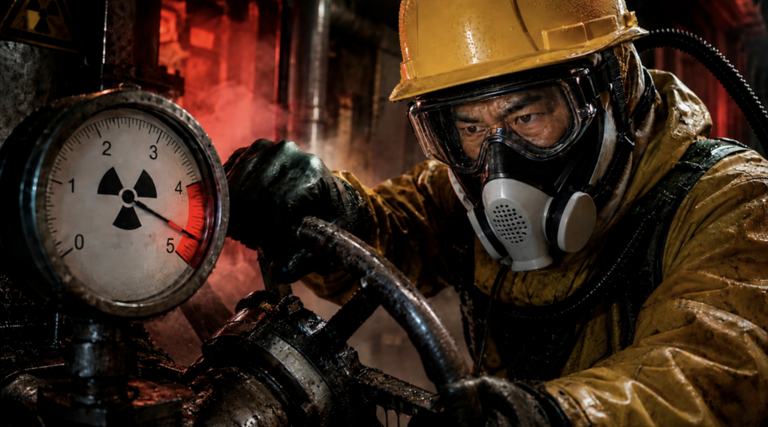
No one knows exactly how many technicians and engineers volunteered to remain inside the plant after the vast majority of the staff departed. The best guess is somewhere between 50 and 80. But after a journalist dubbed them The Fukushima 50, the name stuck.
The task before them was daunting. The 50 somehow needed to stabilize the entire facility and prevent a nuclear disaster from morphing into a nuclear catastrophe – one that would not only compromise Japan for generations to come but potentially spread radioactive contagion around the planet.
The work had to happen in almost complete darkness. The longer they stayed on site, the more they risked life-shortening or even fatal doses of radioactivity.
They were afraid. Who wouldn’t be?
But they were also driven by an impulse stronger than fear – an overwhelming sense of duty to stand in the gap for their community, their country, and the rest of the world.
Within a week, the 50 succeeded in containing the reactors. There is global acknowledgment that apart from their courage and diligence, the Fukushima Daiichi story would have had an immeasurably worse ending.
In a world that seems to casually bestow the word “heroes” on Marvel comic book characters, the 50 have been celebrated as real life heroes by people everywhere.
Except, that is, by the people of Japan.
Historically, Japan is a shame-based culture. To lose is to become a loser. To be associated in any way with a public failure (like a nuclear power plant meltdown) is to be tainted with that failure for the rest of one’s days.
Over the past decade and a half, a number of the 50 have reported shunning and hostility from neighbors. They have sometimes been refused service at businesses – a bias that attaches even to their families. As some continue to struggle with serious health issues and post-traumatic stress from those frightening days in the darkness, they hesitate to show themselves in public.
According to the authors of a recent post on the ScienceInsights website, “The Fukushima 50 remain a powerful contradiction in modern history: ordinary workers who faced an extraordinary catastrophe, prevented a far greater disaster, and then faded into one of the most complex and painful aftermaths of any industrial crisis.
“They did not fight a war in the traditional sense. But inside a collapsing nuclear plant, they stood between stability and global catastrophe, and chose to stay when almost everything else was falling apart.”
Here we begin to glimpse something of the incredible challenge facing Christianity’s earliest representatives.
In the shame-based culture of the ancient Near East and the Mediterranean world, they were promoting a loser – another of those wannabe Messiahs who ended up nailed to a Roman cross.
“Hanging from a tree,” according to the Jewish scriptures, was proof positive that the guy hanging there was cursed. People professing loyalty to an executed criminal should be ashamed of themselves. Who would ever want to join a crowd like that?
The Greek word “stigma,” which in Bible times referred to a mark or a brand signifying shame or discredit, has come into modern English almost entirely unchanged. And the medieval word “stigmata,” which refers to marks or pains that resemble the wounds of Jesus, still carries an echo of the shame of his death on a cross.
One of the genuinely amazing things about the Son of God is that he stared down shame, so to speak, and didn’t flinch. It reveals what can only be called God’s humility.
Hebrews 12:2 says that we should be “fixing our eyes on Jesus, the pioneer and perfecter of faith. For the joy set before him he endured the cross, scorning its shame, and sat down at the right hand of the throne of God.” Even his ultimate humiliation was transformed into glory.
That’s why Paul can say in Romans 10:11, “Anyone who believes in [Christ] will never be put to shame.”
What can we learn from the Fukushima 50?
Be courageous. Do what is right. Be willing, even like Jesus and those extraordinary workers, to risk your wellbeing for the greater good.
Others may not understand. Some may even turn away.
But enduring that kind of shame for the sake of loving others is nothing to be ashamed of.