
To listen to today’s reflection as a podcast, click here
Each day this month of August we’ll be looking at one of the extraordinary metaphors that the Bible uses to illustrate the nature of our relationship with God.
“You are the salt of the earth” (Matthew 5:13).
The Jesus-following life doesn’t begin with a long list of “you must’s.” It starts with the words “you are.”
This is a big deal. People are typically prepared to hear a track coach or a military general or a chemistry teacher or a Bible-waving preacher set out the territory that has to be conquered. “Here’s what you’re going to have to do, and it’s not going to be easy.” We are used to being challenged to become what we should be.
But Jesus comes at things from the other direction. Before he tells us what we must do, he tells us who we are. Rather than urging us to become what we ought to be, he simply states we should be what we already are.
According to the Sermon on the Mount, if you’ve thrown in your lot with Christ, you are exactly what the world needs.
But since modern Americans have become anxious about their sodium intake, is it really a happy thing to be identified as salt? It is indeed.
Here we should pause and note that our month-long exploration of biblical metaphors is happening in ascending order of intimacy. In these first few days, in other words, we’re spotlighting word pictures in which we are little more than inert objects. We are rocks. We’re lumps of clay. And today we’re the crystalline combination of sodium and chlorine atoms – two deadly poisons that become something special when they hold hands.
When Jesus’ original listeners heard him say they were the salt of the earth, as many as five things might have come to mind.
First, salt was a symbol of purity. The salt crystals that we shake onto our brussels sprouts are almost totally unmingled with other compounds. Salt was valuable enough in the ancient world to be used as a form of payment. To this day someone might say, “He’s worth his salt.” The word “salary” (from the Latin word salarium, which literally means “salt money”) is directly related to those little crystals.
Second, Jesus’ mention of salt connoted flavoring. Salt provided miraculous seasoning in a nearly spice-free diet. It’s hard to imagine anything tasting better than ripe watermelon. But I remember watching my grandmother shake some salt on her melon. And she was right. Salt makes almost everything taste better.
We are meant to be the spice that flavors society; that takes the edge off the world in which we live; that brings joy and pleasure and a heightened sense of taste wherever we go.
Third, salt was the finest preservative known in the ancient world. Salt, and little else, kept good food from going bad. In the pre-refrigeration era, salt was just about the only way to allow fish and meat to remain safe to eat.
Fourth, salt was known to advance healing. Most of us have experienced that momentary sting, but then the soothing comfort, of plunging a skin wound into a saline solution like the Atlantic Ocean.
Finally, salt cleanses. Those of us who live in a part of the world where streets are routinely salted during the winter months are aware of sodium chloride’s ability to help melt snow and ice – and to leave behind a “death zone” where weeds and grass will struggle to grow next spring.
Being in Jesus’ presence on a regular basis has the effect of checking some of the malignant behavior in those around us.
Purity, flavoring, preserving,healing, and cleansing. That’s what it means to be the salt of the earth.
A lot has happened in the realms of medical and scientific research over the past 20 centuries. We now also know that salt (in the right amounts) is essential for maintaining blood pressure. Iodized salt helps prevent iodine deficiency. It is crucial in the production of baking soda, soaps, glazes, and porcelain enamel. Sodium chloride solutions are irreplaceable as hospital IV drips. And those of us who live with hard water are grateful that the salt in our water softeners has the magical power to remove unwanted calcium and magnesium.
In both ancient and modern times, it’s good to be the salt of the earth.
The problem, of course, is that we’re not much good to the earth if we spend most of our hours inside a salt container – even a beautiful one, like a church sanctuary or a cozy study in one’s home where you can hole up with a stack of great books.
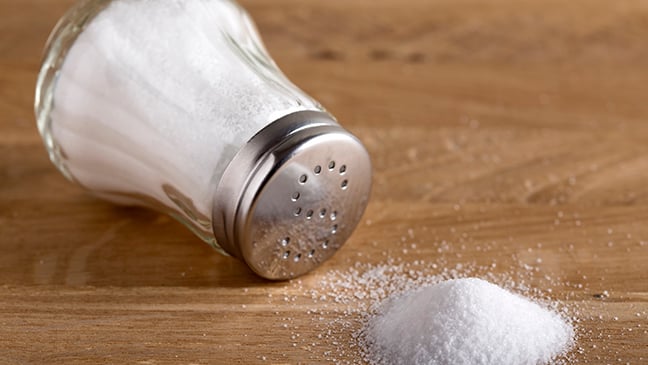
Our grandparents called their little bottles of seasoning salt cellars. We must get out of the cellar and into a salt-shaker – into any ministry or relationship that challenges us to do what we’ve been called to do.
Because of who we are, our call is to be a healing, cleansing, preserving, and flavoring presence wherever we go.
It’s just possible that Jesus would have been the first person to say, “Please pass the salt!”