
To listen to today’s reflection as a podcast, click here
Each day this month of August we’ll be looking at one of the extraordinary metaphors that the Bible uses to illustrate the nature of our relationship with God.
“Jerusalem, Jerusalem, you who kill the prophets and stone those sent to you, how often I have longed to gather your children together, as a hen gathers her chicks under her wings, and you were not willing” (Luke 13:34).
Why did the chicken cross the road?
There are so many more possibilities than just getting to the other side.
- “I envision a world where all chickens will be free to cross roads without having their motives called into question.” (Martin Luther King, Jr.)
- “To boldly go where no chicken has gone before.” (Captain James T. Kirk)
- “In my day, we didn’t ask why the chicken crossed the road. Someone told us it happened, and that was good enough for us.” (Grandpa)
- “To die. In the rain. Alone.” (Ernest Hemingway)
- “Did the chicken really cross the road, or did the road move beneath the chicken?” (Albert Einstein)
- “Isn’t that interesting? In a few moments, we will be listening to the chicken tell, for the first time, the heartwarming story of how it experienced a serious case of molting, yet went on to accomplish its lifelong dream of crossing the road.” (Barbara Walters)
- “Never send to know why the chicken crosses the road. It crosses for thee.” (John Donne)
- “That is not the question.” (Hamlet)
- “Well, I certainly understand that the chicken is having problems, which is why he wants to cross the road so badly. Therefore, I’m going to give this chicken a new car so he can just drive across the road from now on!” (Oprah Winfrey)
- “I invented the chicken.” (Al Gore)
Who said there can’t be new answers to an old riddle?
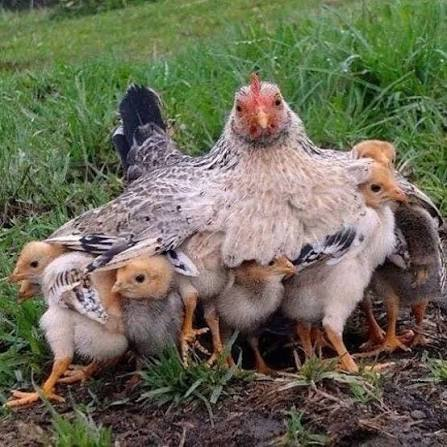
Then again, we can always start with an entirely new question: Why do chicks run and hide under their mother’s wings?
It turns out that sheltering little ones is an aspect of parenting in numerous species of birds.
A parent’s wings protect from rain. And bright sun. And wind. And predators. Wings provide warmth. And a secure place. And the much-needed gift of time – the time that fledglings need to grow and mature before they head out into the wide, wide world.
Barnyard cats and dogs may close in on helpless chicks, only to see them dive under a hen’s wings. When thinking of humans, we tend to associate “mother hens” with doting, over-protective parenting. But on the farm, few predators – even when they are bigger and stronger – relish the thought of taking on a seriously motivated hen committed to defending her young,
The psalmists frequently attribute such parental commitment to God.
According to Psalms 17, 36, 57, and 63, our safe place is “under the shadow of God’s wings.” The most memorable declaration is Psalm 91:4: “He will cover you with his feathers, and under his wings you will find refuge.”
As Jesus approaches Jerusalem for the last time – knowing he is headed for trial, torture, cross, and grave – he is overcome by emotion.
Thinking about God’s reckless, faithless people, he groans, “There have been so many times I’ve wanted to gather you together, the way a mother hen shelters her chicks, but you wouldn’t have it!”
In our present cultural moment, in which we are preoccupied with recovering America’s “manosphere” and appropriate testosterone levels, it’s hard to imagine a male leader presenting himself as a mother hen. But that is exactly what Jesus does.
Make no mistake: Even though Jesus declares this extraordinary metaphor of God’s compassion, his words are also a strong rebuke. There is a tension between God’s love and human free will. God’s people were not willing to receive God’s care, and they will suffer because of it.
Even Jesus’ closest friends were not yet able to grasp the ends to which he was willing to go to make good on God’s promises of security.
He, as God’s own Son, is about to give up his own life so they might live.
Chickens can only fly short distances. There’s no easy escape from disasters such as a barnyard fire or a violent storm. But a hen will do what she can.
Farmers occasionally report, in the smoldering ruins of an incinerated barn, the discovery of the charred body of a lifeless hen – only to see living chicks scurry out from beneath her wings, having been protected from the flames.
In Psalm 91 we learn that God is the refuge we can always trust. In the story of Jesus, we learn what that promise looks like in the real world.
When Jesus says he will cover us with his feathers, it means he is willing to die for us.
And our call? We are to run to him for shelter and place ourselves under his sacrificial work on the cross.
We will never find a safer place to live.