
To listen to today’s reflection as a podcast, click here
Each day this month of August we’ll be looking at one of the extraordinary metaphors that the Bible uses to illustrate the nature of our relationship with God.
“I am the good shepherd. The good shepherd lays down his life for the sheep… I know my sheep and my sheep know me” (John 10:11, 14).
A Gorlok sounds like a creature from a horror movie.
In truth, it’s the nickname of the athletic teams of Webster University in St. Louis, dreamed up by a campus committee about 40 years ago.
According to the school website, a Gorlok has “the paws of a speeding cheetah, the horns of a fierce buffalo and the face of a dependable Saint Bernard. The myth of the Gorlok ‘embodies the highest standards of speed, agility and stamina in an atmosphere of fairness and good conduct.’”
And the name? It’s derived from Gore and Lockwood Avenues, a pair of campus streets that intersect in beautiful downtown Webster.
The Gorloks are among several dozen innovative collegiate nicknames – some of which are meant to sound intimidating, while others simply defy categorization. With the approach of a new college football season this month, here are some of the competitors we might see on the gridiron:
- The University of Arkansas-Monticello Boll Weevils
- The Cal State-Fullerton Dirtbags (which memorializes the fact their baseball team originally played on a 100% dirt field)
- The University of South Carolina-Sumter Fire Ants (just typing those words generates anxiety)
- The Delta State University Fighting Okra
- The Arkansas Tech Wonder Boys (a name that celebrates a football victory 106 years ago)
- The University of North Carolina School of the Arts Fighting Pickles (who seem destined to meet the Fighting Okra in the Veggie Bowl)
- The University of California at Santa Cruz Banana Slugs
- The Presbyterian College Blue Hose (my denomination may not win many games, but we sure have colorful socks)
Most universities and professional sports franchises gravitate to tough-sounding nicknames.
That’s why this fall the Wolverines, Badgers, Jaguars, Tigers, Panthers, Cougars, Bears, and Lions will all take the field. Not to mention angry birds like the Eagles, Falcons, Ravens, Skyhawks, and Seahawks. And don’t forget the teams that sound like seriously tough people: Vikings, Giants, Buccaneers, and Fighting Irish.
Salisbury University features the Sea Gulls. Years ago they called themselves the Salisbury Steaks, and their head cheerleader dressed like a bottle of A1 Sauce. I am not making this up.
Every year, only one team can win a national championship or a Super Bowl. But every team can have fans cheering like crazy for a great nickname.
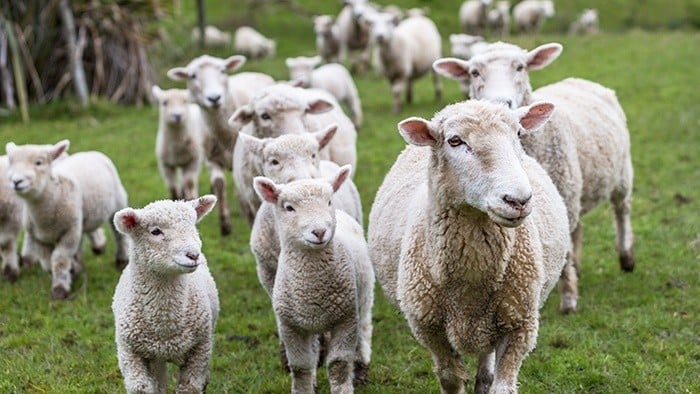
There’s one animal, however, that won’t be featured in stadiums this fall. No sports team – college or pro – has ever tried to intimidate its foes by calling themselves the Sheep.
There’s a caveat here, of course. Mature male sheep are known as Rams – a name beloved by the fans of Colorado State University and the NFL’s Los Angeles Rams, who are currently the odds-on favorites to hoist another Super Bowl trophy next February.
“Sheep” is a term typically bestowed on both young males and adult females (also known as ewes). From Psalm 23 (“The Lord is my shepherd”) to Isaiah 53:6 (“All we like sheep have gone astray”) to Exodus 34:30 (“You are my flock, the sheep of my pasture”), the Bible celebrates the metaphor of God tenderly watching over his human flock.
And that’s a good thing, for sheepish human beings need a great deal of watching over.
Sheep, to put it bluntly, are not particularly bright. They’re skittish. They play Follow the Leader, even when the leader is leading the flock over a cliff. Biblically, to be a sheep is to be in trouble or very close to trouble all the time – an all-too-accurate representation of human behavior.
Sheep have no claws, no threatening teeth, no wings, no breakaway speed, and no attitude. In short, they are fundamentally defenseless. That’s why it ought to get our attention when Jesus tells his followers, “I am sending you out like sheep among wolves” (Matthew 10:16).
Not many wolves are going to lose sleep over that.
Recently some high-profile individuals in our country have proclaimed that it’s time for Christians to stop acting like sheep. It’s time to fight. Or at least fight back. The last thing we should put up with is being steamrolled in the culture wars.
The primary difficulty with these ideas is that they’re nowhere to be found in the teaching of Jesus.
Biblically speaking, a sheep’s list of Things to Do Today never includes frontal assaults, sneak attacks, tossing insults, or airing grievances. Instead, every sheep’s job assignment is straightforward: stay near the shepherd, listen to the shepherd, go where the shepherd goes.
Sheep are not heroic animals. Jesus appears to be saying that for God’s reign to come to earth, it will take a different kind of hero – sheep that devote their lives to hearing and responding to the voice of the Good Shepherd.
Maybe that’s why, in order to show us what that might look like, Jesus identified himself as the Lamb of God.
It’s certainly a possibility that the Gorloks, Dirtbags, or Flying Pickles will inherit a championship at some point in the future.
But it’s a certainty that God’s faithful sheep will one day inherit the earth.