
To listen to today’s reflection as a podcast, click here
Each day this month of August we’ll be looking at one of the extraordinary metaphors that the Bible uses to illustrate the nature of our relationship with God.
It’s been a summer of devastating earthquakes.
On June 26, a pair of monstrous quakes rocked Venezuela, claiming more than 6,300 lives. Earlier this week, a magnitude 7.4 tremor shattered impoverished communities just west of Bogota. Thousands of Colombians are believed to be buried in the rubble.
These are profound tragedies in a part of the world where restoration and rebuilding will take a very long time.
For decades, Americans have been advised that the so-called Big One is overdue on our west coast. If there’s a break in the Cascadia subduction zone, cities like Seattle may be devasted by tsunamis. If there’s major horizontal earth movement along the San Andreas Fault, Californians from Los Angeles to San Francisco will be in for some serious shaking.
It’s fair to wonder what might happen to one of our country’s most iconic symbols.
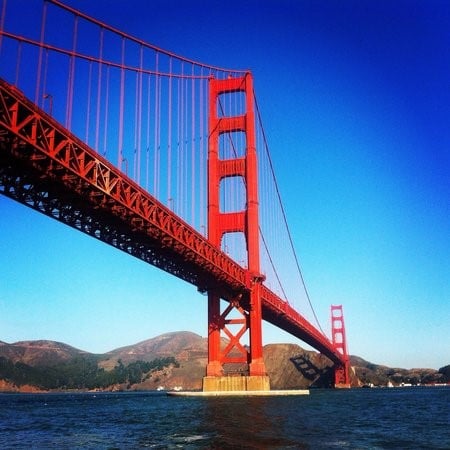
The Golden Gate Bridge, over seven stories tall and almost two miles long, is arguably the most beautiful span in the world. It’s certainly the most photographed. One of its charms is that it almost appears to be fragile.
It’s anything but.
Even though the famous red-orange bridge lies just seven miles from the San Andreas – one of the world’s most unstable intersections of tectonic plates – engineers are convinced that it may turn out to be one of the safest places to be the next time a quake rocks San Francisco.
That’s because its two gigantic support towers, or piers, are anchored on the bedrock underlying the bay.
During the 1930s, when engineers began to seriously contemplate building what would then become the world’s largest suspension bridge, they recognized the challenge of finding solid foundations. The Golden Gate strait is a place of tumultuous tides, powerful winds, and occasional blankets of fog.
Construction of the south pier, in particular, proved to be daunting.
It was located 1,100 feet from shore, and divers had to descend over 100 feet into dark, freezing waters to reach the serpentine rock below. Since portable air tanks for divers had not yet been invented, the workers survived by breathing air continuously flowing through a hose connected to the surface. These were harrowing conditions.
Dynamite was used to prepare the submerged rock. Debris had to be cleared away in the darkness. Would the resulting area be strong enough to hold the immense weight of the bridge?
A geologist named Andrew C. Lawson devised a test. He placed a weight equivalent to a fully loaded railroad boxcar on an area of undersea rock only 20 inches square. The bedrock held. The bridge was open to great fanfare in 1937.
Engineers have recently installed “shock absorbers” that will help the span survive even a magnitude 8.0 quake. Nevertheless, the Golden Gate has been exceptionally secure from Day One. That’s because every aspect of the bridge – its span, its cables, every nut, and every bolt – is ultimately preoccupied with the bedrock.
Whatever is built on the rock is built to last.
Which happens to be the very thing Jesus says in the Sermon on the Mount.
“Therefore everyone who hears these words of mine and puts them into practice is like a wise man who built his house on the rock” (Matthew 7:24). Jesus asserts that living one’s life is like building a house. All of us are in the construction business. The only question is whether we choose lasting foundations.
If our lives are jolted this week by the equivalent of horizontal earth movement, will they stand?
The metaphor of God and God’s ways providing secure bedrock is found throughout the Old Testament. Psalm 18:2 is typical: “The Lord is my rock, my fortress and my deliverer; my God is my rock, in whom I take refuge, my shield and the horn of my salvation, my stronghold.”
In the Judean wilderness, a rock meant stability, safety, and security. When David was fleeing his enemies, he concealed himself within rocky terrain.
One of the understated advantages of finding a massive rock in the wilderness is deriving protection from the blazing sun. In Isaiah 32:2, God is described as being “like the shadow of a great rock in a weary land.” To draw close to the Lord is have it made in the shade.
It may seem strange to picture God geologically. Who in their right mind would associate tenderness and intimacy with a granite boulder?
But this is why there are at least three dozen metaphors of the divine-human relationship in Scripture. No single picture can tell the whole story.
To say, “the Lord is my rock,” is to affirm that our lives can be built on God’s unchanging character and promises. Like the bedrock underlying the Golden Gate strait, God can bear the weight of whatever we might be facing.
He is our safe refuge, our source of strength, and our unyielding foundation.
The ground beneath us may shake this summer, literally or figuratively.
But if we are anchored on the Rock, we shall not be moved.