
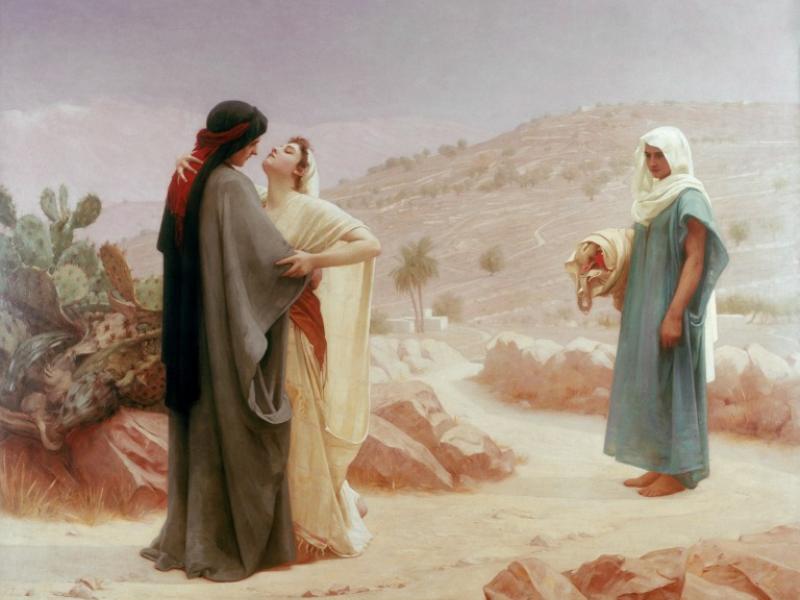
To listen to today’s reflection as a podcast, click here
Each day this month we’re looking closely at one of the 1:1 verses of the Bible – exploring what we can learn from chapter one / verse one of various Old and New Testament books.
“In the days when the judges ruled, there was a famine in the land. So a man from Bethlehem in Judah, together with his wife and two sons, went to live for a while in the country of Moab.”
Tucked away amongst the voluminous historical and prophetic narratives of the Old Testament, like a Mom and Pop grocery store on a street that is lined with skyscrapers, there is a surprisingly humble Bible story called the book of Ruth.
It has a surprising hero – a foreign-born woman whom no one expected to give a rip about the God of Israel, let alone God giving her so much as a second thought.
It has a surprising theme – ordinary people trying to find hope in the midst of the scariest kind of hopelessness.
And it has a surprising ending – Ruth, whom many saw as a nobody, becoming Ruth the great-grandmother of David, Israel’s greatest king, and thereby becoming a crucial link in the genealogy of Jesus himself.
Ruth is all about hope.
What stands out in this story is that hope appears almost out of the blue. As Bible scholar Robert A. Watson puts it, these four short chapters take us “from emptiness to fullness; from aimlessness to direction; from hopelessness to purpose; from impossible to already done; and from loneliness to love.”
The first sentence in the first chapter sets the scene. And it’s a difficult one.
When famine strikes Israel, a man from Bethlehem in Judah (whose name is Elimelech), together with his wife (Naomi) and two sons, go to live for a while in the country of Moab. By moving to Moab, Elimelech has made a disastrous mistake. This would be like an Amish family experiencing some bad harvests and choosing to move to Las Vegas to seek a better life.
Moab had a reputation for corruption and immorality, and God had specifically warned his people not to put down stakes there. The two sons then go a step farther and marry Moabite women, something expressly forbidden by Jewish law.
By the time we reach verse five, all three men have died. The family line of Elimelech is teetering on annihilation.
Real families have real problems. In the Bible, as in real life, we learn that families should not be idealized. David Frost once interviewed Billy Graham’s wife Ruth. He pressed her: “In all these years, haven’t you had problems? Have you never once contemplated divorce?” “Not once,” she shot back. “Murder, yes, but not divorce.”
Naomi’s family and consequently her very life have been shattered.
Her widowhood falls into the most precarious category. She is an old widow who has no sons. In the ancient world, women depended on male guardians for protection and financial security. Now she has no husband. Her sons were her retirement package – her 401(k). But that safety net has also been taken away.
Employment wasn’t an option for mature women. Thus she is facing the likelihood of a future in which no one will be there to take care of her. She is the ancient world’s version of a bag lady.
She feels hopeless and uncertain. What’s going to happen next? How will these three widows eat? No one is going to sponsor a brainstorming session in which creative new solutions will be proposed. Naomi and her daughters-in-law have entered a spiritual and relational wilderness.
Here we need to pause and acknowledge an uncomfortable truth. A great deal of the teaching that is heard in contemporary churches turns out to be what we might call “Wilderness Avoidance Theology.”
Its core message is that if you’re faithful to God, God will be faithful to you. He’ll protect you from disaster, disease, and depression – not to mention unemployment, bankruptcy, and humiliation. If you end up in dire straits, like Naomi, you really only have yourself to blame.
But it just isn’t so.
All it takes to refute the Gospel of Prosperity is to glance at the life of Jesus. If God’s own Son was led into literal and metaphorical wildernesses, why – in the light of his assurance that his followers will always be called to follow in his footsteps – should we think ourselves exempt?
When St. Teresa of Avila (1515-1582) was thrown from a cart into a creek, she came up out of the water and exclaimed, “Lord, if this is how you treat your friends, no wonder you have so few!”
The Bible doesn’t teach Wilderness Avoidance Theology.
It offers something infinitely better: the assurance that there is always hope in the wilderness. Even if we are the ones who have stranded ourselves in spiritual cul-de-sacs, God is at work. And few of us can predict what he’s going to do next.
Naomi certainly couldn’t.
Things begin to turn when she decides to trudge, broken and defeated, back to Bethlehem. She urges her two daughters-in-law to go back to their families of origin, through which they might be able to meet new husbands.
One of them, Orpah, decides that’s an entirely sensible recommendation. She bids farewell. Her one consolation, from the perspective of history, is that in 1954 an unwed Mississippi teenager would give birth to a little girl to whom she was determined to give a biblical name. She settled on Orpah. But her family and friends had so much trouble spelling and pronouncing her name that eventually she became known as Oprah – Oprah Winfrey.
The other daughter-in-law is Ruth. The love and loyalty that she pours out on Naomi, whom she refuses to abandon, has been celebrated as a model of virtue for more than three millennia.
The two widows will somehow need to put food on the table. Back in Israel, Ruth volunteers to glean in a local field – an exhausting and even dangerous task in the males-only world of harvesting. In Ruth 2:3 we read, “So she went out and began to glean in the fields behind the harvesters. As it turned out, she found herself working in a field belonging to Boaz…”
As it turned out is a fascinating phrase in the original Hebrew. It literally reads, “as chance chanced it.” Chance here is both a noun and a verb.
Now before we jump to the conclusion that the Bible teaches there is some kind of impersonal force called Chance that’s at work in the universe, we need to smile along with the author of Ruth and say, “Hmm, what are the odds that Ruth would end up gleaning at just the right place – leading her to meet the gracious man she is destined to marry?”
Did that happen by chance? Not a chance.
The first verse of the first chapter of Ruth introduces us to a family in crisis.
We encounter famine. Misguided decisions. Heartbreaking losses. Destitution.
But then comes hope.
And this little book of hope may turn out to be exactly what we need in our own day and time.