To listen to today’s reflection as a podcast, click here
Are you ready for Christmas? During the season of Advent – which annually begins on the fourth Sunday before Christmas and leads up to December 25 – followers of Jesus traditionally look for ways to prepare themselves for the coming of God’s own Son into the world. Throughout December we’ll ponder ways that we can ready ourselves to receive Jesus, once again, into our own hearts.
Victor Hugo’s 1862 masterpiece Les Miserables (roughly translated “The Wretched Ones”) is one of the longest novels ever written.
Standard print editions approach 3,000 pages. Hugo’s account of the lives of multiple characters – some good and some villainous – set against the turmoil of post-revolutionary France in the early 1800s, is not light beach reading.
But the story has proven to be irresistible.
Hugo himself wrote that his book depicted “a progress from evil to good, from injustice to justice, from falsehood to truth, from night to day, from appetite to conscience, from corruption to life; from bestiality to duty, from hell to heaven, from nothingness to God…[and] the angel at the end.”
Many people, no doubt, assume Les Miserables (or Les Mis, as it’s come to be called) is basically the 2-hour-50-minute musical that burst onto the global scene in 1980. But that is merely one adaptation of Hugo’s masterwork. Between 1909 and 2025, the primary storyline has inspired at least 22 feature films.
All of them focus on Jean Valjean, a “criminal” sentenced to prison for stealing a loaf of bread to feed a starving child. After 19 years of confinement, he re-enters the world as a bitter man.
A generous soul named Bishop Myriel offers him hospitality. Valjean repays his kindness by stealing the silverware, even knocking the cleric out when he walks in on his larceny.
Valjean flees but doesn’t get far. Soldiers bring him back to the scene of the crime, where a single word from the bishop will send him back to prison for the rest of his life.
To the surprise of everyone – Jean Valjean above all – the bishop insists that the silverware had actually been a gift to this broken man. “But why didn’t you also take the candlesticks?” he asks Valjean. They would fetch far more cash than the tableware.
When the two are alone, Bishop Myriel looks at him eye to eye – perhaps as no one has done for almost two decades. “And don’t forget,” he says. “Don’t ever forget. You’ve promised to become a new man.” Valjean asks, incredulously, “Promised? Why are you doing this?” The bishop replies, “With this silver, I’ve bought your soul. I’ve ransomed you from fear and hatred. And now I give you back to God.”
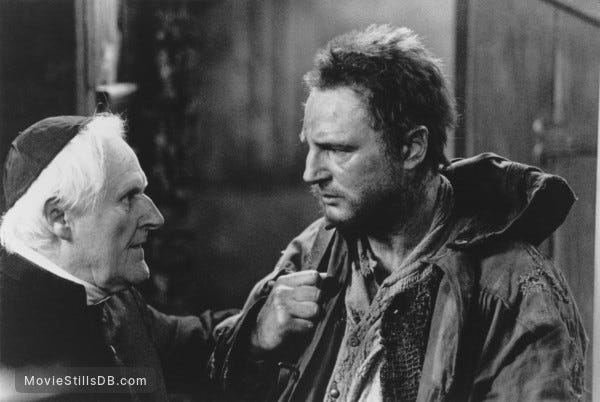
Valjean’s life is never the same after this moment – one of the most transcendent in all of literature. Valjean is saved by grace – transformed by someone else’s sacrificial kindness. Here’s how it plays out in the 1998 film version, starring Liam Neeson.
Christmas is a love story.
Like all love stories, there is a sacrifice somewhere at the center of things. Someone has to surrender something precious so someone else can be blessed.
For instance, the only way for children to become healthy adults is for loving parents to surrender a gigantic portion of their time, their resources, and their energy. Author Timothy Keller points out that if moms and dads refuse to make such sacrifices, their kids will pay the price by being emotionally damaged.
Either way, someone has to pay.
If you choose to spend time with an emotionally anguished person, it’s going to cost you something. At some level you’ll feel drained. You will give away some of your fullness so they won’t feel so empty.
And you’ll wonder from time to time if you’re really making a difference.
Anyone who has ever made a positive impact on your life – a coach, a spouse, a teacher, a mentor, a pastor, a friend – gave something up so you could be blessed, so you didn’t have to face something that was quite so hard. It’s likely that a number of someones over the years have given you the equivalent of the bishop’s candlesticks so you could belong more fully to God.
That’s what love is all about.
In the love story of Jesus’ birth, it’s impossible to overstate the sacrificial courage of Mary.
When Mary says Yes to the angel Gabriel’s announcement that she will bring the Messiah into the world, she’s also saying No.
She’s saying goodbye to her reputation. Unmarried, expectant teenagers in first century Israel didn’t get a guest spot on MTV’s 16 and Pregnant. They and their families got scorn and misunderstanding instead.
Mary is losing the honor game – the most important game in town. In an “honor culture” like that of the Middle East (then and now), people assume that only a finite amount of honor exists. There’s not enough to go around. If one person’s public esteem goes up, someone else’s has to go down.
Because Mary’s child will be publicly identified as a mamzer – the Hebrew term for a child from an illicit relationship – she and Jesus and Joseph will live under a cloud of shame for the rest of their lives, an association almost impossible to eradicate.
Mary is likewise saying no to her dreams of a quiet, pain-free life. After Jesus is born, a wise old man named Simeon will tell her that raising God’s Son will involve great suffering. “A sword will pierce your soul,” he assures her (Luke 2:35). This is not the kind of sentiment that inspires a new line of Christmas cards.
Why does she say Yes?
Mary, who would no doubt have been dismissed in her own time as a nobody from Nowheresville, intuitively understands what so many of history’s brightest, best-educated figures never seem to comprehend:
True love always involves sacrifice. The only real issue is whom or what we will discern is actually worth living and dying for.
Years later, one of the followers of Mary’s son will write this:
“This is love: not that we loved God, but that he loved us and sent his Son as a sacrifice for our sins” (I John 4:10).
The musical Les Mis will never be mistaken as a mere recitation of Victor Hugo’s words.
But the lyricists definitely got this line right: “To love another person is to see the face of God.”