To listen to today’s reflection as a podcast, click here
In 1934, an African American pastor from Georgia embarked on a dream trip to the Old World.
He sailed across the Atlantic. He toured the Holy Lands. Then he crossed the Mediterranean and journeyed to Berlin, where he attended an international conference of Baptist pastors.
During his time in Germany, Michael King had a chance to learn about Martin Luther.
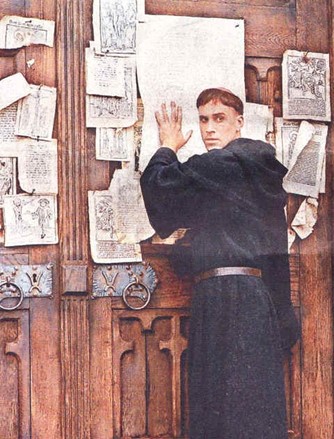
He visited some of the celebrated sites where the German monk in 1517 unintentionally launched a movement to reclaim the spiritual roots of the Church, triggering the Protestant Reformation.
The visiting pastor was so moved by what he discovered that he made a dramatic decision.
He decided to change his name from Michael King to Martin Luther King.
Back in Georgia was his five-year-old son, Michael, Jr. His father also decided to change his name. He now became Martin Luther King, Jr. – even though his closest relatives would call him “Mike” until his dying day.
For the rest of the world, he’s known simply as MLK. And this is the day that acknowledges both his birthday and his central role in America’s civil rights movement of the 1950s and 60s.
As Eric Metaxas explains in his voluminous biography Martin Luther: The Man Who Rediscovered God and Changed the World, the German monk, without having any actual idea he was doing so at the time, basically ushered in the modern world.
Luther’s only intent was to know God’s will and to do it.
But by taking a stand on the authority of Scripture to provide direction for the daily life of “every plowboy and milkmaid” in Europe, Luther lit the fuse that exploded into the idea that individuals have personal responsibility before God alone, and only secondarily before any religious body or government.
That stunning concept is still being worked out around the world 500 years later.
His namesake, Martin Luther King, Jr., followed a similar path.
The civil rights leader didn’t start out with a master plan to transform the world (although he never doubted God was capable of doing such a thing).
Dr. King essentially chose to know God’s will and to do it.
By simply being obedient – by deciding that he would stand up against systemic evil, refusing to use violence as a means of opposing violence, praying for those who despised him, and persevering even when there seemed to be compelling reasons to quit – God used him to change the world.
Few, if any, of history’s spiritual difference-makers have begun with a master plan.
Instead, they began with a heartfelt desire to know God’s will and to do it. And then to let God do the rest.
On this MLK Day, may we receive the grace to find that same transforming path.
And then to follow it – with body, mind, soul, and strength.