
To listen to today’s reflection as a podcast, click here
Throughout the season of Lent, we’re taking a close look at the Apostles’ Creed – one of the earliest and most concise summaries of what followers of Jesus believe.
The Apostles’ Creed begins, “I believe in God the Father Almighty, creator of heaven and earth…”
In the hearts and minds of Christ-followers, that’s an exquisitely compact statement of extraordinary power and beauty.
In more than a few 21st century institutions of higher learning, those are fighting words.
One of the not-so-secret hopes of many scientists over the past 50 years has been the creation of a plausible Theory of Everything that excludes the supernatural. The ongoing dream is to explain the cosmos as the product of natural, arbitrary processes that are entirely based on chance.
No miracles. No angels. No creation. No purpose. Just particles and the laws of physics.
Theoretical physicist Steven Weinberg recently asserted that “the world needs to wake up from the long nightmare of religion. Anything we scientists can do to weaken the hold of religion should be done, and may in fact be our greatest contribution to civilization.”
But something unexpected happened on the way to the confident announcement of a 100% God-Free Universe.
Around 100 years ago, most astronomers believed in the “steady state” model of the cosmos. The universe is simply there. And it’s always been there, seemingly immune from change.
But then evidence began to emerge that the universe actually has a fixed beginning – a dramatic, one-of-a-kind event that brought everything into existence.
The dawning realization of a so-called Big Bang has had a jarring effect on religiously skeptical scientists and philosophers – for the simple reason that it seems uncomfortably reminiscent of Genesis 1:1 (“In the beginning, God created the heavens and the earth”). “The heavens and the earth,” by the way, is a Hebrew idiom that means, “everything you can think of.”
The tipping point in the accelerating case for the Big Bang came on April 24, 1992, when a team of astrophysicists reported the findings of the Cosmic Background Explorer satellite.
No matter which direction they point their most powerful instruments, astronomers have been able to “hear” the background hiss of radioactivity – essentially the all-pervasive “sound” that is still reverberating from a primordial explosion that occurred about 13.78 billion years ago.
Scientists were awestruck.
“It is the discovery of the century, if not of all time,” said Stephen Hawking, the world’s most celebrated physicist. The discovery was “unbelievably important,” said Michael Turner of the University of Chicago. “The significance of this cannot be overstated. They have found the Holy Grail of cosmology.”
So, what exactly is the Big Bang?
It’s the notion, as one astronomer puts it, that “the entire physical universe – all the matter and energy, and even the four dimensions of space and time – burst forth from a state of infinite, or near infinite, density, temperature, and pressure. The universe expanded from a volume very much smaller than the period at the end of this sentence, and it continues to expand.”
Scientists are not naïve. If the Big Bang really happened, they immediately grasped the implications.
The universe had a beginning. This discovery was completely unexpected.
Here we need to pause and address a misunderstanding. A number of Christians have received the news of the Big Bang with dismay, imagining it to be a secular alternative to the notion of divine creation. It is anything but.
The Big Bang has provided, for the first time, plausible evidence that a singular act of creation is how the cosmos came into existence. This has elated theists, but irritated skeptics. Geoffrey Burbridge of the University of California at San Diego complained that his fellow astronomers were rushing off to join “The First Church of Christ of the Big Bang.”
But wait.
In the words of Ron Popeil, the late great pioneer of TV infomercials, “There’s more.”
In recent decades, astrophysicists have begun to make discoveries about the fine-tuning of the universe.
Currently, more than 100 physical constants – everything from the strength of gravity to the shape of the carbon atom to the number of protons in the cosmos – are so precisely configured that even the slightest variation would eliminate the possibility of life.
That’s gotten a lot of attention.
The late astronomer Sir Fred Hoyle, who was not a person of faith, reported, “A common sense interpretation of the facts suggests that a super-intellect has monkeyed with physics, as well as chemistry and biology, and that there are no blind forces worth speaking about in nature.” He went on to admit he was “greatly shaken” by the fine-tuning discoveries.
It seems increasingly hard to fathom, in other words, that the special features of the cosmos just happened.
We know of exactly one universe, and it appears to be exquisitely crafted for life.
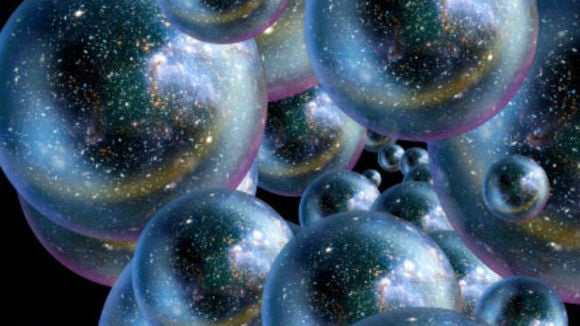
But scientists who get queasy at the mention of a super-intellect have made a counterproposal. What if this isn’t the only universe? What if ours is just one of countless universes that somehow “bubbled up” – all by chance – and we lucked out and drew the one in which life is possible?
It’s called the Multiverse Hypothesis. And it’s sharply dividing the global physics community.
A number of theoreticians, like Hawking, have pointed out that the idea of a multiverse is plausible, and it leaves in place the all-important possibility that everything can still happen by chance.
Other well-known physicists, like Paul Davies, aren’t having it. “The multiverse theory may be dressed up in scientific language, but in essence it requires the same leap of faith.” The same leap of faith, that is, as believing in the Apostles’ Creed – that God the Father Almighty created the heavens and the earth.
When you think about it, it is impossible (by definition) for us ever to find out if there is another universe.
That’s because all the tools at our disposal – our senses, our minds, our best technology – are confined to this universe, which means we can never “go outside” and have a look around to see if there’s anything else to see.
Even the advocates of the Multiverse Hypothesis admit we can never actually confirm its validity through scientific experimentation. All of which suggests that cosmologists who are eager to embrace this intriguing new idea aren’t necessarily doing do because it’s good science, but because it’s a way of not falling back onto the tired old notion of God.
Actually, it’s not entirely true that God cannot be verified experimentally.
You can always try two experiments.
First, wait until you die and see what happens. It’s worth noting that you and I will in fact have that very experience, whether we’re particularly curious about God or not.
Second, if you don’t want to wait that long, try Jeremiah 29:13: “If you look for me wholeheartedly, you will find me.”
Look around. Ponder the world to which you awaken every morning. Consider its stunning beauty. Its biological complexity. The unshakeable sense that this is not an accident, but a work of art.
The work of an extraordinary Creator.
The odds are high that such an experiment will turn out to be far more transforming than anything you learned back in high school science.