
To listen to today’s reflection as a podcast, click here
Throughout the season of Lent, we’re taking a close look at the Apostles’ Creed – one of the earliest and most concise summaries of what followers of Jesus believe.
A few years ago, I came up behind a car driven by a teenage girl. It was turning into the parking lot of our local high school.
I noticed its bumper sticker: Galileo was wrong; the world revolves around ME.
In today’s world that makes laughably perfect sense. If there is nothing outside myself that is eternally valid or true, then the question of where I will get my rules for living is easy to resolve: Everything that means anything begins and ends with me.
“Truth” is what turns out to suit my appetites. My feelings, my perspectives, and my take on reality become Reality itself.
The cereal aisle in the grocery store, fully stocked with scores of colorful options, is a compelling metaphor for current spiritual decision-making. Individuals insist on limitless choices. As author Mike Starkey puts it, “If theology is the study of God (from the Greek word Theos), then most contemporary spirituality is ‘me-ology,’ the art of taking my own tastes, preferences and moods and creating a customized religion just for me.”
No wonder it’s so hard for so many 21st century people to embrace the Apostles’ Creed.
According to the New Testament (which is foundational for the Creed), there is only one God. Who has only one Son. Who provides – by his life, death, and resurrection – the only path to that only God. “I believe in God the Father Almighty, creator of heaven and Earth, and in Jesus Christ his only Son our Lord.”
That’s a whole lot of “only’s” to swallow in a single gulp.
The earliest Christian missionaries, in their journeys around the Mediterranean world, insisted that Jesus was not just the latest item on the take-your-pick buffet of Olympian deities. Today’s Christian witnesses in south Asia have to clarify that he is not to be confused with the more than 300 million “local” gods and goddesses that are part of the religious scene in India.
According to the Bible, Jesus stands alone. All other powers and authorities are pretenders.
That “only-ness” is quite possibly the most counter-cultural aspect of what it means to follow Jesus, no matter when or where we happen to live.
From time to time I’ve heard skeptics suggest that Jesus, apart from a verse here and a comment there, rarely went out of his way to declare that he was God’s one-and-only Son, and seemed hesitant to present himself as the centerpiece of God’s efforts to heal this broken world.
We can only say that’s not how he was perceived by his fellow Jewish citizens. There was little doubt in their minds that Jesus was presenting himself as Someone Special.
Consider, for instance, his Palm Sunday entrance into Jerusalem, riding on a donkey. Throngs of people were waving branches in a messianic frenzy. Some of them began to ask out loud:
Who is this?
That’s the kind of question we ask all the time about other people. When someone joins our workplace team, or a new person moves in next door, or we encounter a stranger at a gathering, we almost immediately begin to categorize them. Is this someone I should pay attention to? Is this a person I should fear, respect, or ignore? Is she more likely to become my rival or my friend?
Putting people into categories helps us define them. Figure them out. Make them small enough that we can predict their moods, their decisions, and the potential roles they might play in our lives.
This is a typically human thing to do. It is, of course, exceedingly costly. More often than not, by quickly dropping men and women into the preexisting categories of our limited experience, we miss the chance to hear them, meet them, and actually find out who they really are.
The crowd lining the road to Jerusalem seems to have had a difficult time finding the right pigeonhole in which to place Jesus.
Their question, “Who is this?” appears to have the force of “Who does he think he is, anyways? The prophets told us that God’s Messiah would appear riding a donkey. Is this man trying to present himself as the answer to our prayers and the solution to our problems?”
In the days following Palm Sunday, Jesus would quickly demonstrate that he didn’t fit anyone’s preexisting categories for God’s Chosen One. So the question remains:
Who is this?
Even after twenty centuries, it’s impossible to be neutral about him. He delights and he infuriates. He inspires and he irritates. He answers life’s deepest questions even while raising a host of new ones.
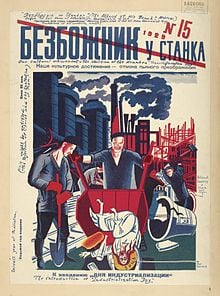
Within the past 100 years, some of the world’s superpowers have made it their mission to dump Jesus. During the early days of the Soviet Union, an ideological group called the League of the Militant Godless openly ridiculed him. The 1929 Soviet magazine cover that appears above shows two factory workers literally dumping Jesus out of a wheelbarrow.
But the League found their task considerably tougher than they thought. “Christianity is like a nail,” said Yemelian Yaroslasky, their leader. “The harder you strike it, the deeper it goes.”
When the USSR collapsed in 1991, polls revealed that two-thirds of the Russian people still believed in Christ, even after eight decades of state-sponsored atheism.
Who is this person?
Yale historian Jaroslav Pelikan has written: “Regardless of what anyone may personally think or believe about him, Jesus has been the dominant figure in the history of Western Culture… If it were possible, with some sort of super magnet, to pull up out of history every scrap of metal bearing at least a trace of his name, how much would be left?”
The answer, of course, is not very much. The man who entered Jerusalem on a donkey, apparently quite aware of the forces aligned to destroy him in a few days, has seemingly left his fingerprints on everything.
Which brings us to the key question of our time: Does the world revolve around me, or does it revolve around someone else? And who is qualified to be that someone else?
In 2016 Richard Hays, one of the world’s leading New Testament scholars, completed his book Echoes of Scripture in the Gospels.
A panel of fellow scholars gave his work favorable reviews at the meeting of the Society of Biblical Literature that year in San Antonio. The author himself was present for the Q&A that followed, even though he was in the midst of treatments for pancreatic cancer.
One of the reviewers thought Hays might have gone a bit too far in his conclusions – especially when he asserted that the early church had unequivocally taught that Jesus was the world’s only Savior, and that Christians today should do the same. Why had he expressed himself so strongly?
Hays began to weep.
He admitted to the audience, “I thought that these were going to be the last words I was ever going to write.”
A man who had spent most of his life studying Scripture could think of nothing more important, at the end of his life, than to affirm the only-ness of Jesus Christ.
He is the only Son.
The only Way.
And our only Hope.