To listen to today’s reflection as a podcast, click here
Throughout the season of Lent, we’re taking a close look at the Apostles’ Creed – one of the earliest and most concise summaries of what followers of Jesus believe.
According to the Domino Effect, one thing leads to another.
It can be great fun to stand up hundreds of tiles in creative patterns. Then your only task is to knock down the first tile, step back, and enjoy the action.
Some people take this more seriously than others. Participants in the Netherlands’ annual Domino Day compete to invent the most complex and spectacular effects. On November 13, 2009, 89 players teamed up to create a domino field that utilized 4,491,863 tiles, a global benchmark that is still unsurpassed. It took more than an hour for all the dominoes to fall.
Even with four million tiles, the only thing that really has to happen is the first thing. Everything else follows.
And what if that first thing is an event like no other, such as the alleged resurrection of Jesus of Nazareth? Even Hugh Hefner understood what was at stake.
The founder of Playboy and celebrity embodiment of the all-about-me lifestyle wasn’t a particularly big fan of religion. He acknowledged in an interview before his death that there was probably something like “the beginning of it all,” and that God might be defined as the Great Unknown.
Did he believe in the resurrection? “If one had any real evidence that, indeed, Jesus did return from the dead, then that is the beginning of a dropping of a series of dominoes that takes us to all kinds of wonderful things. It assures an afterlife, and all kinds of things that we would all hope are true.”
Hefner appears to have remained a skeptic to the end. But he grasped that if that first spiritual domino had really fallen, and if it somehow was put into play in one’s life, you would never know where things might lead.
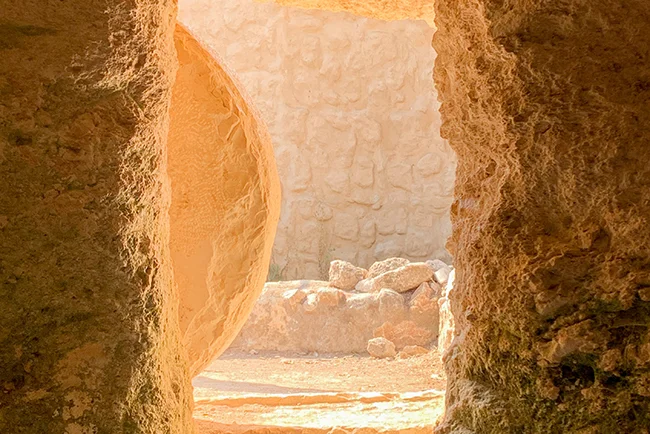
The Apostles’ Creed does not mince words. After reporting what everyone knows to be true – that Jesus of Nazareth was executed by crucifixion and then entombed late one Friday afternoon outside Jerusalem – it dares to go where literally no one had gone before.
“On the third day he rose again from the dead.”
The apostle Paul was all-in. Take away the resurrection and the whole scaffolding of Christianity comes down.
Cultural critic Gertrude Stein famously commented about her hometown of Oakland, California, “There’s no there there.” If the resurrection turns out to be nothing but sentimental bunk, the religion game, at least for Christians, is over. There’s nothing there worth paying attention to.
Here’s how Paul put it, as rendered in the Bible paraphrase called The Message: “If there’s no resurrection, there’s no living Christ. And face it — if there’s no resurrection for Christ, everything we’ve told you is smoke and mirrors, and everything you’ve staked your life on is smoke and mirrors. Not only that, but we would be guilty of telling a string of barefaced lies about God, all these affidavits we passed on to you verifying that God raised up Christ — sheer fabrications, if there’s no resurrection” (I Corinthians 15:13-15).
But if the Easter story is really true, it’s the ultimate first domino. Tip it over, and it will knock down another domino, and that one will knock down a third. And by the time it gets to our lives, it has the power to change everything.
Since the validity of orthodox Christianity hangs by a single thread – was Jesus’ tomb empty or not on the first Easter? – the pushback by skeptics has been intense.
A considerable amount of pressure has even come from “inside.” Since the middle of the 20th century, something like half of America’s pastors have expressed either doubt or outright dismissal of Christianity’s central miracle. In a scientifically skeptical age, it seems far-fetched to believe that a deceased person is ever going to breathe again.
According to Lifeway Research’s 2020 State of Theology survey, two-thirds of Americans believe the Creed’s assertion that Jesus rose from the dead.
In her book Confronting Christianity: 12 Hard Questions for the World’s Largest Religion, author and apologist Rebecca McLaughlin says that number “makes me feel two things: hopeful and heartbroken. First, I feel hopeful, because it suggests that twice as many Americans as attend church weekly might be open to doing so if they were invited. This is a huge opportunity.
“But I also feel heartbroken,” she continues, “because the idea that someone would say they believe Jesus actually rose from the dead but that this belief would have so little impact on their life that they weren’t even part of a church is truly tragic.
“This exposes the danger of ‘cultural Christianity’—the vague assent to Christian beliefs without any evidence of actual faith in Christ.”
What happens if we genuinely become persuaded that the Easter story is true?
Living as if Jesus is alive and well and ruling the cosmos will change the way we pump gas, and make coffee, and read to our kids, and sacrifice for others, and respond to social media, and wait in that long line, and pray for people we don’t know, and deal with that cantankerous relative, and wake up in the morning, and serve beyond our comfort zones.
All it takes is tipping over that first domino: Lord, show me how to live as if Jesus is really alive.
And before we know it, four million other things are happening that we didn’t even see coming.