To listen to today’s reflection as a podcast, click here
Throughout the season of Lent, we’re taking a close look at the Apostles’ Creed – one of the earliest and most concise summaries of what followers of Jesus believe.
Americans love happy endings.
Sitting in darkened movie theaters, we have come to expect that the monster will be vanquished, the toad will be changed back into a prince, the bad guys will be brought to justice, Beauty’s love will transform the Beast into a seriously ripped surfer dude, and everyone will live happily ever after.
More than a few major films, however, have gone out of their way to present endings cloaked in sadness, contemplation, or moral ambiguity. Sometimes hearts remain broken and the bad guys win.
Platoon (1987), Million Dollar Baby (2004) and No Country for Old Men (2008) all won the Academy Award for Best Picture. None of them left audiences cheering.
The winner of last night’s Best Picture Oscar, One Battle After Another, will never be confused with The Sound of Music.
Even fans of 2004’s Dodgeball, a laugh-out-loud comedy, seldom realize that in the original version, the underdog team of Average Joe’s loses the big championship game to narcissistic White Goodman and Globo Gym. Test audiences were so upset that the writers had to go back to the drawing board and substitute a happy ending.
The ancient Greeks, those master storytellers of the classical world, would have preferred the original version.
There is not a single happy ending in any of their epic literature or mythology. The Greek notion of “hero” was someone who rose to glorious heights, only to come crashing back to earth through hubris, miscalculation, or betrayal.
Life is wretched and short, perhaps briefly glorious, and then you die.
Historians have suggested that a story that raced rapidly around the Mediterranean world in the first century – that a Jewish miracle-worker named Jesus had come back to life and could supply his followers with love, grace, and power – is the first happy ending in world history.
It’s no surprise that myriad people enthusiastically embraced it.
Will human history have a happy ending?
Within the past two decades, astrophysicists have confirmed that the cosmos is headed for total entropy. That’s a fancy way of saying that all the stars are going to burn out, every particle will exhaust its energy, and every square inch of reality will be dark, cold, and absolutely motionless, with no hope of revival.
No wonder “eat, drink, and be merry, for tomorrow we die” sounds like a realistic Plan A for the next 24 hours, and every day to follow.
If God doesn’t show up, there is no future. And there are no happy endings.
If God doesn’t show up, the people who knew us and loved us will leave our bodies in the cemetery and then walk away, knowing that the same fate awaits them, too.
But if God does show up, there’s real hope for a real future – not only for the cosmos, but for each of our own lives.
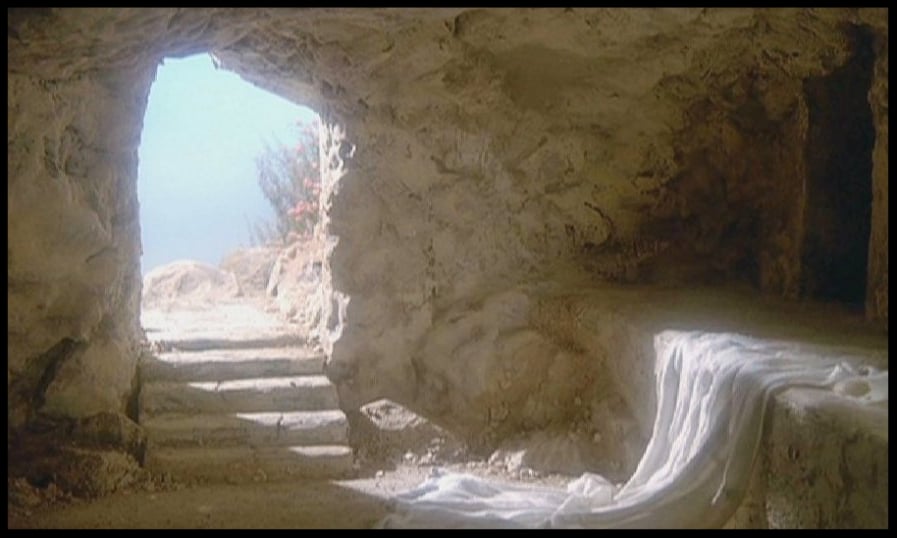
Spoiler alert: According to the Apostles’ Creed, God did in fact show up on a Sunday morning in the vicinity of Jerusalem about A.D. 30. “On the third day he rose again from the dead…” That’s far more than just an historical footnote, or a reason for worshippers to sigh on Easter morning, “Well, maybe things will turn out OK after all.”
According to the New Testament, the resurrection was like an explosion that reverberated across the ancient world. It ultimately sent shock waves to the shores of every continent. Something had happened – something that people thought might take place at the end of history, but which had suddenly happened to one special person in the very midst of history.
And now the word was going around that the cosmos itself was somehow different – that a new way of belonging to God had opened up, and that Death would no longer hold sway over the lives of Jesus’ followers.
He rose again from the dead.
If we believe those words of the Apostles’ Creed, we’re forced to conclude that Jesus is alive. Here. And now. And that makes all the difference in the world.
If Greek storytellers veered toward pain and tragedy, one of the great storytellers of our own time unfailingly veered toward hope and joy.
Tony Campolo left us almost a year and a half ago. One of the stories he loved to tell, and which we’ve shared in the past, concerns his opportunity to speak at a small Pentecostal college in eastern Pennsylvania.
Before the chapel service, several of the faculty members took Tony into a side room to pray with him. Tony got down on his knees and six men put their hands on his head and began to pray. Pentecostal prayers can be a bit like the Energizer bunny. They keep going and going and going. The longer those men prayed, the more they leaned on Campolo’s head.
“Do you feel the Spirit?” one of them whispered. Tony recalls that he definitely felt something pressing on his neck.
One of the faculty members kept praying about a man named Charlie Stoltzfus. “Oh, Lord, you know Charlie Stoltzfus. You know that he is about to abandon his wife and three children. Send an angel to bring that man back to his family. You know whom I’m talking about, Lord…Charlie Stoltzfus. He lives down the road about a mile on the right-hand side in a silver house trailer!”
About that time Campolo was thinking, “God knows where this guy lives. He’s not up in heaven saying, ‘Uh, could you run that address by me one more time?’” Mostly Tony was just hoping at that point he could get back up off his knees.
After the chapel talk, Campolo hopped into his car and headed home. He was getting onto the Pennsylvania turnpike when he saw a young hitchhiker. As Tony told the story, he acknowledged that picking up hitchhikers was less than wise, but as a Baptist preacher he hated to pass up a captive audience.
He opened the door to his car. “Hello,” he said, “My name is Tony Campolo.” “Hi,” said the young man. “My name is Charlie Stoltzfus.”
Campolo said nothing. He drove down the turnpike, got off at the next exit, turned around, and headed back.
“Hey, mister,” said the hitchhiker, “where are you taking me?” “I am taking you home.” “Why?” “Because you just left your wife and three children, right?” “That’s right!” Campolo exited the turnpike and drove straight to the silver trailer about a mile down the road – you know, the one on the right-hand side.
“How did you know I lived here?” With all the solemnity he could muster, Campolo turned and said, “God told me!”
For the next hour Tony sat in that silver trailer with Charlie Stoltzfus and his wife. That was the day their marriage was healed. That was the day they both began a personal relationship with Jesus.
Charlie Stoltzfus went on to become a Pentecostal preacher.
Now, just in case you’re thinking, “Stuff like that never happens to me,” one day all of us will be stunned when we learn what God has been doing in us and through and around us, all the time, day after day after day.
If Jesus is indeed risen from the dead, he’s not a spectator to what is going on.
He’s in all your meetings. Your family room. Your car. Alongside every step you take.
The astonishing truth of Jesus’ resurrection is that he is now able to make good on the promise of his name, Immanuel:
He is God with us.
And just like that, happy endings seem more assured than ever.