To listen to today’s reflection as a podcast, click here
Throughout the season of Lent, we’re taking a close look at the Apostles’ Creed – one of the earliest and most concise summaries of what followers of Jesus believe.
“I shall return.”
Those three words are among the most memorable ever uttered by an American military leader.
That’s because an entire nation was inspired by them during some of the darkest hours of World War II.
A day after bombing the U.S. fleet at Pearl Harbor on December 7, 1941, Japanese forces invaded the Philippines, where General Douglas MacArthur was America’s chief military adviser. After four months of desperate fighting, it was clear the island nation would fall.
In March 1942, President Franklin D. Roosevelt ordered MacArthur to Australia. There he would assume command of Allied forces that would attempt to reconquer the Philippines.
MacArthur was far from a perfect person. He was an egomaniac, a flamboyant showboat who wasn’t above manipulating the press to shine his own star. He publicly rankled two presidents – FDR and Harry Truman – and irritated almost everyone who served alongside him. General Dwight Eisenhower, who would himself one day enter the White House, was once asked about his association with MacArthur. Ike responded, “I studied dramatics under him for five years…”
MacArthur reluctantly obeyed the order to leave the Philippines. He was stricken by the thought of abandoning 90,000 American and Filipino troops in the face of an advancing enemy.
Upon arriving in Australia, he boldly issued a statement to his soldiers and the people of the Philippines: “I shall return.”
Only then did he grasp the demoralizing reality that there was no Allied army awaiting his command. FDR and the Joint Chiefs, in fact, had quietly concluded that the Philippines would have to be sacrificed. They had chosen a “Europe First” strategic policy. Only after containing Adolph Hitler would America give its full attention to defeating Japan.
It is painful to recollect the horrors that befell those who had been left behind. The names Bataan and Corregidor have become synonymous with Japanese brutality.
MacArthur felt helpless. And livid.
As their suffering stretched from months into years, Filipinos cherished feelings of hatred toward America’s political leaders, whom they considered untrustworthy.
But they trusted Douglas MacArthur. They clung to the hope he would one day keep his promise to liberate their homeland.
“I shall return” began to appear everywhere. Postal workers in Manila, risking their own lives, stamped those three words on envelopes and parcels – some of which were delivered to Japanese military facilities. At dawn, Filipinos might awaken to see billboards repainted with MacArthur’s slogan. Sheets of paper declaring “I shall return” were posted on fences, left in railway stations, and even turned up in the filing cabinets of Japanese officials. An entire nation rallied around a single promise.
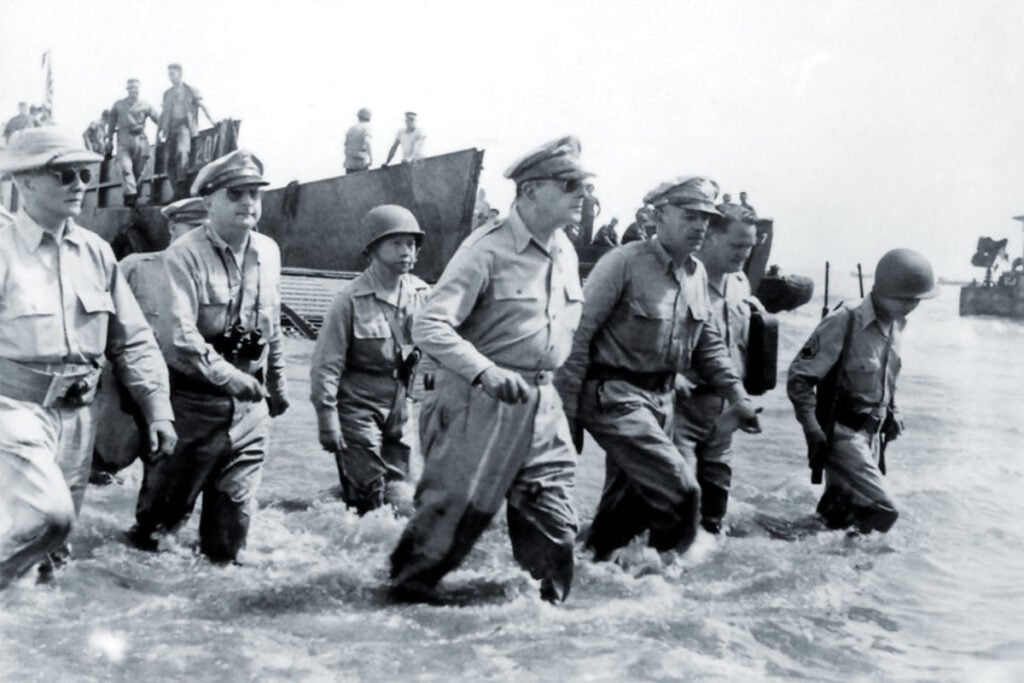
On the afternoon of October 20, 1944 – two and a half years after his departure – MacArthur waded ashore onto the Philippine island of Leyte.
Only one third of the troops he had left behind had survived. But by the spring of 1945 they had been rescued, and the Philippines were once again in Allied hands.
In the years that followed, as Filipino leaders continued to quarrel with Washington, efforts were made to erase any evidence of America’s decades-long presence. Streets, buildings, parks, and airports were renamed to honor Filipino citizens and concerns.
All except for a special handful. Today there’s a bridge, two highways, and three towns in the Philippines that preserve the memory of General Douglas MacArthur.
That’s the power of promise-keeping.
Here we arrive at the final leg of the Trinitarian outline of the Apostles’ Creed. Having affirmed our trust in God the Father Almighty and Jesus Christ his only Son, we declare, “I believe in the Holy Spirit.”
Who is the Holy Spirit? While the biblical answer to that question is deep and wide, and can take us in dozens of different directions, one of the foundation stones is the notion that the Spirit is God’s assurance that he keeps his promises.
Paul says in 2 Corinthians 1:21-22: “Now it is God who makes both us and you stand firm in Christ. He anointed us, set his seal of ownership on us, and put his Spirit in our hearts as a deposit, guaranteeing what is to come.”
The word translated “deposit” is the Greek word arrabon, which indicated a down payment or first installment. The Spirit is like an appetizer – the first taste of God’s grace. The rest of the meal – the fullness of what God has in store for us – is coming in the future.
Think of the “earnest money” that a prospective home buyer gives to the seller as a way of saying, “I’m not going to back out of this purchase. I’m in earnest about buying your house.”
One day, at the closing – the closing of history, that is – God will deliver the complete experience of spiritual transformation. The gift of God’s Spirit, in the meantime, is our assurance that he isn’t going to renege on his promise.
Paul expresses similar thoughts in Ephesians 1:13-14:
“And you also were included in Christ when you heard the message of truth, the gospel of your salvation. When you believed, you were marked in him with a seal, the promised Holy Spirit, who is a deposit [there’s that word arrabon again] guaranteeing our inheritance until the redemption of those who are God’s possession—to the praise of his glory.”
What does it mean to be sealed with the Spirit?
Back in the days when people communicated by means of “snail mail,” you might have received an envelope emblazoned with the letters SWAK across the flap. There might even have been the take-your-breath-away evidence of bright red lip prints.
SWAK means “Sealed with a Kiss.” This is not what one would expect to find on the back of a utility bill or a summons for jury duty.
If your snail mail is SWAK, it is personal. Intimate. And lovingly sealed by a very special person. Receiving such a note has considerably greater impact on the human heart than a whole string of emojis at the end of a text.
Seals were a very big deal in the ancient world.
A seal was a visible sign that clearly identified the author of a particular correspondence. After the document was carefully rolled up, hot wax would be dribbled on the seam. Then the seal would be pressed into the wax, leaving behind a distinguishing mark.
Such a mark represented a signature. It demonstrated authenticity.
Since only wealthy or influential people could afford to create and distribute documents, the mere appearance of a seal commanded attention. As soon as you saw such an emblem, you knew you were dealing with a person of significance.
Seals also represented ownership. To put a seal on something meant, “I authored this. This belongs to me.”
If you’ve abandoned yourself to Christ, you’ve been marked with a seal that trumps every other claim to ownership. You belong to the One who loves you and died for you.
It goes without saying that a distinguishing mark has to be pressed into something soft. That could be wax, mud, or clay. No handheld seal could make a lasting mark on metal or stone. Likewise, the seal of the Holy Spirit can only be pressed into a soft heart. A humble heart.
The best news of all? God’s stamp of ownership lasts forever.
So, when we say, “I believe in the Holy Spirit,” we’re saying to God, “I believe that by giving me your Holy Spirit you’re assuring me you’re going to keep your promises.”
History changes when a general keeps a promise by striding into the surf of a Pacific island.
But when Jesus makes good on his promise to all of us – “I shall return” – the entire world will never be the same.