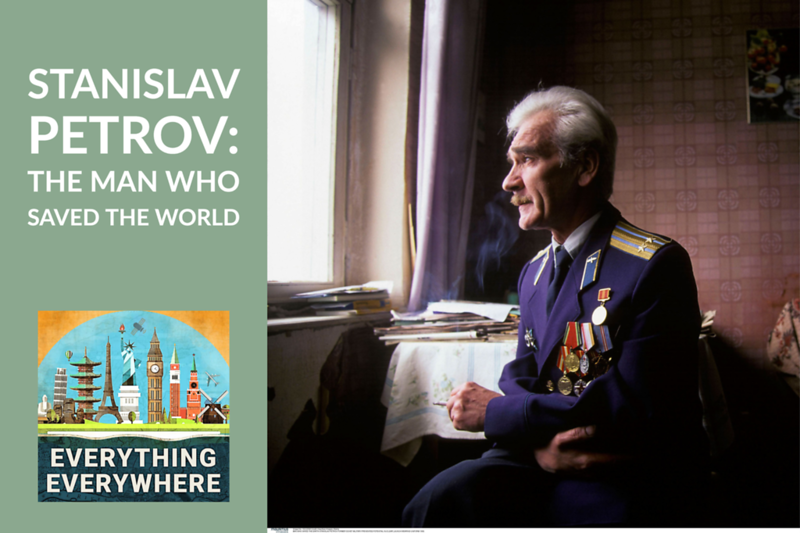
To listen to today’s reflection as a podcast, click here
Four minutes.
They were the four longest minutes of Stanislav Petrov’s life.
They also represented, arguably, the closest our world has ever come to nuclear catastrophe.
On September 26, 1983, Petrov – a lieutenant colonel of the Soviet Air Defense Forces – was the duty officer at the command center for the Oko nuclear early warning system.
It was a particularly tense moment in the Cold War. Since the late 1940s, the United States and the Soviet Union had been locked in a struggle for global dominance. President Ronald Reagan had recently declared that the USSR represented an “empire of evil.”
On September 1, a Soviet fighter intercepted Korean Airlines flight 007, which had accidentally strayed into Russian airspace. Fearing that the 747 was spying on behalf of the American government, the fighter shot it down, taking the lives of all 269 passengers and crew.
Historians now know that in the fall of 1983, military leaders on both sides of the ideological divide were on hair trigger alert. Perceived provocations were taken very seriously.
It was at this moment that Stanislav Petrov’s computer screen suddenly glowed with the images of five incoming American ballistic missiles.
Petrov was a military officer. Military protocols were unambiguous. If and when the Soviet early warning system signaled an attack, the duty officer had to pick up a red phone and alert his superiors. They would then initiate further contacts up the chain of command until the highest-ranking decision-makers either took no action or authorized a retaliatory nuclear strike.
It was assumed that the entire process had to be completed in about 10 minutes. Otherwise, it might be too late. The enemy’s ICBMs could compromise one’s capacity to respond.
America’s early warning system was founded on similar assumptions. Speed was essential. Cold War strategizing had evolved into the doctrine of MAD (Mutually Assured Destruction) – a wonderfully ironic acronym if there ever was one. Each side knew that if the other side had time to respond, neither side would emerge unscathed. Everything and everybody would be nuked.
Quick responses were urgent. No provision was made for agents to pause and ask, “Is it possible that something else is happening here? Maybe we should step back for a few minutes.”
Both sides knew they needed early warning systems that would never fail and personnel who would never hesitate – two significant acts of faith. It’s not an exaggeration to say that the fate of humanity hung in the balance.
Petrov took note of the images of the five incoming nukes.
He sat at his console. He did not reach for the red phone.
The pressure to act was overwhelming. His comrades in the Oko early warning center were watching him. Was he or was he not going to alert his superiors to this crisis? Petrov was risking his career. His life. In a real sense, he was risking all their lives and the lives of countless Soviet citizens.
Four agonizing minutes went by.
Petrov finally picked up a phone. But it wasn’t the red one. He reported the data on his screen to a trusted superior, along with his suspicion that there was, in fact, no nuclear threat. “Are you certain?” asked the supervisor. “No, I am not certain,” he admitted.
But within a few minutes it was clear that he was right.
Radar revealed no incoming ICBMs. A later inquiry determined that sunlight bouncing off high-altitude clouds above North Dakota had triggered false images in the Soviet satellites’ detection system.
The world went to bed that night not knowing that World War III had been averted. Historians agree that if Petrov had obediently dialed his superiors on the red phone, there was a genuine possibility they would have authorized a nuclear counterstrike.
None of these details were known until 1998, long after the USSR had collapsed and Soviet officials felt free to write their memoirs.
What had happened to Stanislav Petrov? He had been quietly kept from public view, then compelled to take early retirement. After all, he had revealed that the Soviet early warning system was seriously flawed – a major embarrassment to the military brass.
The rest of the world gradually realized that Petrov was a hero. Before his death in 2017 at the age of 77, he received multiple World Citizen Awards and was honored by the United Nations. A documentary on his life was called The Man Who Saved the World.
For his part, Petrov humbly thought he had merely done his job.
Which raises the question: What led him to think that what he was seeing was a false alarm?
Petrov had done his homework.
For years, he had studied the early warning system. Specifically, he had quietly become an expert in anomalies – recognizing conditions that weren’t what they appeared to be. On that September night in 1983, his trained intuition told him not to nudge humanity closer to nuclear holocaust.
Followers of Jesus need to do their homework, too.
Are you yearning to grow in spiritual wisdom and to hone your intuition concerning God’s direction for your life?
Don’t settle for secondhand ideas. Commit yourself to diving into God’s Word.
You don’t have to read the entire Bible to be transformed by what you find there. But where’s a good place to start?
With Lent and Easter in the rear-view mirror, this might be a great time to read or reread the four Gospels: Matthew, Mark, Luke, and John. Together that’s 89 chapters. If you read a chapter a day, beginning today, you’ll finish on the Fourth of July, having experienced for yourself the four biographies of Jesus that Christians have pondered now for twenty centuries.
When Jesus said that the truth will set us free (John 8:32), he seems to have had something specific in mind.
The freedom to understand and respond as he would have us respond to our own circumstances – to spot with greater discernment the “false alarms” that sometimes come our way – such freedom can become ours only when we decide to read, ponder, debate, chew on, and dare to apply Scripture to our lives.
Such wisdom doesn’t come overnight. But it will come if we choose to become lifelong learners of God’s Word.
We may not save the world.
But we just might save a few other things – including the depth of our own lives with God and with others.