
To listen to today’s reflection as a podcast, click here
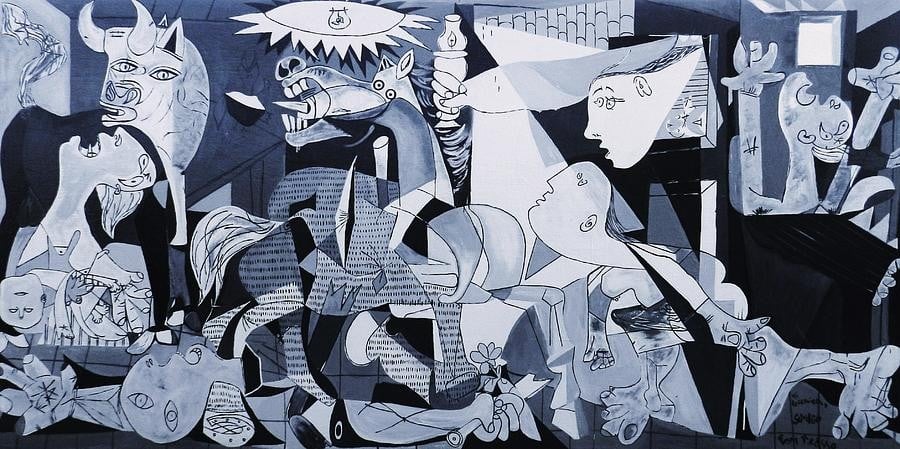
Pablo Picasso’s 1937 mural Guernica is one of the most emotionally disturbing paintings of all time.
It is enormous, standing about 12 feet tall and stretching 25 feet side to side.
It is stark, featuring not a single vibrant color from his palette, but only blacks, whites, and grays.
It is abstract, displaying classic Picasso images bereft of realism and perspective.
And it is painful, portraying the chaos and despair of people and animals suffering in the midst of war.
On April 26, 1937, Nazi bombers – operating in support of Spain’s ultra-right wing Nationalist Party – obliterated the ancient town of Guernica, a place of great historical significance in the Basque region. Most of Guernica’s male citizens were gone, having left to fight the Nationalists in the Spanish Civil War.
The bombing, which lasted two hours, was a slaughter. Militarily, Guernica had no strategic value. It offered no resistance. Most of the casualties were women and children.
The world would soon have forgotten the village and its name. But Picasso’s painting changed all that. The 20th century’s most influential artist, who was Spanish by birth, invested Guernica with all the rage and angst he could pour out upon the canvas.
He intended his work to be provocative. And he definitely succeeded.
In 1944, when Picasso was under house arrest in Paris, a Nazi German officer looked at a copy of the painting and imperiously demanded, “Did you do this?”
“No,” Picasso snapped. “You did!”
Over the centuries, numerous artists have assumed the role of prophet. A prophet is someone who points to reality and says, “This is wrong. This has to change. What are you going to do about it?”
The great prophets of Israel – the ones who called God’s people to account for their idolatry, their pride, and their self-serving lifestyles – were not outsiders. They were true-blue insiders, loyal and righteous Jewish believers who only wanted the best for their nation.
Prophets like Isaiah, Jeremiah, Amos, and Hosea weren’t rock-hurling, name-calling, hissy-fit-throwing strangers. They were family members who pleaded, “We can do better than this!”
It’s not easy being a prophet.
If you’ve ever assumed the role of truth-teller in your own family, you realize it’s a thankless job. Most family members are invested in maintaining the status quo (even when it’s deeply unhealthy), and are hoping against hope that you won’t wreck Thanksgiving again this year.
If you’ve ever chosen to speak up at a workplace team meeting, you quickly found out that certain colleagues who had promised “I’ll have your back” instead began looking at the floor or checking their cell phones for text messages.
But there’s a reason God keeps calling women and men to be bravely prophetic.
In his book Everything Belongs, Father Richard Rohr observes, “Cheap religion teaches us how to live successfully in a sick system.”
Costly religion, on the other hand, invites us to stop, think, and trust that by relying on God’s grace and power, broken realities in a broken world can actually be healed – if we are willing to confront them with humility, candor, and courage.
Most of us aren’t called to be outsiders who paint the big picture on a canvas.
But we are called, as loyal insiders, to bravely speak up for the world that God is even now working to bring about.