
To listen to today’s reflection as a podcast, click here
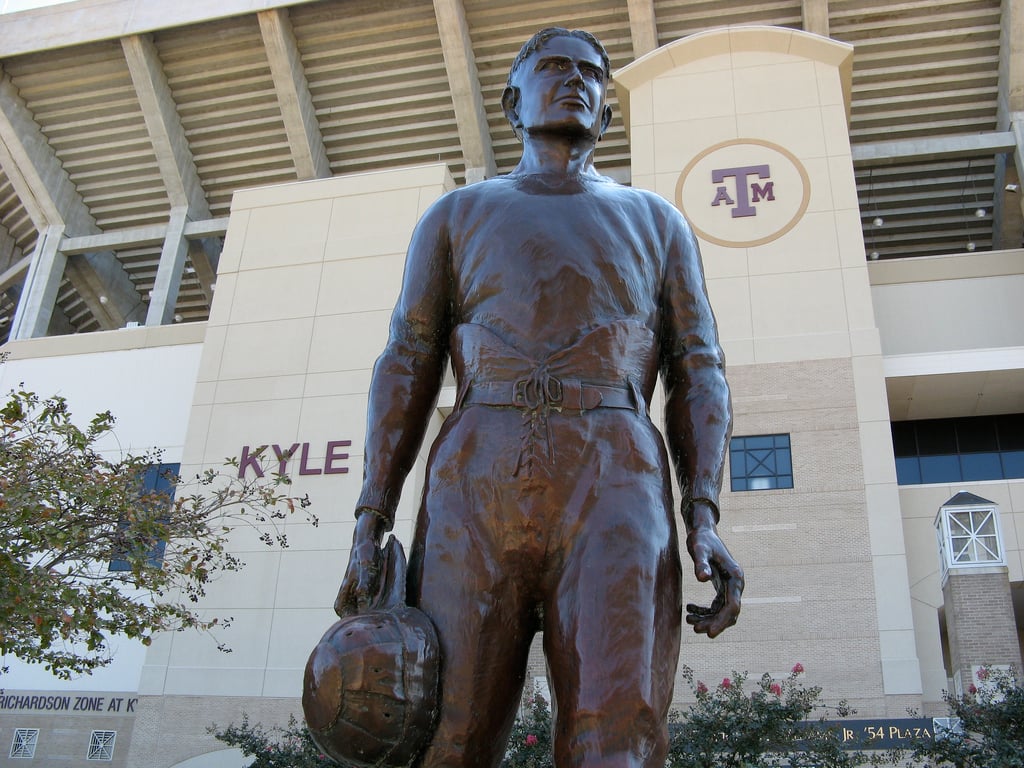
Just outside Kyle Field – Texas A&M University’s football stadium in College Station, TX – stands the bronze statue of a young man named E. King Gill.
Gill was sitting in the stands of another stadium in Dallas on January 22, 1922, as A&M (known by a different name at the time) played in the first-ever major bowl game in the Southwest.
A&M was in trouble. During the first half, one running back after another was sidelined by injuries.
That’s when Coach Dana X. Bible remembered Gill, an undersized but gritty running back who had failed to make the traveling team. Before the game, however, Gill had said, “Coach, I’ll be in the stands if you need me.” The coach dispatched someone to find him.
Gill suited up for the second half. Although he never took the field, his eagerness and availability launched Texas A&M’s most hallowed tradition: the Twelfth Man.
To this day, members of the student body remain on their feet throughout every home game, symbolically declaring their readiness to take the field in case one of the 11 starters on offense or defense goes down.
Just before the 1983 season, A&M coach Jackie Sherrill even created the Twelfth Man Kickoff Team. This group of 11 non-athletic scholarship students would wear the home team’s uniform and hurl themselves recklessly at their opponents’ kickoff returner.
Unsurprisingly, they became known as the Suicide Squad. Surprisingly, they were actually quite good.
Ike Liles made the Twelfth Man Team’s first-ever tackle on opening night against the California Golden Bears. “We were slobberin’ hungry to go hit somebody,” he said. He will never forget the ovation that arose from the stands when he brought down his opponent.
The essence of the Twelfth Man is that leadership doesn’t always have to come from “proper channels.” A key player can seemingly come from out of nowhere and make a difference.
That’s what happens in Psalm 110, one of the Old Testament’s Messianic texts. It looks forward to the One who would save Israel and ultimately rescue the whole world. Concerning this future Messiah, the psalmist writes,“You are a priest forever, in the order of Melchizedek” (110:4).
Wait. Who?
This Melchizedek seems to come out of nowhere. He had been mentioned just once before, in Genesis 14:18-20, where the patriarch Abraham honors him. So why does a shadowy one-and-done pagan priest like Melchizedek suddenly take center stage in the Psalms?
Author Tim Stafford notes an analogy to the three branches of American government. Our Constitution carefully separates the authority of each realm. When the system is working in a healthy way, Congress makes laws, the Executive enacts laws, and the Supreme Court interprets laws.
Ancient Israel recognized three “branches” as well. There were prophets, priests, and kings. Prophets proclaimed God’s will. Kings carried out God’s will. Priests represented the people to God and God to the people.
During Old Testament times, it was understood that no single figure could assume all three roles, especially since kings had to come from the family of David and priests had to come from the family of Levi.
Psalm 110 is basically an announcement that something new is about to happen.
The Messiah would indeed be a royal figure from the line of David. But he would also be a priest – not from the line of Levi, but from the “line” of Melchizedek, a spiritual Twelfth Man who suddenly steps into the picture and sets the stage for Jesus becoming a one-time-only combination of prophet, priest, and king.
The only other mention of Melchizedek comes in the middle chapters of the New Testament book of Hebrews, where this idea is explored in depth.
Interestingly, Melchizedek was not a Jew. He wasn’t a member of the Chosen People. Yet, as Stafford points out, he embodied the kind of leadership that Israel (and the whole world) would need in the person of Jesus.
In our resume-driven culture, the spotlight tends to shine on a handful of leaders who have been blessed with the best training, the deepest experience, and the most glowing recommendations. We must not minimize such essentials. But it’s amazing how often great leaders seem to “come out of nowhere” at moments of need.
That’s especially true within the gatherings of those who follow Jesus.
Concerning gifts or abilities provided by the Holy Spirit, Paul writes, “Now to each one the manifestation of the Spirit is given for the common good” (I Corinthians 12:7).
You might be gifted as an administrator. Or a listening ear. Or someone who loves teaching children. Or who offers encouragement. You might be gifted with a hammer and saw on a Habitat for Humanity work site. Or with a laptop, offering writings that inspire other people. Or with a guitar. Or with a financial ledger, making sure your congregation pays its bills on time.
The variety of such Twelfth Man leadership – making use of your gifts at just the right moment – is endless.
Many of us, however, are afraid that our gifts aren’t sufficiently important or spectacular. “I can’t pray out loud, so don’t ask me to do that. I could never teach a Bible lesson. And I’m terrified of walking into a hospital room and spending time with someone who’s just gotten bad news. I can’t do anything.”
But God refuses to let us define ourselves by what we cannot do. Paul is adamant that while the Spirit’s gifts are different, every one of them matters.
Nor are we to spin our wheels in the emotional bog of gift envy. “If only I could sing like him. Then I’d feel useful. If only I could lead the way she leads. Then I’d be happy.”
To put it bluntly, “No, you wouldn’t!” Each of us has been specially gifted and specifically wired to serve in particular ways – ways that have been prepared in advance by the Holy Spirit.
The drama of discovering our own call is too marvelous to squander by wondering what life would be like if only we had someone else’s gifts.
Real discipleship, after all, is not an invitation to sit comfortably in the stands.
God’s call is that all of us should get into the game.