To listen to today’s reflection as a podcast, click here
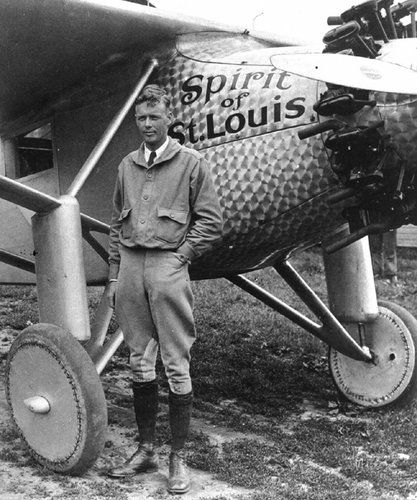
It’s hard to overstate the global acclaim that fell upon Charles Lindbergh when he became the first aviator to fly solo from the United States to Europe.
In his book One Summer, cultural historian Bill Bryson documents the mania that engulfed Lindbergh when he landed outside Paris 99 years ago today – May 21, 1927, at 10:22 pm.
Lindbergh, a shy and obscure 25-year-old Air Mail pilot, had been airborne for 33-and-a-half hours.
As he approached Le Bourget airfield, he wondered if he should have applied for a French visa. He also wondered if anyone would still be awake to meet him.
Looking down, Lindbergh caught sight of the lights of tens of thousands of cars streaming toward the airport. He had no idea they had all come in the hope of seeing him.
Once on the ground, he was mobbed. Euphoric people tore at his clothes. Souvenir hunters wrenched off pieces of his plane, Spirit ofSt. Louis. He was rescued by two French aviators who guided him to safety, while the mob descended jubilantly upon an innocent bystander named Harry Wheeler, a merchant from the Bronx who had a passing resemblance to Lindbergh.
Back in America, the country seemed to come unglued.
Bryson writes, “Horns sounded, sirens blared, church bells rang. From end to end the nation erupted in the kind of jubilant cacophony made when wars end.”
The New York Times dedicated its first four pages to “Lucky Lindy’s” flight, even though the only news they actually had to report was that he had made it. The New York Evening World called it “the greatest feat of a solitary man in the records of the human race.” Another newspaper declared it to be “the greatest event since the Resurrection.”
Not to be outdone, the North American Review breathlessly declared that the earth reverberated with “the long-waiting joy of humanity at the coming of the first citizen of the world, the first human being entitled to give his address as ‘The Earth,’ the first Ambassador-at-Large to Creation.” Wow.
It quickly became clear that no one could possibly live up to such expectations.
But the mania had just begun.
Politicians proposed that May 21 should become a national holiday. Major League Baseball granted America’s new hero a lifetime pass to every game (a pretty awesome perk during the same year that Babe Ruth famously hit 60 home runs). His home state of Minnesota even considered the idea of renaming itself Lindberghia.
“Parks were named after him, children were named after him, streets and mountains, hospital wards, zoo animals, rivers, high schools, and bridges – all were named after him.”
The painfully introverted aviator, who had never been on a date, received more than 3.5 million personal letters, the vast majority from adoring females. At least 250 songs were written in celebration of his epic flight across the Atlantic.
Charles Lindbergh was the kind of hero the world had never seen.
The irony is that he wanted none of the adulation. He mourned the loss of his privacy. Why couldn’t people just leave him alone?
It wasn’t long before Lindbergh became a disappointment. He didn’t seem grateful enough for all the honors he received. He didn’t smile and wave enough during every small town’s parade.
He later elicited outrage by expressing admiration for Nazi Germany and suggesting that America should stay out of World War II. Years after his death, evidence emerged that he had secretly fathered children with multiple women, another blow to his reputation as the ideal human being.
Our heroes inevitably let us down. But the yearning for heroes never seems to fade.
Where we can find someone who will lead us and love us? Where can we find someone who will always come through for us?
Strangely, even the Bible turns out to be a library of failure stories.
Abraham failed to take seriously God’s promise that his descendants would one day become a great nation. Jacob failed to treat his children fairly, thus sowing murderous anger between them. Moses failed in his first attempt to rescue the Hebrews from slavery in Egypt, thereby squandering 40 years of his life. David failed in his marriage(s) and his parenting. Paul failed to join the new Jesus cult, rounding up its members for execution. Peter failed to stand beside his Master in his darkest hour, declaring three times that he had never even met him.
Our would-be heroes always disappoint us. In the end, none of them can save us.
Only Jesus can do that.
Only Jesus can bear the weight of our over-the-top expectations.
No other figure in history can hold a candle to his wisdom, his grace, and his forgiveness. From no one else do “weary and heavy-laden” people receive an invitation to find rest. Jesus alone is associated with credible evidence of an empty tomb and a living presence.
“Lindy” may indeed have been fortunate to complete his astonishing flight.
But followers of Jesus consider themselves blessed – not merely lucky – when it comes to the One in whom they place their trust.