
To listen to today’s reflection as a podcast, click here
About 100 years ago, advertisers introduced Americans to a problem they didn’t know they had.
It was a catastrophe that could cost someone a potential friendship or a new job – maybe even the chance to link up with the true love of their life.
More ominously, social politeness prevented others from coming right out and saying, “You have this problem that is ruining all of your relationships, and you don’t even realize it.”
Medical professionals called it halitosis. They didn’t think it was a particularly big deal.
The makers of an antiseptic mouthwash called Listerine called it “bad breath” – and they assured the public it was a very big deal, indeed. After advertisers successfully planted the looming specter of relational abandonment, sales of Listerine exploded.
It was an astonishingly successful ploy: Invent a problem, then sell the solution.
Advertising executives eager to sell other personal hygiene products quickly followed suit.
As journalist Jim Stovall notes in his book Seven Things You Should Know About Soap, few people doubted that cleanliness was a good idea. And soap was widely known to be effective in removing dirt, sweat, and grime. The new factor was the notion that apart from using a particular product, something awful might happen.
And others would notice your heartbreaking predicament long before you did.
In the 1920s and 30s, Lifebuoy Soap built its entire advertising strategy around fear. People have always been aware of body odor. But when marketers began to call it “B.O.,” it was as if society had discovered a secret, shameful reality that could only be identified with initials – the Social Catastrophe that Must Not Be Named.
BO became “the smell that you yourself can’t smell.” Ads strongly implied that those who didn’t pursue appropriate hygiene were societal and moral failures. How dare you not care enough about others to prevent them from being offended.
Children would be mocked on the playground. Men would flunk job interviews. Women would never get that all-important second date.
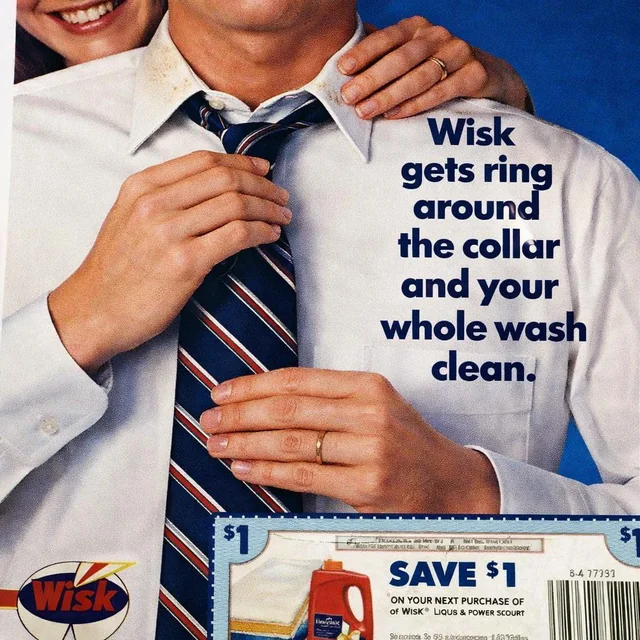
During the 1960s, Wisk detergent targeted “ring around the collar” – the discoloration that typically appears on the inside of dress shirts.
Housewives were singled out for public humiliation. If she couldn’t succeed at the simple task of keeping her husband’s shirts clean, what kind of spouse was she? In the original advertisement above, notice the wife’s joy and relief that she was wise enough to use Wisk.
Hopefully it occurred to a number of people that there was another solution to this social emergency: Her husband could always choose to wash his neck.
Stovall points out that there was nothing new here with regard to American cleanliness. It’s just that marketers decided to catastrophize and moralize ordinary grime.
It may seem hard to believe, but the human body doesn’t actually need daily washing for someone to be healthy and socially acceptable. But we’ve long been told a different story. Advertising in the 20th century almost singlehandedly planted the idea that “a clean person is a good person” – and that those who fall short of certain hygienic standards should be regarded as pitiable failures.
When it comes to soap, fear works.
That brings us to one of the most common critiques of organized religion.
Pastors and priests and televangelists can seem a lot like people who are trying to sell soap. They have invented a problem – the sinfulness of the human race – and – surprise, surprise – they just happen to have the solution.
The story goes like this: You may not know it, but humanity is afflicted by a terrible disease. You should be afraid. Very afraid.
Fortunately, Jesus is the cure. All you need to do is (fill in the blank): believe or repent or read the Bible or go to church or stop sinning or do something good or do a whole lot of good things or turn in a pledge card for the biggest gift you have ever given to world missions.
But what if people stop believing the premise that we’re all afflicted with a spiritual disease that should leave us shaking in our spiritual shoes?
In contemporary Western culture, fear seems to have little motivating effect. A billboard emblazoned with the words “Prepare to Meet Thy God” may have stirred previous generations to serious self-reflection. These days, more often than not, those passing by shrug their shoulders and wonder what in the world such words might mean.
Followers of Jesus should not be dismissive of one of the Bible’s central claims:
Humanity really is afflicted with the terrible disease of estrangement from God. And entering a relationship with Jesus really is the only solution that Scripture proposes.
We can even affirm the proposition that “a clean person is a good person” – as long as we understand that the cleanliness we’re talking about has to do with the heart, and that we can never accomplish a spiritual housecleaning on our own. As God says in Jeremiah 2:22, “Though you wash yourself with lye and use much soap, the stain of your guilt is still before me.”
That stain can be fully removed, however – not through what we might do but what Jesus has already done for us on the cross.
What we seem to have learned is that stoking a sense of fear (“You’d better do this or else”) rarely brings about the desired effect of helping someone else find new life in Christ.
God’s love, after all, is always persuasive and never coercive.
Which just happens to be a message you can preach from a soapbox with a truly clean conscience.