
To listen to today’s reflection as a podcast, click here
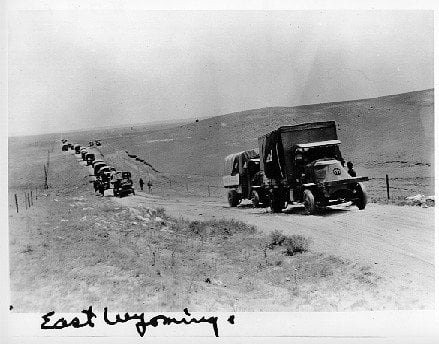
In the summer of 1919, the U.S military – less than a year after the end of World War I – undertook a major mission.
Their goal was to find out if it was possible to drive from one coast of the United States to the other.
Thus was born the Motor Transport Corps Convoy, a train of 81 trucks and vehicles that carried almost 300 officers and enlisted men. There was serious doubt that they could actually succeed.
The convoy left Washington D.C. on July 7 and headed west, following a route that would one day become the Lincoln Highway. They snaked their way through 11 states and more than 350 communities.
The roads, to put it bluntly, were rough. From Illinois to Nevada, most of them were little more than dusty trails.
The convoy’s official journal logged more than 230 “road incidents.” Those included vehicle collisions, trucks mired in mud above their axles, and wooden bridges that collapsed under the weight of so many wheels. In all, the soldiers had to rebuild 88 bridges along the way.
Twenty-one men suffered injuries and had to drop out. Nine of the trucks broke down and were left behind. Long before the era of billboards and Buc-ee’s, there was almost nothing to shatter the monotony.
The convoy finally arrived in San Francisco on September 6. It had taken 62 days to traverse 3,250 grueling miles. The trucks averaged 5.67 miles per hour, an exceedingly low bar for what would one day become known as the Cannonball Run.
But the experiment had been a success. Americans now knew it was possible to drive from sea to shining sea. Even more important, the trip ignited the imagination of a young military officer who had joined the trip, as he later put it, “on a lark.”
His name was Dwight D. Eisenhower, future commander of the Allied forces in Europe during World War II, and president of the United States from 1953 to 1961.
Eisenhower never forgot his trip across the wilderness of the United States. That’s his personal scrawl (“East Wyoming”) on the photo above.
He resolved that the country should have fast, beautiful, multi-lane highways. Today they are known as the Eisenhower Interstate Highway System, and it’s possible that you will drive on one before you go to bed this evening.
America’s interstates have some features you may not have noticed. According to the original design, every fifth mile was to be straight (in case a plane needed to make an emergency landing). And every overpass was to be high enough to accommodate the passing of a truck carrying a nuclear-tipped ICBM. Eisenhower was president, after all, during the Cold War.
He knew what it took to prepare highways for his homeland, and he made it happen.
What would it take to prepare a highway for God?
A familiar text in the book of Isaiah the prophet answers that very question.
“A voice of one calling: ‘In the wilderness prepare the way for the Lord. Make straight in the desert a highway for our God. Every valley shall be raised up, every mountain and hill made low; the rough ground shall become level, the rugged places a plain. And the glory of the Lord will be revealed, and all people will see it together. For the mouth of the Lord has spoken'” (Isaiah 40:3-5).
Christians have traditionally understood this text (which was recited verbatim by John the Baptist) to have been fulfilled by the coming of Jesus of Nazareth.
But it also provides a timeless set of guidelines.
What would our nation need to do as we approach our 250th birthday to “pave a path” for God to move amongst us? The text suggests four highway-building imperatives:
First, we must fill up the low places. Symbolically, that means filling in the holes or gaps that plague our lives. Connecting with God is not a summer thing, or a holiday thing, or a weekend thing. It is an everyday privilege to pursue a walk with the One who made us.
Second, we must bring down the high places. That means checking our pride at the door. America is an extraordinary place. But we have no grounds for arrogance before the watching world.
Third, we must straighten the crooked places. That begins with the bent and misshapen habits that steal our peace of mind and prompt us to hide from ourselves, God, and others.
Fourth, we must smooth out the rough places. It’s so easy to become tolerant of a chuckhole. We just learn to drive around it. But God wants to heal what is broken in this world, beginning with our society’s aching need for true justice and spiritual vitality.
If God wanted to drive into our lives today, would he find an open highway?
Prepare the way for the Lord, says the ancient prophet.
That’s an invitation to join our Creator on the ultimate summer road trip.