
To listen to today’s reflection as a podcast, click here
Each day this month of August we’ll be looking at one of the extraordinary metaphors that the Bible uses to illustrate the nature of our relationship with God.
“Yet you, Lord, are our Father. We are the clay, you are the potter; we are all the work of your hand” (Isaiah 64:8).
We will never experience peace in this world unless we master a crucial skill.
We must learn the art of letting go.
Bowlers, by definition, have to let go of their bowling balls. But some of us appear to do that only with extreme reluctance. After the ball is out of our hands and heading down the lane, we figure it might be helpful to shout additional instructions.
“Left, left, left! No, not into the gutter!” We wave our hands. We balance precariously on one leg, as if our gyrations will magically transmit course corrections to a solid object whose trajectory has already been established.
Golfers aren’t immune from this behavior, either. “Come on, drop in there – no, not in the trees!”
And then there’s parenting. It’s hard to watch your teenager take off on her first solo drive in the family car, or wave goodbye to your oldest kid on his first day at college, without thinking, “But I’m still in control of what happens next, right?” Actually, no.
And that brings us to the greatest Letting Go challenge of all: We need to let go of the management of our own lives.
That may qualify as the Bible’s most counter-cultural assertion to a modern Western audience.
We have been schooled to believe that our lives are our own project. Commercials urge us to “color outside the lines” when it comes to expressing our individuality, and to “find our own roads” behind the wheel of an off-road vehicle. Earnest speakers tell children they can be anything they want to be. Disney movies assure kids they will experience fulfillment if they discover their true selves by listening to the inner voice that will never mislead them.
Pop stars will show us the way. In her 2022 commencement address at New York University, Taylor Swift told the graduating class, “You’re on your own now… Trust your intuition in navigating life’s uncertain path.”
All of a sudden, the Bible seems seriously out of step.
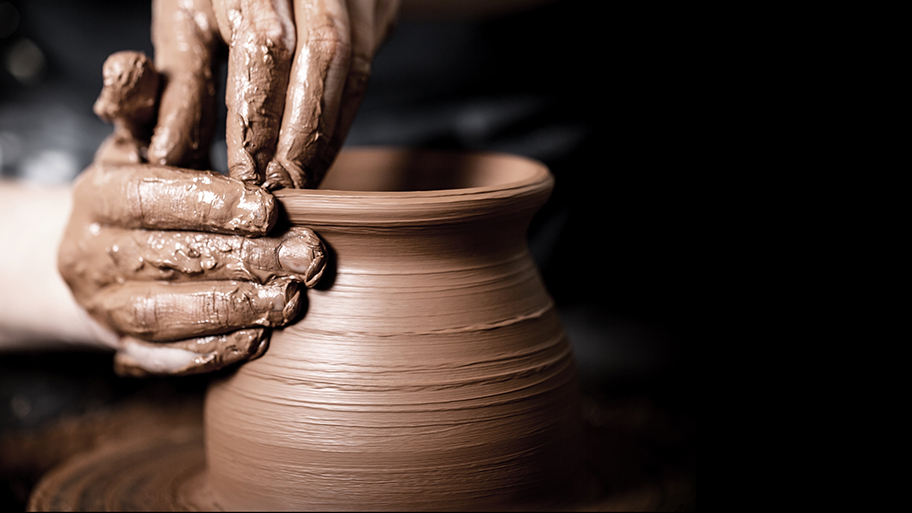
That’s screamingly obvious when we hear Isaiah tell us that God is a celestial potter who has just thrown a lump of wet clay onto the wheel – and we are the clay.
A potter exercises complete artistic sovereignty. That’s another way of saying that the one who shapes the clay is in charge. The clay’s job isn’t to trust its own intuition. It doesn’t have an inner voice. The clay cannot protest, “But my lifelong dream was to become a flowerpot, not a candy dish!”
The apostle Paul pushes things to the limit in Romans 9:20-21:
“But who are you, a human being, to talk back to God? ‘Shall what is formed say to the one who formed it, “Why did you make me like this?”’ Does not the potter have the right to make out of the same lump of clay some pottery for special purposes and some for common use?”
If the potter-and-clay metaphor is the only thing we knew about our relationship with God, we would all be in despair.
There would be no provision for free will, for growth, for change, for failure, for forgiveness, for love.
That’s why Scripture provides at least three dozen different metaphors for knowing and serving the Lord. One picture cannot say everything. And we dare not build our theology around just one or two of them.
This is not to say, of course, that the motif of God as potter has nothing to teach us.
Both Old and New Testaments declare that God is an artist. We are his masterpieces. God intentionally shapes our lives according to his purposes and desires. He is actively involved in every aspect of our existence – past, present, and future. And the wonderful news is that flawed vessels can be reshaped by the power of his Spirit.
What role does that leave us?
Our call is to be malleable – to pray that we can be pliable in the Master’s hands. We must depend on him in everything, trusting that he knows best even when we cannot grasp where he’s taking us. Every day we can live in the hope that even when life seems shattered beyond repair, God the artist is a master of restoration. As long as we live, that hope has not been extinguished.
To put it simply: God is pleading with us to let go. It’s time to let go of the management of our own lives.
Our lives are not our own project. They are God’s project. And he knows what he’s doing.
It’s worth noting that there’s no verse in the Bible that says, “And God began to worry.” God has nothing to worry about. That’s because God is actually in control of the cosmos – which means we can give up trying to control all the circumstances, family members, and projects we were never really in charge of in the first place.
Author and theologian Dallas Willard once wrote, “At the beginning of each morning I commit my day to the Lord’s care… I have already placed God in charge. I no longer have to manage the weather, airplanes, and other people.”
By taking our minds off the myriad what-might-happens today, we’re free to give our full attention to the actual Managing Director of the Universe.
What, in the end, is the difference between you and God?
God doesn’t think he’s you.
Which means all of us can enjoy the freedom to become the masterpieces the Great Artist has always intended us to be.