
To listen to today’s reflection as a podcast, click here
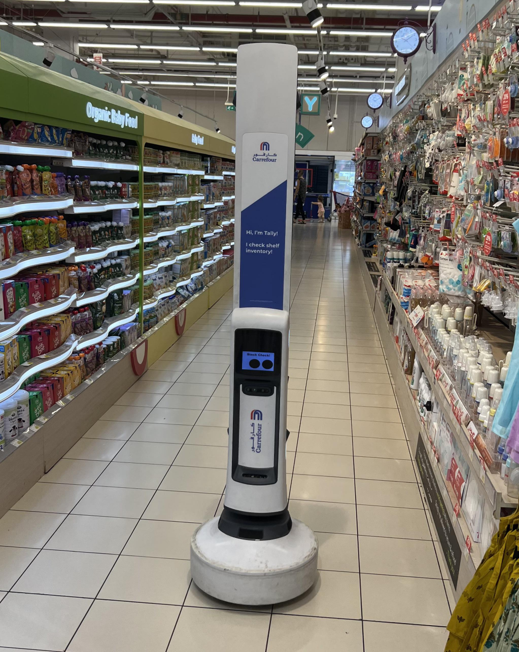
Earlier this week, at our local grocery store, I came face to face with A.I.
A six-foot-tall pylon glided slowly down the aisle, emitting a series of happy squeaks. Its nameplate said, “Hi, I’m Tally! I check shelf inventory.”
Tally is one of several robots being tested at Midwestern Kroger stores. Tally scans the shelves from top to bottom, recording the sales of everything from Cheerios to paper towels to Newman’s Own salsa.
Tally seems entirely harmless. Just your average neighborhood autonomous artificial entity. Time magazine’s culture writer Lev Grossman has called the idea of a robot uprising “one of our most enduring nightmares.” When Grossman is reminded that robots like Tally are here for the sole purpose of making our lives easier, he points out, with mock panic, this is how it always starts in the movies.
Exactly. Is Tally more like the delightful R2-D2 from Star Wars, or The Terminator’s time-traveling cyber assassin?
Patrick Grim, professor of philosophy emeritus at Stoneybrook University, acknowledges that artificial intelligence has already become an intrinsic part of our lives. He also asserts that this revolutionary technology presents both promises and perils.
The promises are extraordinary.
A.I. already helps you navigate traffic jams through GPS, keeps track of your baggage at the airport, helps you effortlessly access information through QR codes, and provides the backbone for the entire international financial industry, and hence the global economy.
For the better part of a century, chemists have known the atomic constituents of various proteins. But proteins only “work” when they are folded in specific ways. For 50 years, researchers failed to make headway in discerning the secrets of molecular folding.
Then a team of chemists turned to a program called AlphaFold A.I. In a matter of months, the puzzles were solved. The scientists received Nobel Prizes. Medical researchers received an incredible new tool to aid in the development of healing drugs.
In A.D. 79, Vesuvius buried Pompeii and adjoining communities under yards of volcanic ash. In the ruins of the village of Herculaneum, archeologists uncovered a library which housed a treasure trove of ancient manuscripts.
Unfortunately, the scrolls – having been subjected to incinerating heat – crumble when attempts are made to unroll them. Scholars can’t access the words.
But A.I. can. Sophisticated programs are even now deciphering burned pages. Will archeologists discover previously unknown works of Plato, Sophocles, and Aristotle? We shall see.
A young woman named Alexis Bogan was stricken with a brain tumor. After surgery successfully removed the mass, she was left unable to speak. Alexis, however, had recently provided a cooking demonstration for a class. An A.I. program, accessing just 15 seconds of her talk, was able to clone the nuances and tone of her speech. Now, by typing on a handheld device, she can “speak” again in her own voice.
Those are just a few of the extraordinary promises of A.I.
But artificial intelligence is also laden with perils.
The voice cloning technology that blesses Alexis is also being used to perpetrate scams. Oprah Winfrey, Kelly Clarkson, and podcaster Joe Rogan have all been “heard” promoting products that they actually do not endorse. Bad actors can simulate the voices of your grandchildren, nephews, or siblings pleading for financial assistance in phony emergencies.
A.I. poses potential threats to privacy, safety, and job security. Tally, we presume, has taken the job of a former Kroger employee.
Then, as Patrick Grim points out, there is the anxiety associated with the Singularity. That’s the theoretical moment when artificial intelligence achieves consciousness or self-awareness – the starting point of dozens of apocalyptic films.
Someone at the National Security Agency was in a playful mood when he dubbed the NSA’s new terrorism-detection software Skynet (the name of the fictional program in The Terminator that turns on humanity).
Then there’s Stephen Hawking, who without a hint of playfulness told the BBC shortly before his death: “The development of artificial intelligence could spell the end of the human race.”
Danger, Will Robinson! Danger, Will Robinson!
What have followers of Jesus discovered? Whenever we look for security or happiness or progress via things that are Not God, our creations often betray us. Our idols always turn on us.
With regard to human-machine interfaces, two issues are currently front and center.
The first is this question: What does it mean to be human?
Many scientists – but certainly not all – subscribe to the view that human beings are highly evolved biological entities. We are complex machines composed of living tissues. In the words of biologist Francis Crick, “You are nothing but a pack of neurons.” Those two words, “nothing but,” should break our hearts. According to Crick and like-minded colleagues, there is no You. Consciousness, free will, and imagination are simply momentary states of brain cell agitation. When your brain is gone, you are gone. Forever.
According to this view, a “bot” with advanced A.I. can equal and surpass any human being, since humans are likewise nothing but machines.
Those who subscribe to belief in a Creator see things differently. Human beings are, as Genesis 1 asserts, made in God’s image. Consciousness is not an “emergent property” from cellular tissues (and therefore just an illusion), but primary evidence that we have been made to know and love the God who has given us the gift of life.
Even the most committed materialists find it difficult to explain fundamental aspects of our common experience – like love, compassion, hope, courage, and the yearning for justice. All of us live as if we are persons, not machines.
The second AI-related issue before us concerns the current speed of technological advance.
How can we make wise decisions about the future when progress in automation is outstripping our ability to engage in careful, essential ethical conversations?
Here we might recall Ian Malcom, one of the characters in Jurassic Park, who says to John Hammond, the entrepreneur who has created a theme park swarming with live dinosaurs: “Your scientists were so preoccupied with whether they could, they didn’t stop to think if they should.”
There’s a huge difference between what is possible and what is wise. It’s urgent for thoughtful people of all persuasions to wrestle with the future of artificial intelligence.
Is there a civilization-threatening Robotapocalypse just around the corner? Despite Hollywood’s vivid storytelling, there’s currently no evidence for such a thing.
God, meanwhile, is in no danger of losing his job.
And he’s not going to be surprised by anything that happens in the present or the future.
Just the same, I have to say I’m relieved that Tally bears no resemblance to Arnold Schwarzenegger.