To listen to today’s reflection as a podcast, click here
So, whatever happened to the ark of the covenant?
That’s easy. If you saw the first of the Indiana Jones movies back in 1981, you know that it is securely tucked away in some back corner of a vast, unidentified warehouse.
The actual story is more interesting. And a lot more mysterious.
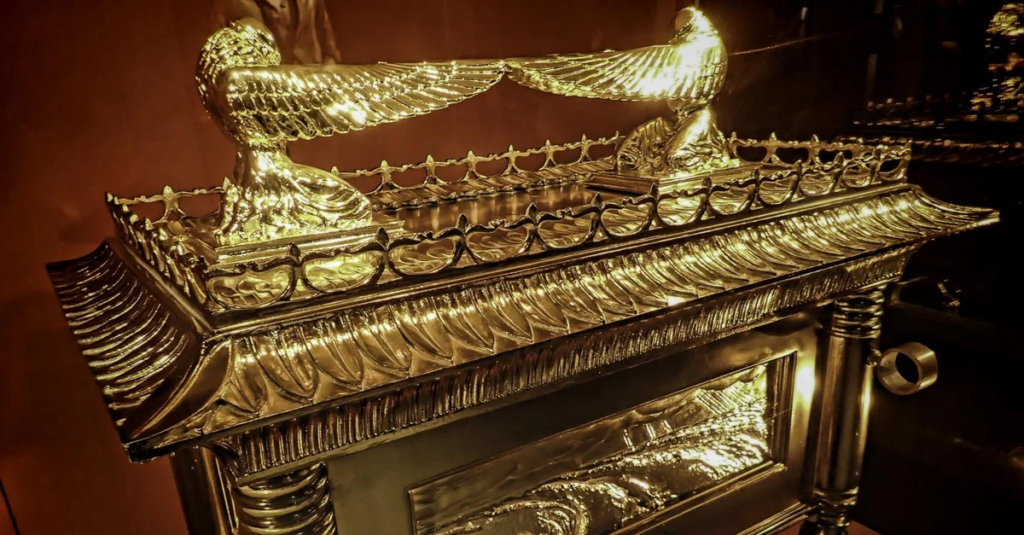
There are two arks in the Bible. One of them was the floating zoo that saved Noah and his family from a cataclysmic flood. The other was a sacred piece of furniture – an acacia wood chest about three and a half feet long, two feet wide, and two feet high, completely covered with gold. It was assembled according to divine specifications by craftsmen during the time of Moses.
The ornamental lid of the box featured two carved cherubim – supernatural beings, angel-like in nature, with outstretched wings. God was present at all times around the ark. It was the focal point of his power and majesty on earth.
According to Scripture, this special box was the storage place for two stone tablets on which God had personally inscribed the Ten Commandments. It also contained a bowl of manna. Aaron’s rod, which had supernaturally budded, was always nearby.
The ark played a prominent role in the time of Joshua. It was present when the Hebrews crossed the Jordan River into the Promised Land, and when they won their first major battle at Jericho.
A number of Old Testament accounts make it clear it was never wise to take the ark lightly. Levitical priests were the only ones authorized to carry it, and only in a carefully prescribed manner. For reasons that God never chose to explain, if you dared to take on the ark, you were actually taking on the living God.
That becomes clear in a fascinating series of accounts in I Samuel chapters 4, 5, and 6.
The narrative unfolds during an ongoing state of war between the Israelites and their sworn enemies, the Philistines. God’s people have been getting the worst of it. An idea occurs to them: Why don’t we carry the ark of the covenant into battle? They presume that will guarantee a military triumph.
For the Israelites, however, the ark doesn’t turn out to be the good luck charm they had hoped. They are soundly defeated. Far worse, the ark falls into the hands of the Philistines. It is a dark day for God’s people.
The Philistines are giddy with joy. It seems like a good idea to parade this new war trophy from town to town. Little do they realize that the happy times are suddenly going to end.
Wherever the ark shows up on the Philistine Victory Tour, unnerving things take place. A celebrated idol falls on its face and shatters into pieces. Plague breaks out. The people are afflicted with tumors. Soon the mayors of the five primary Philistine communities are playing musical ark. “Here, you take it.” “No, it’s your turn.” “No way! We had it last Tuesday. Take it to your neighborhood.”
At last, the Philistine leaders ask a timely question: “How are we going to get rid of this thing?”
They come up with a plan. “Let’s put it on a brand-new cart and hitch the cart to a pair of cows and see where the cows go.” And here we encounter the most interesting sentence in our story, which is found in I Samuel 6:9: “If the ark goes up to its own territory, toward Beth Shemesh, then the Lord has brought this great disaster on us. But if it does not, then we will know that it was not his hand that struck us and that it happened to us by chance.”
The Philistines are still entertaining the possibility that all of these calamities have happened to them coincidentally. Maybe this is all just a run of really bad luck. “Let’s use the Cow-O-Meter,” they decide. “The cows will demonstrate what’s really going on here, one way or the other.”
In order to make it harder for the God of Israel to prove himself, the Philistines decide to make things rough for the cows. Neither of them has ever been hitched to a cart. Both have recently had calves, which are now penned up nearby. A cow in this situation would ordinarily stay near its calf – in this case, that would mean staying in Philistia.
But the cows start walking. They head straight for Israel.
They’re not hanging around their own home. Now that they’re connected to the ark of the covenant, they are walking intently toward its home.
The Bible tells us that the cows don’t turn to the left or to the right, and that they are mooing all the way. Theologian R. C. Sproul wondered if they might be singing in cow-song, perhaps something like Onward Christians Cows.
By day’s end, the Philistines have gotten a graduate theological education from a couple of barnyard bovines. And what’s the lesson? Things in God’s kingdom don’t happen by chance.
Sometime around the year 960 B.C., the ark is transported with great fanfare into the first temple in Jerusalem, the one that Solomon built.
It apparently remains there for the better part of the next four centuries, sitting in the Most Holy Place – the sacrosanct inner chamber of the temple, a room the high priest alone could visit just once each year on the Day of Atonement.
But everything changes in 586 B.C. An invading army from Babylon overwhelms Jerusalem. They demolish the city, including the temple.
After this moment, the ark is never again mentioned on the pages of the Bible. What happened to it? No one knows.
Theories abound.
It’s possible that it was hidden by priests, perhaps in a cave or tunnel beneath the temple mount. According to the apocryphal book of 2 Maccabees, the prophet Jeremiah secretly hid the ark in a cave on Mt. Nebo a few miles from Jerusalem.
One enduring conjecture is that the ark was sent for safekeeping to the Egyptian city of Tanis. That’s where Indiana Jones finds it in the movie Raiders of the Lost Ark.
Others suggest that the ark was retrieved by the Knights Templar, a medieval order of warrior monks, who presumably found it in a secret chamber in Jerusalem during the Crusades. Could they have whisked it off to Paris or some other European city? This sounds like a plot worthy of Dan Brown of Da Vinci Code fame.
Members of the Ethiopian Orthodox Church have long insisted they know exactly where to find the ark. It’s resting in a small chapel in the Church of Our Lady, Mary of Zion in the city of Axum, Ethiopia. It’s guarded by a single monk – the only person allowed to see it.
Scholars and historians have collectively sighed, “Uh, that would be a little too easy.”
As recently as 2019, treasure hunters and archeologists have claimed satellite imaging and ground-penetrating radar have given them new places to look.
Perhaps, however, the ark will never be found for the simple reason that it no longer exists.
Maybe it was looted by the Babylonians, melted down for its gold. Maybe it was lost to the sands of time through circumstances we will never discover.
But here’s the most provocative statement:
It doesn’t really matter whether the ark is still around or whether it will ever be found.
That’s because the ark of the covenant (that is, the ark of the old covenant) is no longer the focal point of God’s power, majesty, and abiding presence on earth.
According to the new covenant – the one that came into effect through the life, death, and resurrection of Jesus – God’s power is now centered on Jesus’ followers.
That means you. You are God’s temple on earth. Your heart is now his Most Holy Place.
You may never get to meet Harrison Ford, and cows are unlikely to walk up to your front door any time in the future.
But the center of God’s work in the world just happens to be wherever you are right now.