
To listen to today’s reflection as a podcast, click here
Each weekday in the month of August, we will pursue “prepositional truth” by zeroing in on a single Greek preposition in a single verse, noting the theological richness so often embedded in the humble words we so often overlook.
In 1852, a resident of New York City, feeling homesick for his native England, came up with what can only be described as a wacky idea.
He resolved to introduce to America all the birds mentioned in the plays of William Shakespeare.
Six to eight mated couples of each species were trapped in England and transported across the Atlantic. Shortly afterwards they were released in New York City.
Most of the birds vanished, never to be seen again. But one of the species took a look around North America and said, “This will do very nicely, thank you.”
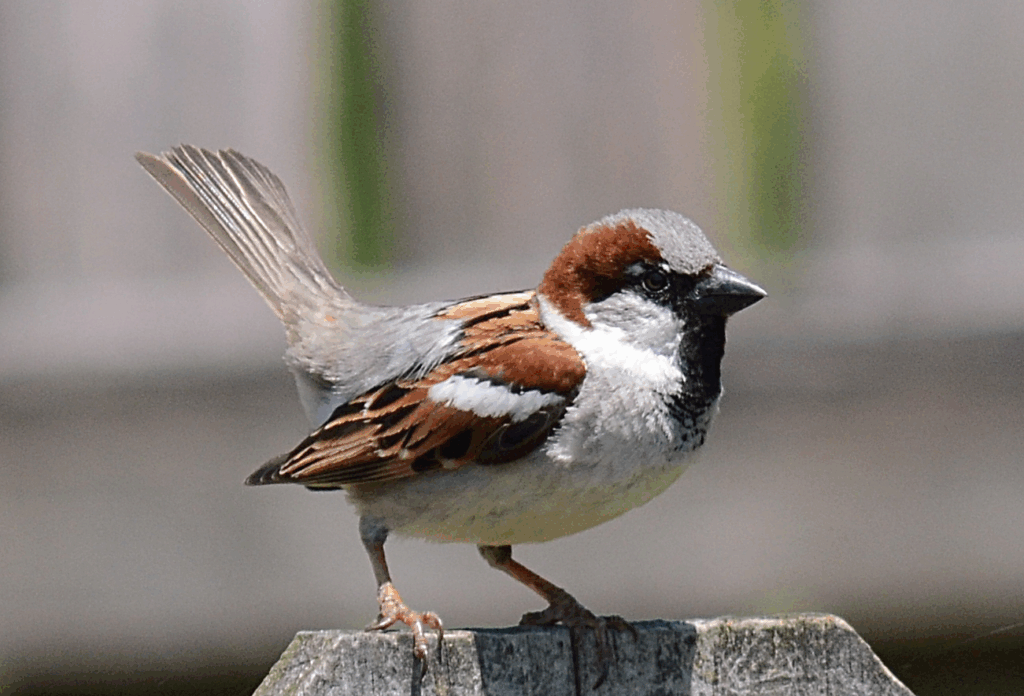
It was known as the Weaver Finch. If that name doesn’t ring a bell, it’s far more common designation is the House Sparrow.
Those dozen original birds became so prolific that today the House Sparrow is on the Least Concern list (along with Starlings, Crows, and Pigeons). While the Endangered Species list calls our attention to creatures that are at the edge of extinction, those ubiquitous little gray, brown, and white birds will almost certainly be with us for a very long time.
They aren’t called “house” sparrows for nothing. They seem to cherish proximity to humans, which is why we are so often treated to their incessant chirping. There’s currently a nest crowded with two-week-old sparrows just above our garage.
During Bible times the poorest people in the land would trap sparrows and sell them for food. Jesus said, “Are not two sparrows sold for a penny? Yet not one of them will fall to the ground apart from [ANEU] the will of your Father… So don’t be afraid. You are worth more than many sparrows” (Matthew 10:29-31).
What’s interesting is the variation of Jesus’ words as reported by Luke: “Are not five sparrows sold for two pennies? Yet not one of them is forgotten by God” (Luke 12:6).
Here we have an insight into the first century marketplace. Two sparrows were sold for one assarion (most translations call it a “penny”), which was the humblest coin in ancient Israel.
Yet five sparrows were sold for two pennies.
In other words, if you bought sparrows in bulk, the fifth one was thrown in for free. The fifth sparrow was worth so little that it was nothing more than a lightweight, feathered incentive to hand over two pennies instead of one.
But Jesus couldn’t be more clear: Every sparrow matters. “Not one of them is forgotten by God…” “Not one of them falls to the ground apart from your Father’s will.”
What does the Greek preposition ANEU mean in this context? Some scholars opt for, “Nothing happens to God’s humblest creatures apart from God’s knowledge.” Others suggest, “apart from God’sconsent.” Still others prefer, “apart from your Father’s expressed desire.” It may be wisest to combine all three of these senses.
In his book Prepositions and Theology, NT scholar Murry Harris observes:
“If God as creator knows about and consents to the death of one of his apparently insignificant creatures, how much more is God as an all-knowing Father concerned about his infinitely more valuable children, especially when they face death by martyrdom.”
In other words, if God cares that much about the fifth sparrow – which is thrown in merely as a rebate – think how much he cares about you.
That’s the background to a hymn that sprang from a conversation in 1905. A Canadian-born songwriter named Cavilla D. Martin was visiting the Doolittles, an invalid couple in Elmira, New York. She was moved by their simple happiness and deep hopefulness despite their physical limitations. When asked the secret of their joy, Mrs. Doolittle replied with a smile, “His eye is on the sparrow, and I know he watches me.”
Martin transformed that single line into a song that has become one of our most cherished expressions of trust, especially in the African-American community of faith.
Lauryn Hill & Tanya Blount reached back to their gospel roots to provide this heartfelt rendition: Lauryn Hill & Tanya Blount – His Eye Is On The Sparrow lyrics
You may be uncertain about many things today, but one thing you can know for sure: God is fully aware of what you’re up against.
God knows what’s keeping you up at night. He knows what’s making you feel overwhelmed. God knows what is breaking your heart, what’s making you hesitate to make an appointment to see your doctor, or making you clench your fists.
Nothing in your life happens apart from his care and his providence.
Which is something we can all bring to mind the next time we hear House Sparrows chirping enthusiastically just outside our front doors.