
To listen to today’s reflection as a podcast, click here
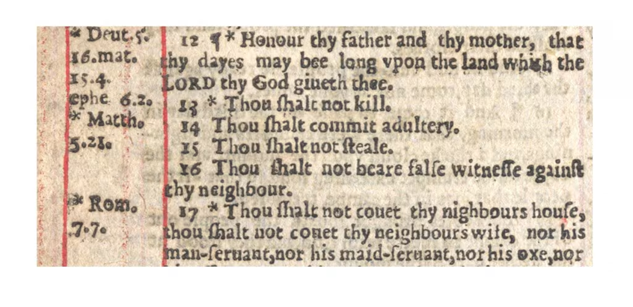
Do you notice anything strange in this picture?
This is a snapshot of Exodus chapter 20 as it appears in a 1631 London publication of the King James Bible.
Exodus 20 is famous as the “home” of the Ten Commandments. But a word appears to be missing in verse 14.
“Thou shalt commit adultery.”
Needless to say, this particular text must have generated some livelier than usual discussion at the midweek Bible study.
King Charles I of England and the Archbishop of Canterbury were not amused. They hauled the two royal printers, Robert Barker and Martin Lucas, into the infamous Star Chamber, where judges mulled the penalties for the gravest crimes.
The two men were fined heavily and stripped of their licenses to print. They were also reprimanded for using cheap paper.
The Barker-Lucas edition of Scripture quickly became known as the Wicked Bible or Sinners’ Bible. Most copies were burned.
Was it all just an honest mistake? Let’s put it this way: In Deuteronomy 5, where the King James Bible reads, “The Lord hath shewed us his glory and his greatnesse,” the Wicked Bible says, “The Lord hath shewed us his glory and his great asse.”
Which means we might also call this the Seventh Grade Boys’ Bible.
Then there’s the so-called Placemakers Bible. In the second edition of the Geneva Bible, published in 1562, Matthew 5:9 reads, “Blessed are the placemakers, for they shall be called the children of God.” That should have been “peacemakers.”
What became known as the Judas Bible (1613), somehow swapped out Jesus’ name for that of his betrayer. In Matthew 26:36, Judas tells the other disciples, “Sit ye here while I go yonder and pray.”
The Sin On Bible, published in 1716, includes this interesting rendering of Jeremiah 31:34: “Sin on more” instead of “Sin no more.”
Just in case you’re tempted to conclude that such biblical fumbles are exclusively lodged in the distant past, consider the so-called Owl Bible (New English Version) from 1944. I Peter 3:5 reads, “For after this manner in the old time the holy women also, who trusted God, adorned themselves, being in subjection unto their owl husbands” (instead of “own”). It turns out the printing plate had utilized a damaged letter “n.”
Some wives might have been relieved to learn that the whole “submission or subjection thing” was valid only if they were married to a certain predatory bird.
As far as we can tell, no one was misled by that misprint. And no one in 17th century England actually concluded that God had upgraded the Ten Commandments to version 2.0.
That’s because people of faith intuitively know there’s a difference between the Word and mere words.
The Word is the timeless expression of God’s character. It never changes. It is fully embodied in the person of Jesus: “In the beginning was the Word, and the Word was with God, and the Word was God” (John 1:1). Over the next 24 hours, God isn’t going to rethink his positions on injustice, truth, love, or grace.
The words on a page or the words from a pulpit are a different matter.
Printers and preachers have to do their utmost to match their words with the Word, avoiding misquotes, misprints, and misinterpretations. Sometimes we fail. Sometimes quite badly.
God’s Word stands, even when the rest of us get the words wrong. Which is why we must hesitate to judge God because of something startling we once read or heard from one of his grace-challenged, mixed-up, learning-impaired human reporters.
So, stick close to the Word with a capital “W.”
With the Spirit’s help, you’ll ultimately develop an intuition for the very heart of God.
And as April 15 approaches next year, it’s probably best not to wonder what the Wicked Bible has to say about taxes.