To listen to today’s reflection as a podcast, click here
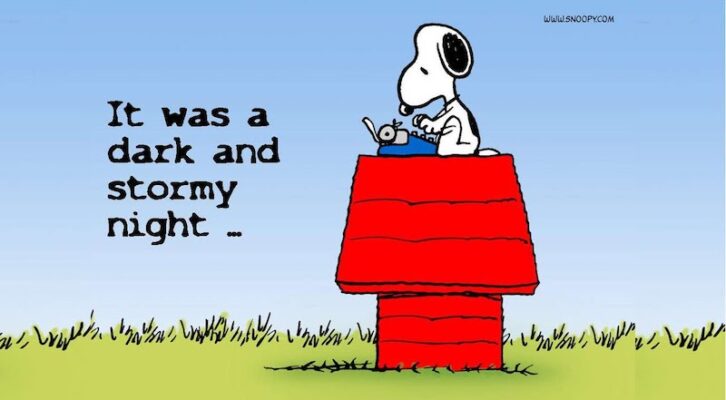
“It was a dark and stormy night…”
That’s the opening line from the 1830 novel Paul Clifford by English writer Edward Bulwer-Lytton.
It is widely regarded as the worst opening line in the history of English literature, and has been endlessly parodied. Charlie Brown’s dog Snoopy, who was committed to writing the great American novel, began every one of his drafts with those seven words.
To be fair, here’s the entirety of Bulwer-Lytton’s first sentence: “It was a dark and stormy night; the rain fell in torrents – except at occasional intervals, when it was checked by a violent gust of wind which swept up the streets (for it is in London that our scene lies), rattling along the housetops, and fiercely agitating the scanty flame of the lamps that struggled against the darkness.”
Just awful.
So awful that it inspired Professor Scott E. Rice of the English Department at San Jose University to establish the annual Bulwer-Lytton Contest in 1982. Entrants were invited to submit “the opening sentence to the worst of all possible novels.”
The first year attracted just three entries. Then the media got wind of Rice’s project. The next year, some 10,000 writers attempted to compose the most dreadful opening to a non-existent novel.
Rice (aided by what he called his Panel of Undistinguished Judges) picked winners for 42 consecutive years. Three months ago, however, he announced that the contest was at last coming to an end – largely because, as he put it, he’s older than Joe Biden. That means we’ll have to let the 2024 winning entrant, submitted by Lawrence Person of Austin, Texas, provide our last good laugh:
“She had a body that reached out and slapped my face like a five-pound ham-hock tossed from a speeding truck.”
So bad it’s good.
Let’s go to the other end of the spectrum. What is the best of all opening lines?
Here are some much-loved openers:
“Life is difficult.” (M. Scott Peck, The Road Less Traveled)
“All happy families are alike. Each unhappy family is unhappy in its own way.” (Leo Tolstoy, Anna Karenina)
“The past is a foreign country. They do things differently there.” (L.P. Hartley, The Go-Between)
“It was the best of times, it was the worst of times.“ (Charles Dickens, A Tale of Two Cities)
“Call me Ishmael.” (Herman Melville, Moby Dick)
“All children, except one, grow up.” (J.M. Barrie, Peter Pan)
“It is a truth universally acknowledged, that a single man in possession of a good fortune, must be in want of a wife.” (Jane Austen, Pride and Prejudice)
Those are the kinds of starters that have compelled millions of people to keep reading to see what comes next.
What about the 66 books of the Bible?
Some aren’t particularly promising. The first sentence of I Chronicles, for instance, is just three names: “Adam, Seth, Enosh.” Not too captivating for modern readers.
But chapter one / verse one of dozens of other Old and New Testament books are like doorways to a set of fascinating stories, insights, and truths.
Each weekday during the month of November, we’ll drill down deep into one of those 1:1 sentences.
Our hope, as we approach Thanksgiving, is that we’ll encounter a few new reasons to be thankful to God for the riches of his Word – embodied even in some of the humblest turns of phrase that we might otherwise overlook.
That’s a worthy goal for a month that almost always features its share of dark and stormy nights.