
Unfortunately, it was not possible to make a podcast recording of today’s reflection.
Each day this month we’re looking closely at one of the 1:1 verses of the Bible – exploring what we can learn from chapter one / verse one of various Old and New Testament books.
Exodus 1:1
“These are the names of the sons of Israel who went to Egypt with Jacob, each with his family.”
Every now and then you’ll hear people say that the Bible is boring, and that it ranks right up there with reading the instructions for installing a new water heater.
That’s a dead giveaway that those individuals have never actually picked up a copy of Scripture and read it for themselves. They certainly haven’t read the books of Genesis and Exodus.
What do we find in the first two books of the Bible? We discover that the descendants of Abraham, the so-called Chosen People, are about as emotionally stable as guests on the Jerry Springer Show. Moms and Dads are passive when they should be assertive, and assertive when they should be gentle. There’s rape, incest, lying, and intergenerational deceit. In the words of John Ortberg, “These are not the Waltons. These people are messed up. They need Dr. Phil, Dr. Laura, Dr. Ruth, Dr. Spock, Dr. Seuss…somebody.”
Does this mean that the writer of those two books, traditionally thought to be Moses, was morally confused? Not at all.
The real hero of the Bible is God. God is the primary actor in all of the biblical narratives. People of every generation may be promise-breakers, but God is a promise-keeper. One of the recurring messages of the Bible is that if God can work through men and women like these, he will never be reluctant or ashamed to work through you and me.
The truth is that God is also the hero of your story.
God is the primary actor in the drama that is called your life. You may be at mid-story right now and cannot imagine that you are headed for a happy ending.
But God is always at work in ways that surprise and confound us. If we will turn to him, if we will receive the blessing that he offers to us in exchange for our trust, we will discover that he is the God of second chances. He is the One who can transform the debris of our relational messes into outcomes we could never have imagined.
That brings us to the first verse of the first chapter of the book of Exodus, which essentially says, “Hey, do you remember that story we started in Genesis? Well, here comes the next part.”
It’s worth pausing to note that the books of the Old Testament go by different names in the Jewish community than the names chosen by Christians over the centuries. Each book of the Torah, for instance (the Torah being the first five books of the Jewish Scriptures), is identified by the first word that appears in the Hebrew text.
The first Hebrew word in Genesis is Bereshit. Therefore the book is called “In the Beginning.” Leviticus goes by “And He Called.” Numbers is “In the Wilderness” (a far more evocative name than the one Christians came up with). Deuteronomy is known amongst Jewish readers as “The Words.”
And what of the second book of the Torah?
Christians have traditionally called it Exodus, a mashup of the Greek words ek (“out”) and hodos (“road”) – essentially, “heading on down the road.”
Rabbis, however, have always called the book Sh’mot, the Hebrew word for “Names.” “These are the names of the sons of Israel who went to Egypt with Jacob, each with his family.”
Exodus is a thrilling book. God’s people are in Egypt, where they have been slaves for something like 400 years. God aims to set them free. He recruits Moses – an 80-year-old whose life has so far been marked by failure – to be his point person. What follow are 10 plagues, the first Passover, a pillar of fire, crossing the Red Sea, and an acting opportunity that cements the career of Charlton Heston.
Genesis tells the story of how Abraham’s descendants end up in Egypt. Exodus tells the story of how God gets them out.
In between those two narratives is Exodus 1:1. It directs our attention to the names of the earliest characters in this drama.
Names were serious business in Bible times. A name connoted one’s heritage, family standing, and personal character, and was sometimes thought to signify one’s destiny.
There are two names in the first verse of the Book of Names: Israel and Jacob. It matters immensely that these names turn out to be one and the same person.
The story behind that story has been told and retold in Jewish households for centuries. In the book of Genesis, Jacob, the grandson of Abraham, spends virtually his entire life trying to earn or deserve or steal what God, as it turns out, has always been willing to give to him for free. Jacob yearns to be blessed – to know that he is living under the sheltering canopy of God’s favor.
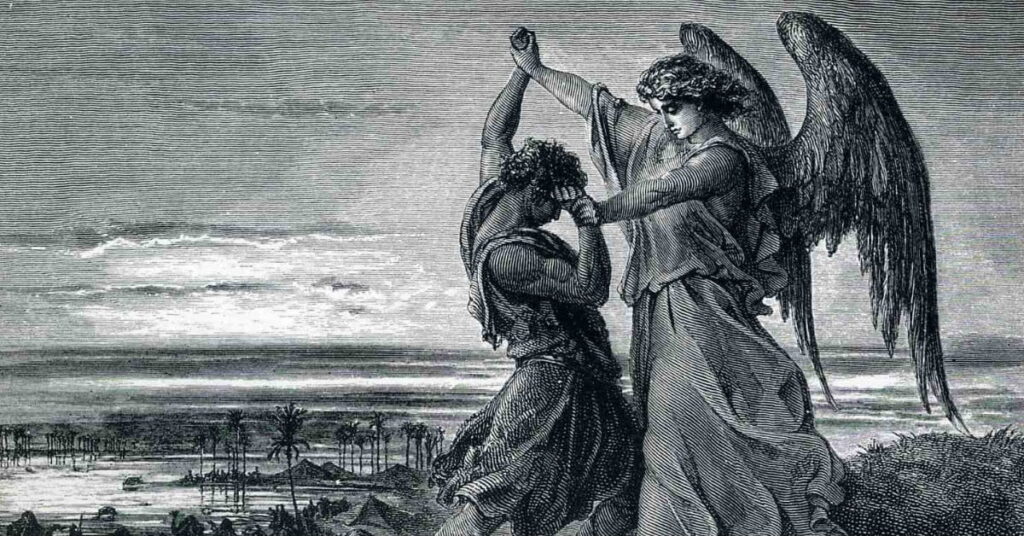
One of the key moments in his search for God’s blessing is an all-night wrestling match on the banks of the Jabbok River.
Here we should pause to note that the more time you spend with God, the more likely it is that you yourself will one day wrestle with God.
Spoiler alert: You will lose that wrestling match.
But there’s a good chance you will end up with a souvenir from the encounter that will be well worth keeping.
Jacob’s wrestling match is reported in Genesis 32:22-32, which has long been regarded as one of the Bible’s most mysterious passages. He is overwhelmed with anxiety as he anticipates a reunion with his twin brother Esau. This would be the same Esau from whom he had stolen, years earlier, both the family’s birthright and their father Isaac’s blessing.
In the middle of his sleepless night, Jacob begins to wrestle with someone described as “a man.” The text implies that this is an angel of the Lord who represents God himself.
Light begins to appear on the eastern horizon. “Then the man said, ‘Let me go, for it is daybreak.’ But Jacob replied, ‘I will not let you go unless you bless me.’ The man asked him, ‘What is your name?’ ‘Jacob,’ he answered.”
Now this may seem like a strange thing to ask somebody after hours of struggle. Had the angel forgotten to take his over-the-counter memory supplement, which is why he couldn’t come up with Jacob’s name?
Actually, the person who has been confused about his own identity is Jacob. Let’s see: How did he answer the last time he was asked the same question? “Father, it is I, Esau.” Jacob had lied about his identity in order to steal a blessing. God will have none of that this time. The only way to make progress when wrestling with God is to say, with absolute honesty, “This is who I am.”
For most of his adult life, Jacob has refused to face difficulties head-on. When things get tough, he runs for his life.
But this time is different. This time he hangs on to God for dear life. “I will not let you go, unless you bless me.”
Are you in a wrestling match with God? Are you struggling with doubt? With anger or disappointment because God has taken away something or someone precious from your life? Are you wrestling with confusion because you’ve asked God for guidance but only seem to hear silence?
Don’t let go.
Way too many people break their clinch with God after just a little struggle and say, “Well, I guess that’s that.” It’s true that wrestling with the deep questions concerning God’s presence and God’s will is hard work. But such hand-to-hand, heart-to-heart grappling appears to be one of God’s chief tactics for shaping our lives.
That was certainly true for Jacob. He emerges with a new identity. Jacob (“Grabber”) will now be known as Israel (“He wrestles with God”). And the people of Israel, who to this day carry his new name, have for more than three millennia modeled for the world what it means to go to the mat with the Creator of the cosmos.
Jacob leaves with something else. “As the sun rose above him…he was limping….” (Genesis 32:31)
We shouldn’t be surprised that wrestling with God can leave a mark.
For years I have looked back on a particularly difficult time in my life and winced. The spiritual growth that sprang from those days was wonderful, and probably couldn’t have happened in my life by any other means. Still, the memories are painful. I’ve lived in the expectation that one day everything would resolve – there would be only positive recollections, with everything tied up in a bow.
Then one day it occurred to me that maybe that’s never been God’s plan.
When it comes to memories, I still limp from time to time. But every twinge of memory is accompanied by God’s reminder: “Don’t forget that I was with you during that long, dark night. Remember that the morning finally came. And I blessed you.”
That is the message of Exodus 1:1. Read it once more: “These are the names of the sons of Israel who went to Egypt with Jacob, each with his family.” The sons of He Wrestles With God – the one who used to be called Grabber – are now helplessly enslaved in Egypt. They have no hope of deliverance.
But they are crying out to God. And the God who is willing to wrestle with his people has heard every prayer and is at last going to save them.
Are you in a wrestling match with God?
Don’t let go.
Life’s hardest moments may leave you with a limp, but you will never walk straighter and taller.